The Siege of Paris: When the City of Light Ate Its Zoo and Took to the Skies
In the autumn of 1870, the "City of Light" went dark. The Prussian army, a highly efficient machine of war, had encircled Paris, severing all rail lines, cutting telegraph cables, and halting the flow of food and information. The Siege of Paris had begun, marking a pivotal moment in the Franco-Prussian War. For four long months, the cultural capital of the world was transformed into a desperate island of starvation and ingenuity. While the geopolitical ramifications were immense—leading to the unification of Germany—the daily reality for Parisians was a surreal descent into culinary madness and steampunk-style technological improvisation.
As the blockade tightened, the city’s larder began to empty. First, the beef and lamb vanished. Then, the horse meat became a staple; it is estimated that some 65,000 horses were butchered during the siege, including the thoroughbreds of the wealthy and the dray horses of the working class. But as winter set in and the temperature plummeted, even the horses were gone. The citizens turned to cats, dogs, and rats. The Rat Catcher’s Market in front of the Hôtel de Ville became a grim hub of commerce. Surprisingly, renowned chefs in high-end restaurants rose to the macabre challenge, serving dishes like "Salmis de rats à la Robert" (Rat stew with spicy sauce) to those who could still afford to dine out.
The most infamous culinary tragedy of the siege, however, occurred at the Jardin des Plantes. With no fodder to feed the animals and a starving human population clamoring for meat, the zoo was liquidated. The tragic menu included antelope, camel, and yak. The most heartbreaking casualties were Castor and Pollux, two beloved Asian elephants who had delighted children for years. They were shot, butchered, and their trunks sold as a delicacy at a premium price. It was a stark symbol of how quickly civilization could erode under the pressure of survival.
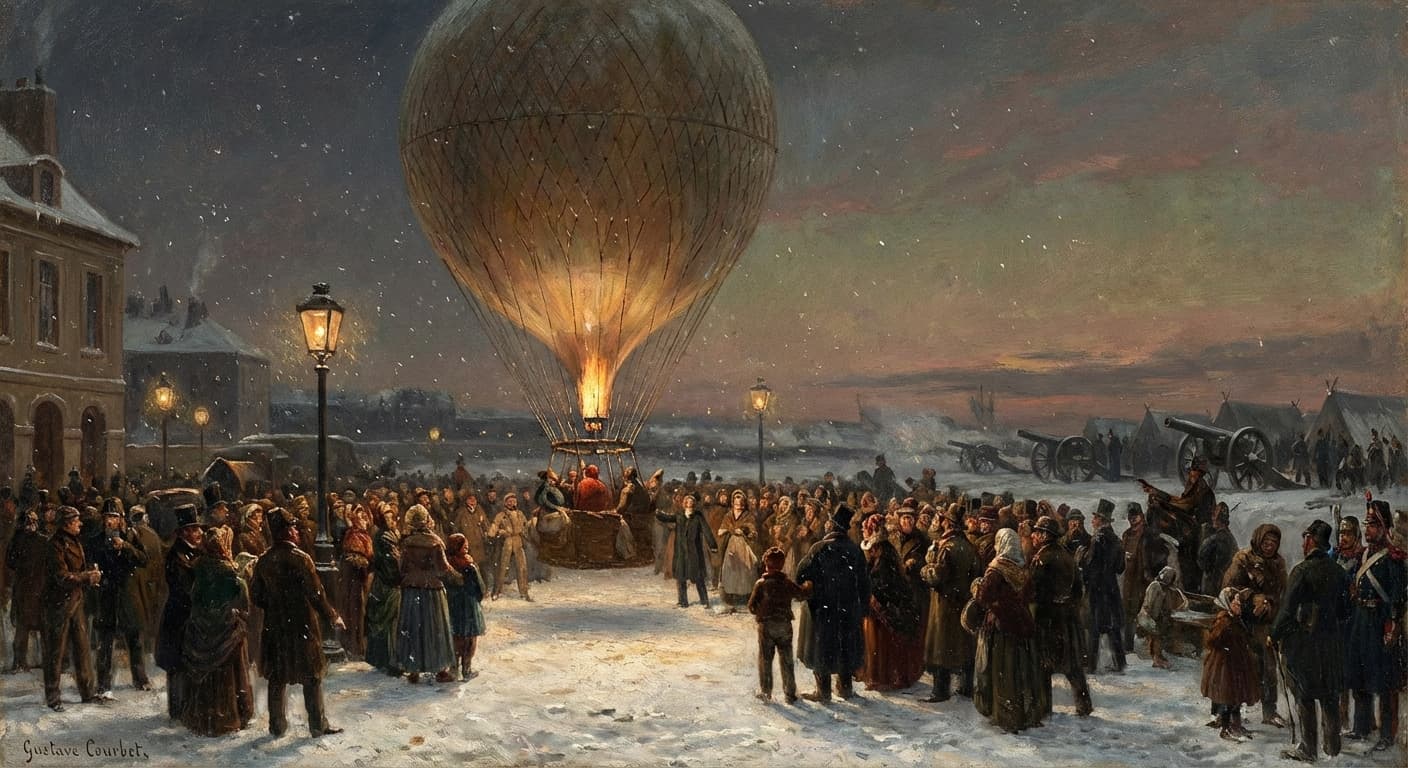
Yet, while Parisians were eating their zoo, they were also looking to the skies to solve a different problem: communication. Cut off from the rest of France, the provisional government needed a way to coordinate the war effort and citizens were desperate to send letters to loved ones. The solution was the "Ballon Monté"—the world's first regular airmail service. Using abandoned rail stations as makeshift factories, sailors and seamstresses constructed dozens of hot air balloons. Between September 1870 and January 1871, 66 balloons lifted off from besieged Paris, carrying 164 passengers (including the Minister of the Interior, Léon Gambetta) and over two million letters. They floated over the heads of the baffled Prussian soldiers, carrying news of the resistance to the outside world.
The problem, of course, was that balloons are at the mercy of the wind. They could fly out, but they couldn't fly back in against the prevailing currents. To solve the return loop, the French turned to nature’s aviators: homing pigeons. The balloons carried baskets of pigeons out of the city to be released later with incoming messages. However, a pigeon can only carry so much weight. This limitation led to a revolutionary technological breakthrough: microfilm.
A photographer named René Dagron utilized a technique to shrink huge amounts of text onto tiny collodion films. Official dispatches and thousands of private letters were photographed, reduced microscopically, and rolled into tiny tubes attached to a pigeon's tail feather. A single bird could carry tens of thousands of messages. When the pigeons successfully dodged Prussian hawks and hunters to return to Paris, the films were projected onto large screens using a "magic lantern" (an early projector), transcribed by clerks, and delivered.
The Siege of Paris ended in capitulation in January 1871, leaving deep scars on the French psyche. Yet, amidst the horror of starvations and the bombardment, the siege produced a strange legacy of resilience. It gave us the first large-scale use of microfilm and airmail, proving that even when the walls close in, human ingenuity—and the hunger to communicate—knows no bounds.