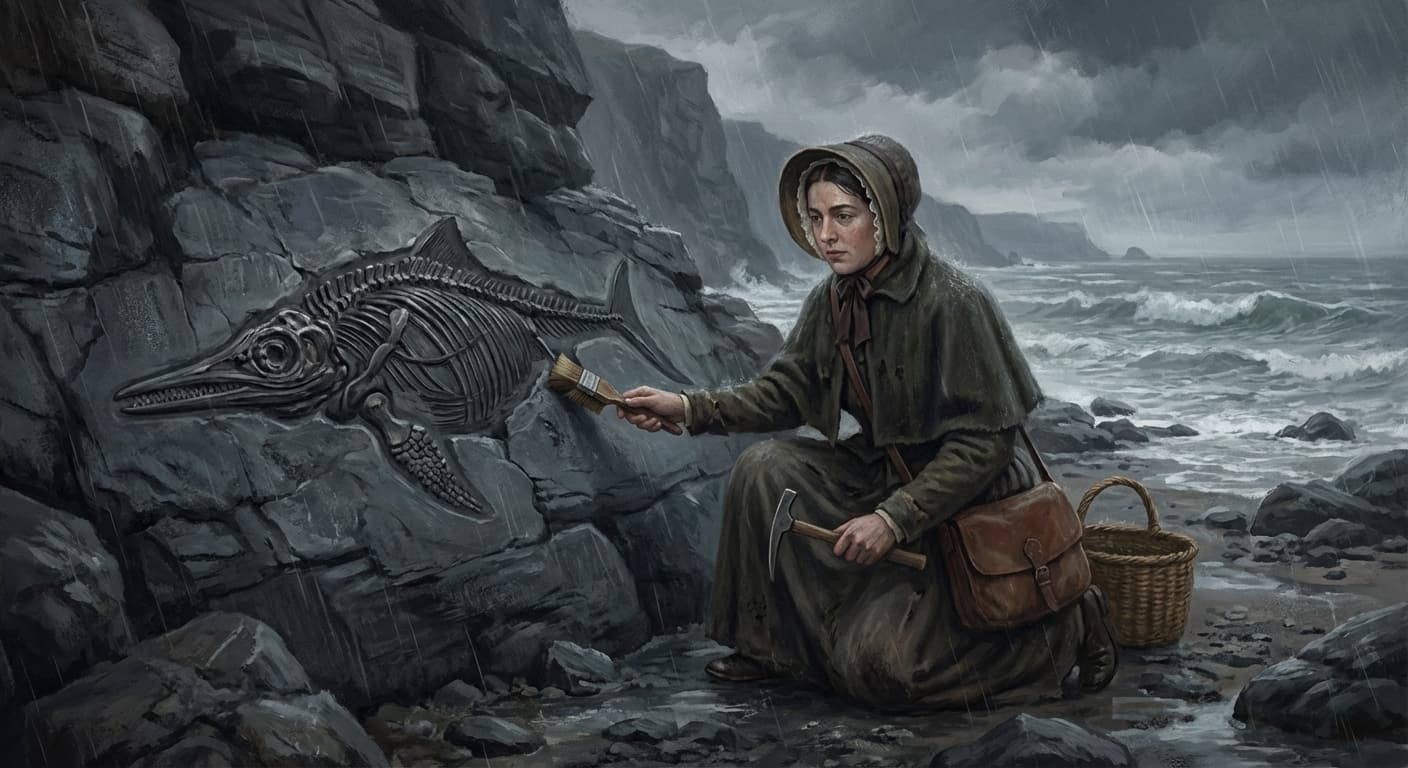
She Sells Sea Shells: The Unsung Princess of Paleontology
In the annals of scientific history, the 19th century stands as a towering era of discovery. It was the age of Darwin, Faraday, and Pasteur—men whose names are etched in the granite of textbooks. Yet, walking the windswept, treacherous cliffs of Dorset, England, was a figure whose contributions were equally monumental but who, for nearly two centuries, remained largely a footnote in the journals of men. Her name was Mary Anning, and she was the woman who taught the world that monsters once swam the seas.
The Girl on the Jurassic Coast
Born in 1799 in the seaside town of Lyme Regis, Mary Anning’s life began with a literal lightning strike. As an infant, she was the sole survivor of a lightning bolt that killed three other women standing near her. Local folklore claimed the event changed her from a sickly baby into a bright and curious child. Whether or not the lightning sparked her intellect, her environment certainly fueled it. Lyme Regis sits on what is now known as the Jurassic Coast, a geological marvel where the cliffs crumble into the sea, revealing millions of years of history with every landslide.
Her father, Richard Anning, was a cabinetmaker who supplemented the family’s meager income by hunting for "curios"—fossilized ammonites and belemnites—to sell to tourists. He taught Mary the trade, showing her how to spot the tell-tale glint of bone in the blue lias clay. When Richard died in 1810, leaving the family in destitute poverty, 11-year-old Mary took up the hammer and basket. Fossil hunting wasn't a hobby; it was a desperate means of survival.
Discovery of the "Fish Lizard"
It was in 1811, just months after her father's death, that Mary and her brother Joseph made the discovery that would shake the scientific establishment. Embedded in the cliffside was a massive, 4-foot-long skull. Over months of painstaking excavation, Mary revealed the rest of the skeleton. It was a creature unlike anything living—a "fish lizard" with a crocodile's jaw and fins like a dolphin.
At the time, the concept of extinction was radical. Many believed animals did not vanish; they just migrated to unexplored corners of the globe. Mary’s discovery, later named the Ichthyosaurus, challenged the biblical timeline and forced the scientific community to reckon with a "deep time" far older than 6,000 years. She was only twelve years old.
The Greatest Fossil Hunter the World Ever Knew
Mary Anning didn't stop there. In 1823, she discovered the first complete Plesiosaurus, a long-necked marine reptile so bizarre that the famous French anatomist Georges Cuvier initially declared it a fake. When he finally admitted its authenticity, Mary’s reputation among the elite collectors soared—even if they didn't invite her to their meetings.
Throughout the 1820s and 30s, she unearthed the first Pterodactylus (pterosaur) found outside Germany and discovered that the "bezoar stones" found in fossil abdominal regions were actually fossilized feces, or coprolites. Her knowledge of anatomy was so profound that wealthy male geologists traveled from London to consult her, often publishing papers based on her findings without crediting her name.
A Legacy Reclaimed
Despite her brilliance, Anning faced a double disadvantage: she was a woman, and she was working-class. The Geological Society of London did not admit women, and as a result, she was barred from the very institutions that built their collections on her back. She famously wrote to a friend, "The world has used me so unkindly, I fear it has made me suspicious of everyone."
Mary Anning died of breast cancer in 1847 at the age of 47. While she was respected by the individuals who knew her, history was slow to grant her the podium she deserved. Today, however, the fog is lifting. She is recognized not merely as a collector, but as a pioneering paleontologist who helped found the earth sciences.
So, the next time you hear the tongue-twister "She sells sea shells by the sea shore," remember that it was inspired by Mary Anning—the woman who sold sea shells to feed her family and, in the process, rewrote the history of life on Earth.