The Secret Subway of 1870: How Alfred Ely Beach Built a Pneumatic Tube Under New York City
Imagine New York City in the years immediately following the American Civil War. Broadway was an absolute nightmare. The main arteries of Manhattan were completely choked with horse-drawn omnibuses, aggressive delivery carts, and throngs of furious pedestrians trying to navigate the chaos. The noise was deafening, the traffic jams could last for hours, and the sheer volume of horse manure made simply crossing the street a hazardous and foul-smelling endeavor. The rapidly growing metropolis was suffocating under its own weight, and city planners desperately needed a solution to relieve the gridlock.
Enter Alfred Ely Beach, an eccentric polymath, brilliant inventor, and the publisher of Scientific American. Beach recognized that the only way to solve the city's transit crisis was to go underground. However, steam-powered locomotives, the standard technology of the era, would fill any tunnel with choking soot and toxic smoke. Beach had a far more elegant vision: what if people could be whisked underneath the chaotic streets in a tube, propelled entirely by clean, quiet air pressure? He envisioned a system functioning much like the pneumatic tubes used in banks, but scaled up to comfortably transport human beings.
There was just one massive obstacle standing in Beach's way, and his name was William 'Boss' Tweed. As the notoriously corrupt leader of the Tammany Hall political machine, Tweed held absolute power over New York City's infrastructure. Tweed and his cronies were making a fortune off the overcrowded surface transit systems and had zero interest in seeing a subterranean competitor succeed. Aware that Tweed would immediately crush any project that threatened his lucrative monopoly, Beach decided on a wildly audacious plan. If the city wouldn't let him build a subway, he would simply have to build one in secret.
In 1868, Beach approached the state legislature and cleverly obtained a permit to build a pair of small, innocuous pneumatic tubes for delivering mail. Boss Tweed, seeing no threat in a mail delivery system, allowed the permit to pass. But Beach had absolutely no intention of building a simple mail tube. Leasing the basement of Devlin's clothing store on Broadway, he quietly brought in an engineering crew. Under the cover of night, using a custom-designed hydraulic tunneling shield, Beach's team began carving out a tunnel twenty-one feet below the bustling street—a tunnel large enough to fit an entire passenger car.
For fifty-eight nights, the stealthy excavation continued. The workers discreetly shoveled out tons of dirt, hiding the excavated earth in the basement of the clothing store to avoid arousing any suspicion from the authorities above. To power his underground marvel, Beach installed a massive, forty-eight-ton Roots blower fan in the basement, a monstrous machine affectionately nicknamed the 'Western Tornado.' By the time the dirt was finally cleared, Beach had constructed a pristine, brick-lined tunnel stretching exactly one block, from Warren Street to Murray Street.
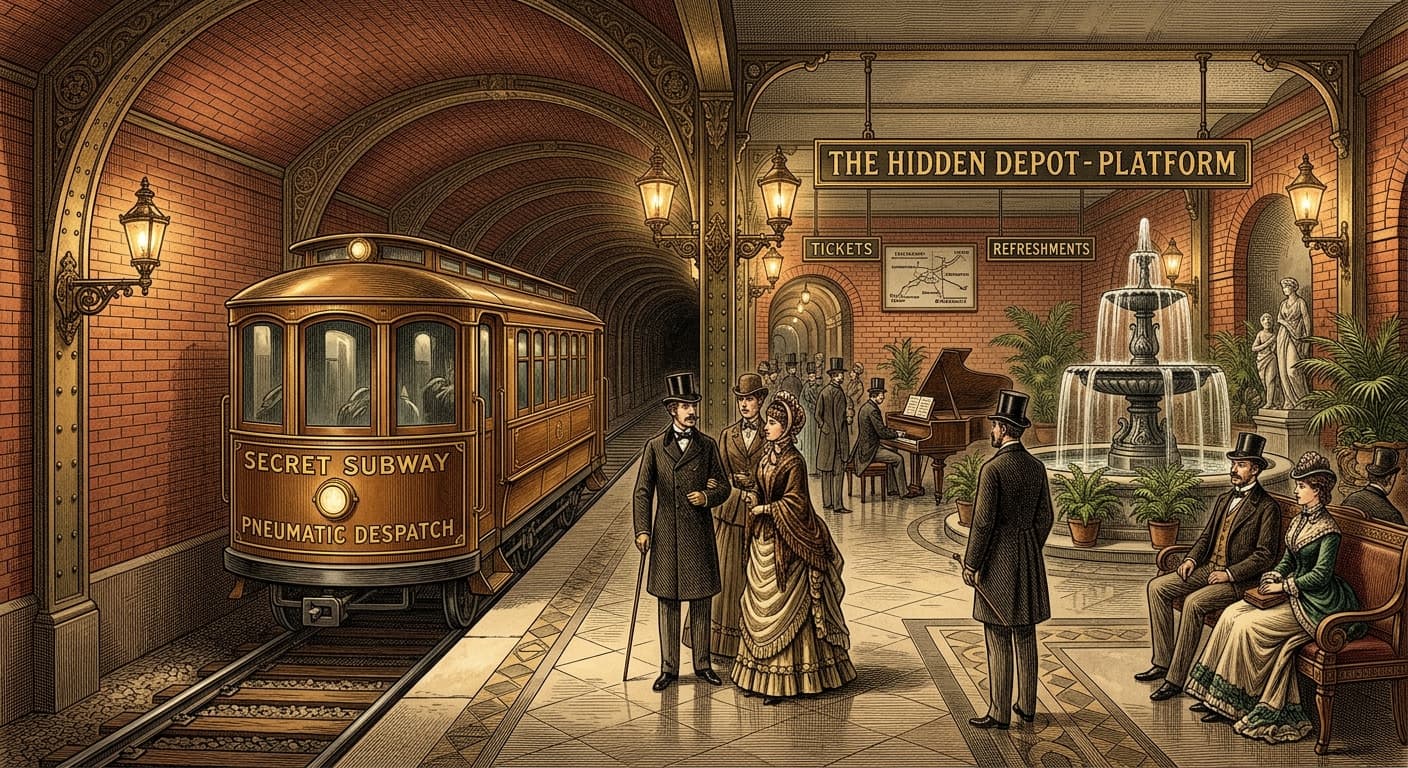
On February 26, 1870, Beach threw open the doors and unveiled his masterpiece to a completely stunned public. The secret subway was nothing short of spectacular. Aware that he needed to win over a skeptical public who feared the idea of traveling underground, Beach had designed his station to resemble a high-end Victorian parlor. The subterranean waiting room featured grand frescoes, gas-lit chandeliers, comfortable seating, a functioning fountain, and even a grand piano playing soothing melodies. It was a stark contrast to the muddy, chaotic nightmare of the streets above.
Passengers eagerly paid twenty-five cents—a hefty sum at the time—to board the luxurious, twenty-two-seat cylindrical wooden car. Once they were seated, the operator would engage the 'Western Tornado.' The massive fan blew air into the tunnel, gently and swiftly propelling the car down the single-block track. When the car reached the end of the line at Murray Street, a baffle was tripped, the fan's gears were reversed, and the car was literally sucked back to the station at Warren Street. It was clean, quiet, and incredibly smooth. In its first year alone, over four hundred thousand New Yorkers took the brief, magical ride.
For all its mechanical brilliance and public popularity, the Beach Pneumatic Transit system was ultimately doomed by a tragic combination of politics and economics. When Boss Tweed discovered the deception, he was furious. He used his immense political leverage to block Beach's requests to extend the subway line. By the time Tweed was finally ousted and Beach successfully secured permission to build his full transit network, the devastating financial Panic of 1873 had struck the nation. Funding completely dried up overnight, and investors abandoned the project.
With no money to continue, the revolutionary pneumatic subway was shuttered. The luxurious station was boarded up, the tunnel was sealed, and the grand piano was left to rot in the dark. Over the decades, Beach's visionary creation slipped into urban legend, largely forgotten by the city rushing above it. It wasn't until 1912, when workers were excavating the modern BMT Broadway subway line, that they accidentally broke through a brick wall and discovered the perfectly preserved pneumatic tunnel, complete with the wooden passenger car sitting silently on its tracks. Today, Alfred Ely Beach's secret subway remains one of the most fascinating 'what-ifs' of the 19th century, a magnificent testament to a future that New York City almost had.