The Day the Clocks Aligned: How Sandford Fleming Tamed the Chaos of Time
Imagine boarding a train in the mid-19th century. As you settle into your seat for a journey across the country, you are faced with a dizzying logistical nightmare. If it is 12:00 PM in Washington, D.C., it is exactly 12:12 PM in New York, 12:24 PM in Boston, and 11:43 AM in Richmond. Prior to the 1880s, the concept of "Standard Time" simply did not exist. Instead, the world operated on "Local Mean Time," dictated entirely by the sun. Every city, town, and rural hamlet had its own local time, usually kept by a prominent clock on a church or town hall. As long as people traveled by horse or on foot, this hyper-local timekeeping was perfectly fine. But the invention of the steam locomotive was about to throw the world's clocks into absolute chaos.
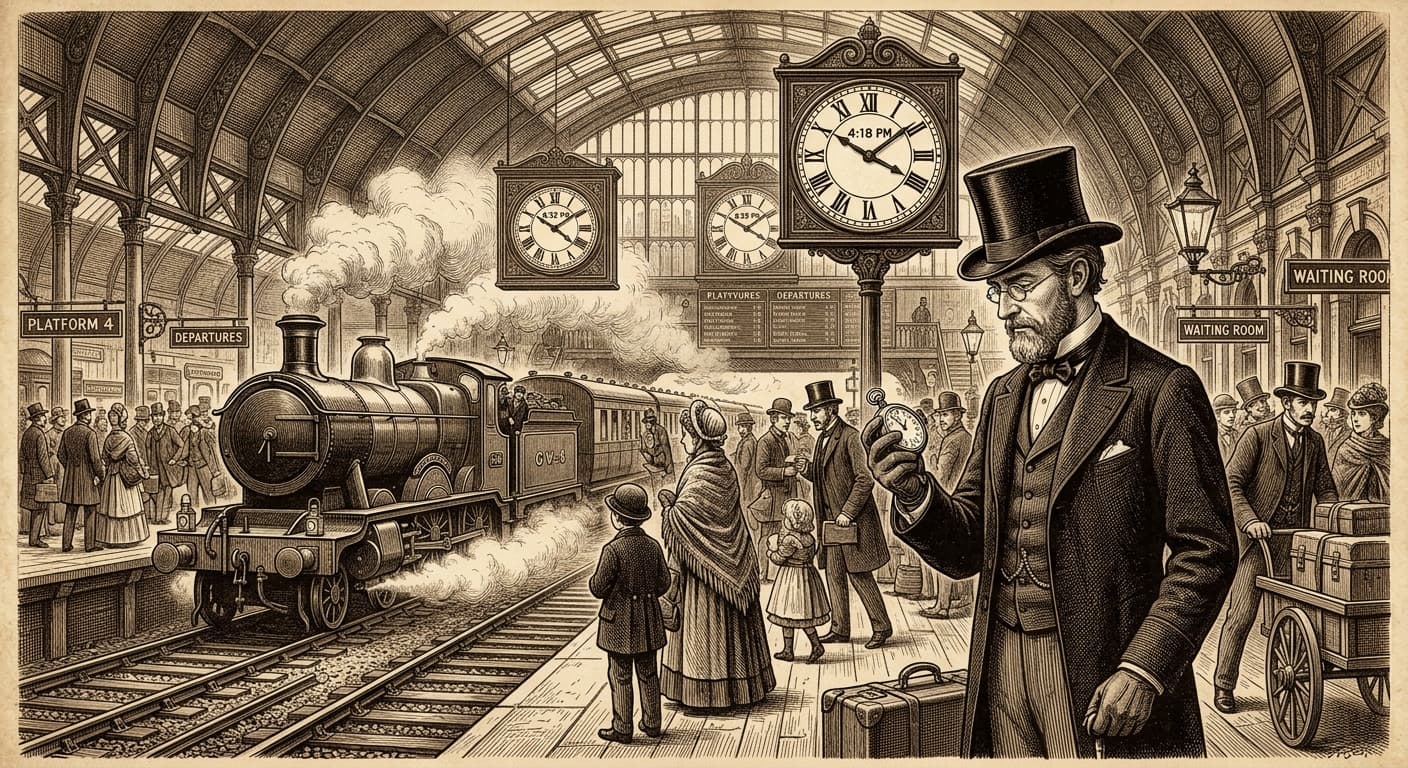
The rapid expansion of the railroad networks in the 1850s and 1860s abruptly shrank distances that once took weeks to cross into mere hours. Suddenly, the fact that there were over 300 local times in the United States alone became a profound crisis. Railroad stations had to maintain dozens of different clocks on their walls to show the time at various destinations. Conductors struggled to calculate arrival times, and passengers routinely missed connections. More terrifyingly, the temporal confusion led to catastrophic and deadly train collisions. Since trains shared a single track, engineers relied entirely on strict timetables to avoid each other. When "railroad time" conflicted with "town time," or when two engineers' pocket watches were set to different local meridians, the results were often fatal head-on crashes.
The tipping point came not with a horrific crash, but with a profoundly mundane annoyance. In 1876, a brilliant Scottish-Canadian engineer named Sir Sandford Fleming was traveling through Ireland. Due to a misprint in a confusing railway timetable that listed a "PM" instead of an "AM," Fleming missed his train. While stranded at the station in County Donegal, Fleming didn't just grumble about his bad luck—he decided to completely reinvent how humanity measured the day.
Fleming was no ordinary commuter. He was the chief engineer of the Canadian Pacific Railway, a man accustomed to solving massive logistical puzzles. He realized that the problem wasn't just bad railway management; the very concept of local solar time was fundamentally incompatible with the industrial age. Fleming envisioned a bold, sweeping solution: a standardized, global 24-hour clock. He proposed dividing the entire globe into 24 distinct time zones, each spanning 15 degrees of longitude. Within each zone, all clocks would strike the same hour, regardless of where the sun was in the sky.
Today, this concept seems like mere common sense, but to the Victorians, it was an outrageous proposition. The idea of abandoning "God's Time"—the natural solar rhythm—in favor of an artificial "Railroad Time" was fiercely resisted. Religious leaders argued that it was unnatural and arrogant for man to dictate the hours of the day. Politicians balked at the idea of synchronizing their proud cities with distant, rival towns. Farmers, whose lives were dictated by daylight rather than clock hands, saw it as an oppressive overreach by wealthy railroad tycoons. One mayor in Maine famously declared that no one would force his town to abandon the "time given to them by the Almighty."
Despite the backlash, the railroad companies knew that survival depended on standardization. They couldn't wait for squabbling politicians to pass laws, so they took matters into their own hands. William F. Allen, a railroad engineer inspired by Fleming's ideas, championed the cause in the United States. Together, they orchestrated one of the most remarkable logistical feats of the 19th century: the "Day of Two Noons."
On Sunday, November 18, 1883, the grand switch took place. Across North America, telegraph lines buzzed with a synchronized signal. As the sun reached the meridian, people effectively experienced two noons—one by their old local time, and another minutes later when the clocks were adjusted to the new Standard Time. In cities like Chicago and New York, crowds gathered in front of public clocks, holding their breath as the minute hands were manually shifted to conform to the new invisible grid. Miraculously, the transition went off without a hitch. The terrifying specter of temporal chaos was banished overnight.
Fleming didn't stop at North America. He spent the next year aggressively lobbying international governments, leading to the pivotal International Meridian Conference in Washington, D.C., in 1884. There, delegates from 25 nations agreed to adopt a global time zone system and officially designated the Royal Observatory in Greenwich, London, as the Prime Meridian (Longitude 0°).
Sir Sandford Fleming's crusade to synchronize the world fundamentally rewired human civilization. He transformed time from a fickle, localized phenomenon into a universal constant, laying the invisible groundwork for everything from safe modern air travel to the global internet. The next time you effortlessly adjust your watch while crossing a border, spare a thought for the frustrated Victorian engineer stuck in an Irish train station, who decided that if he couldn't catch his train, he would simply tame time itself.