The Captain Who Tamed the Sky: Robert FitzRoy and the Tragic Birth of the Weather Forecast
Before you leave your house, you probably check your smartphone to see if you need an umbrella. We take the ability to anticipate the elements completely for granted. But in the mid-19th century, predicting the weather was considered a fool's errand, akin to astrology or witchcraft. To claim you could foresee the heavens was not just scientifically dubious; to many, it was playing God.
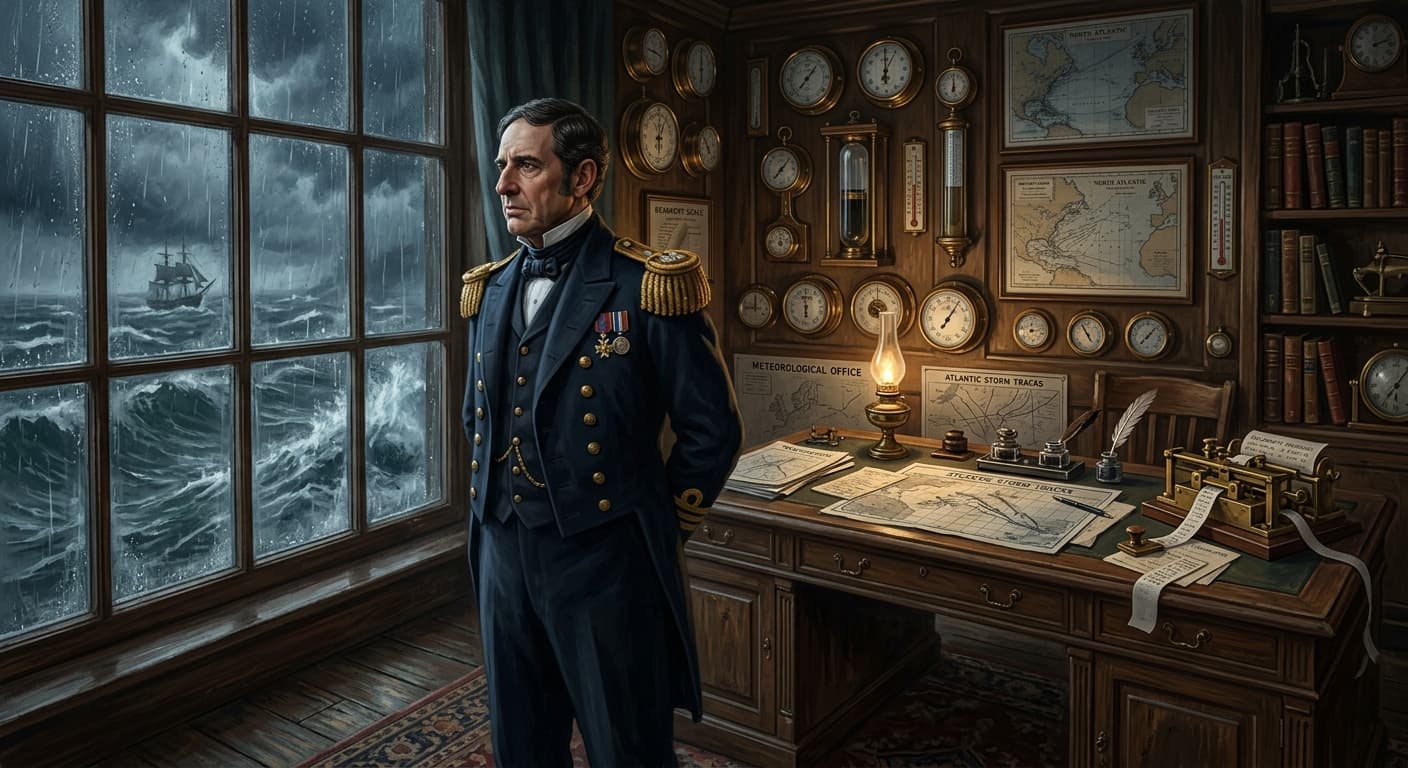
Enter Vice-Admiral Robert FitzRoy. Most history buffs know him as the aristocratic, temperamental captain of the HMS Beagle, the man who ferried a young Charles Darwin around the globe. But FitzRoy’s ultimate legacy wasn't in evolutionary biology; it was in the sky. He was a meticulous, obsessed meteorologist who essentially invented the modern weather forecast—and even coined the term itself.
The catalyst for FitzRoy's revolutionary idea was a catastrophe. In October 1859, a brutal hurricane known as the Royal Charter storm smashed into the British coast, sinking the steam clipper Royal Charter and drowning over 450 people. The disaster shocked the nation. FitzRoy, who had recently been appointed the head of a small, obscure government department tasked with collecting maritime weather data (the precursor to the UK’s Met Office), believed the tragedy was entirely preventable.
He realized that the recently invented electric telegraph was the key to saving lives. Weather systems generally moved slower than telegraphic messages. By establishing a network of coastal observation stations that could telegraph their local atmospheric pressure, temperature, and wind directions back to London, FitzRoy could track a storm's movement in real-time. He could then telegraph warnings to ports in the storm's path before it arrived.
In 1860, FitzRoy implemented a system of visual storm warnings at major ports. He designed large canvas cones and drums that were hoisted on tall masts to signal approaching gales to sailors. It was an immediate success, saving countless lives. But FitzRoy wanted to go further. On August 1, 1861, he published the world’s first daily "weather forecast" in The Times of London. He deliberately chose the word "forecast" to distance his scientific deductions from the astrological "predictions" or "prophecies" of charlatans.
Initially, the public was enthralled. The forecasts became a daily talking point at breakfast tables, and FitzRoy became a household name. However, meteorology was in its infancy, and his predictions were frequently wrong. The backlash was swift, highly public, and ruthless. Commercial fleet owners were furious when his storm warnings kept their ships in port on days that turned out perfectly sunny, costing them money. Politicians complained about the expense of the telegraph network. Even the scientific establishment turned on him, arguing his empirical, data-gathering approach lacked theoretical rigor.
FitzRoy was a man of intense passion and deep depression, and the relentless public mockery took a heavy toll. Compounding his stress was a profound personal crisis. A devout literalist of the Bible, FitzRoy was horrified by the publication of Darwin’s On the Origin of Species. He felt immense, crushing guilt for having commanded the voyage that allowed his former friend to develop a theory he believed was heretical.
Tragically, the combined weight of public ridicule, overwork, and religious despair proved too much. On April 30, 1865, FitzRoy took his own life. Following his death, the British government briefly suspended the daily weather forecasts, citing their inaccuracy and expense. However, a sudden, sharp increase in maritime disasters and shipwrecks led to a massive public outcry from the sailors and fishermen who had come to rely on FitzRoy’s warnings. The forecasts were quickly reinstated, never to go away again.
Today, Robert FitzRoy is largely vindicated by history. Every time we check a weather app, watch a meteorologist on the evening news, or cancel a picnic due to rain, we are participating in a system pioneered by the troubled captain of the Beagle. In 2002, the UK's Meteorological Office finally gave him his due, renaming the sea forecasting area of Finisterre to "FitzRoy"—a fitting tribute to the brilliant, flawed man who gave humanity the power to foresee the sky.