The River That Ran Backward: The Forgotten Fury of the New Madrid Earthquakes
When we imagine the earth splitting open and cities trembling in American history, our minds instinctively jump to the San Francisco earthquake of 1906 or the looming threat of the San Andreas Fault. We look West. But the most violent series of earthquakes in the contiguous United States didn't happen in California. It happened in the heart of the frontier, along the Mississippi River valley, in the winter of 1811 and 1812.
These were the New Madrid earthquakes—a cataclysm so powerful that it reshaped the geography of the continent, rang church bells a thousand miles away, and, in a terrifying display of nature's power, forced the mighty Mississippi River to flow backward.
The Day the Earth Turned to Liquid
It began in the early morning hours of December 16, 1811. The American Midwest was then a sparsely populated frontier, a quiet expanse of forests and river settlements. Residents in the town of New Madrid (in what is now Missouri) were jolted from their beds by a violent roaring sound. The ground didn't just shake; it rolled. Eyewitnesses described the earth moving in waves, rising and falling like the swell of the ocean.
This wasn't a short tremor. The ground convulsed for minutes that felt like hours. As the earth cracked open, deep fissures swallowed livestock and trees whole. But the terror came from below in more ways than one. The pressure was so intense that it forced mixture of sand and water to shoot high into the air, creating phenomena known as "sand blows" or "sand boils." These volcanic-like eruptions covered thousands of square miles in sand, ruining farmland for generations. The air grew thick with sulfurous vapor, turning the sky a bruised, dark color that convinced many the Apocalypse had arrived.
Chaos on the Mississippi
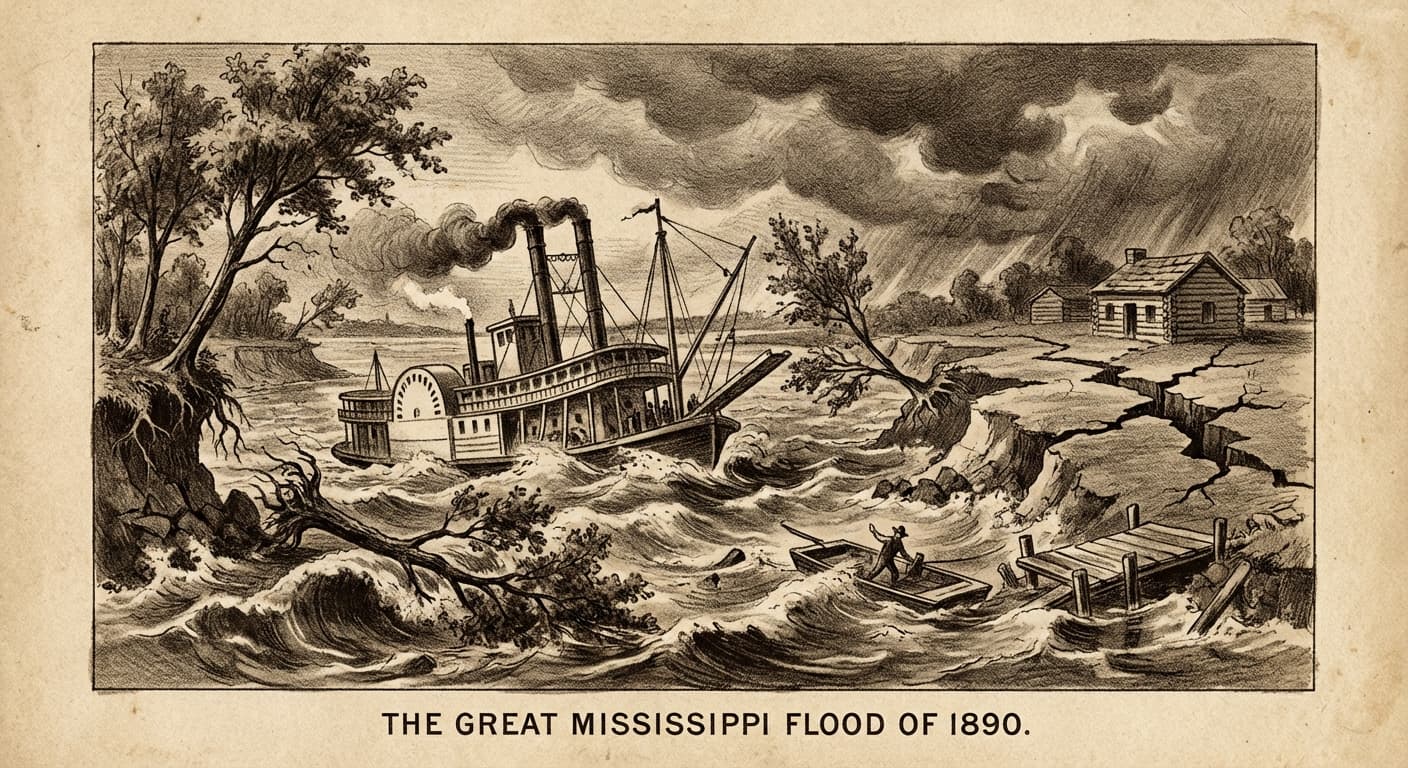
The most harrowing accounts came from the water. The Mississippi River, the lifeblood of trade and travel, turned into a death trap. The initial shockwaves caused parts of the riverbanks to collapse, sending thousands of trees crashing into the water. Islands that had been used as navigational landmarks for decades simply vanished beneath the churning brown waves.
The geological upheaval created temporary dams on the riverbed. When the current hit these obstructions, the water had nowhere to go but back. For several hours, the Mississippi actually flowed upstream. The upheaval was so violent that it created temporary waterfalls and rapids where none had existed before. Boats were capsized, and crews were thrown into the roiling water, never to be seen again.
Caught in this maelstrom was the New Orleans, the first steamboat to ever attempt the journey down the Ohio and Mississippi rivers. Piloted by Nicholas Roosevelt (a great-great-uncle of Theodore Roosevelt), the boat had to navigate a river that was literally changing shape beneath its hull. The pilot couldn't rely on his maps, as the islands and channels he knew were gone. It is a testament to the crew's skill—and sheer luck—that they survived a voyage through a landscape that looked more like Hades than America.
The Stomp of the Prophet
The timing of the earthquakes coincided with a tense moment in history, lending the event a supernatural aura. Just months prior, the Great Comet of 1811 had blazed across the sky, visible to the naked eye for months. To the Shawnee leader Tecumseh, who was traveling across the region attempting to unite Native American tribes against encroaching settlers, the comet was a sign.
Tecumseh had allegedly prophesied that upon his return home, he would stomp his foot and the earth would shake. When the earthquakes struck shortly after he left the Creek nation in Alabama, many tribes interpreted the tremors as "Tecumseh’s Stomp," a divine signal to join his confederacy. The psychological impact of the quakes galvanized resistance across the frontier, adding a layer of geopolitical chaos to the natural disaster.
A Continental Shock
The magnitude of the New Madrid quakes is difficult to comprehend by modern standards because the geology of the Midwest is colder and more rigid than the fractured rock of California. This rigidity allowed the seismic waves to travel incredible distances without losing energy.
The shocks weren't just felt in Missouri. They woke people up in Pittsburgh. They cracked sidewalks in Washington D.C. Most famously, the vibrations traveled all the way to Boston, Massachusetts, where they set church bells ringing, over 1,000 miles away from the epicenter. If such an event were to happen today, the infrastructure of half the United States—from St. Louis to Memphis to Indianapolis—would face catastrophic failure.
The Legacy of the Lakes
By the time the major shocks subsided in February 1812, the landscape was permanently altered. The most enduring scar of the event is Reelfoot Lake in Tennessee. During the quakes, the land there subsided violently, and the reversed waters of the Mississippi rushed in to fill the depression, creating a massive lake where a forest had stood just hours before. Even today, if you look beneath the surface of Reelfoot Lake, you can see the ghostly remains of submerged cypress trees that were drowned in 1812.
The New Madrid earthquakes remain a terrifying anomaly—a reminder that the most dangerous ground isn't always on the edge of a tectonic plate, but sometimes deep within the heart of the continent, waiting to wake up again.