The Modest Doctor Who Changed Medicine: René Laennec and the Birth of the Stethoscope
Picture the scene: a doctor’s visit in the early 19th century. If you had a persistent cough or a suspected heart condition, your physician would employ a diagnostic method known as "immediate auscultation." This clinical-sounding term was actually a rather awkward affair. It required the doctor to press his ear directly against the patient's chest to listen to their internal rhythms. In an era where daily bathing was a luxury and personal hygiene was, frankly, questionable, this practice was often unpleasant for the doctor. For the patient, particularly young women, it was deeply uncomfortable and highly immodest. The medical establishment desperately needed a barrier, a tool to bridge the physical gap while amplifying the sounds of the body. They just didn't know it yet.
Enter René Laennec, a deeply religious, asthmatic, and exceptionally shy French physician working at the Hôpital Necker in Paris in 1816. Laennec was a brilliant diagnostician, but his timid nature made the practice of immediate auscultation a constant source of professional anxiety. He found the physical proximity required for chest examinations particularly distressing when dealing with female patients, constrained by the rigid social and moral conventions of the post-Napoleonic era.
The turning point in medical history arrived on a cool autumn day when Laennec was summoned to examine a young, overweight woman exhibiting symptoms of a diseased heart. Due to her age, her gender, and her "degree of fatness," Laennec felt that pressing his ear to her chest was completely out of the question. Frustrated and searching for a solution, his mind cast back to an observation he had made earlier while walking through the courtyard of the Louvre. He had seen children playing with a long, hollow piece of wood. One child would scratch the end of the stick with a pin, while another held their ear to the opposite end, listening in delight as the sound traveled clearly through the solid material.
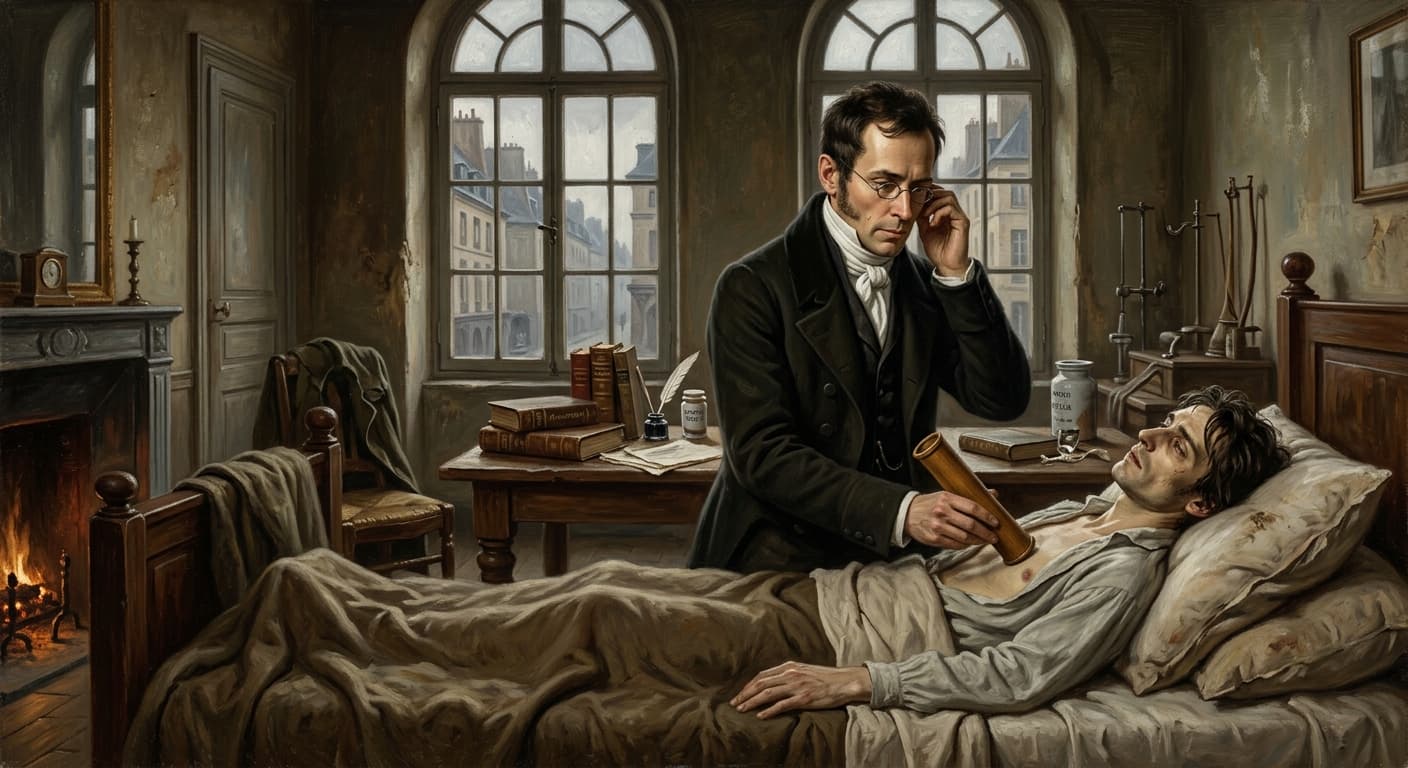
Desperate to maintain his patient's modesty, Laennec grabbed a quire of paper, rolled it tightly into a cylinder, tied it with string, and gingerly placed one end on the woman's chest and the other to his ear. The result was nothing short of miraculous. Not only was the patient's dignity preserved, but Laennec found that the sounds of her beating heart were far clearer and more distinct than he had ever heard through direct contact. In this desperate moment of 19th-century prudishness, the concept of "mediate auscultation" was born.
Knowing that a rolled-up piece of paper was hardly a durable medical instrument, Laennec set to work refining his invention. A skilled woodturner in his spare time, he began crafting wooden cylinders. His final design was a hollow wooden tube, about a foot long and an inch and a half in diameter, which could be disassembled into two pieces for easier carrying. He named his creation the "stethoscope," derived from the Greek words stethos (chest) and skopein (to explore or look at).
In 1819, Laennec published a groundbreaking treatise on his invention, De l'Auscultation Médiate. He didn't just introduce a new tool; he entirely mapped out the acoustic landscape of the human chest. Laennec spent years listening to the lungs and hearts of his patients, correlating the sounds he heard with the physical ailments he discovered during autopsies. He coined terms that medical students still memorize today—like rales, rhonchi, and crepitance—giving the medical world a shared language to describe the symphony of sickness occurring beneath the skin.
However, the medical establishment was predictably stubborn. Many older physicians mocked the stethoscope, dismissing it as a gimmick or complaining that it was too cumbersome to carry. Some doctors argued that they had God-given ears and didn't need a wooden tube to do their jobs. One medical journal even declared that the stethoscope would never catch on because its use required "too much time and trouble." But the evidence of its efficacy was undeniable. Within a few decades, the stethoscope crossed oceans and borders, evolving from Laennec’s rigid wooden cylinder into the flexible, binaural models we recognize today.
There is a profound, tragic irony to René Laennec's story. Despite giving the world the ultimate tool for diagnosing chest diseases, Laennec himself suffered from a fatal respiratory illness. In 1826, just a decade after his ingenious paper-rolling maneuver, he died of tuberculosis at the age of 45. It was a disease that he had extensively studied and categorized using his own invention. Laennec passed away knowing his creation was revolutionizing medicine, but he likely never imagined that his modest attempt to avoid an awkward encounter would produce the most enduring and universal symbol of the medical profession.