The Race That Birthed the Railway: The High-Stakes Drama of the 1829 Rainhill Trials
In the autumn of 1829, the modern world was quite literally waiting at the station. The Liverpool and Manchester Railway (L&MR)—the world’s first intercity railway—was nearing completion. But there was a massive, multi-million-pound problem: the directors of the railway had no idea how they were actually going to move the trains. The tracks were laid, but the technology to conquer them was still fiercely debated.
The idea of using steam locomotives was highly controversial. Many distinguished engineers argued that "traveling engines" were too heavy, too unreliable, and too dangerous. They advocated for stationary steam engines positioned along the route that would pull cars with long cables, or even falling back on the tried-and-true method of horse power. To settle the debate, the L&MR directors decided on a spectacularly public gamble: they would host a competition.
They offered a handsome prize of £500—a small fortune at the time, equivalent to over £60,000 today—to anyone who could build a locomotive that met a strict set of criteria. The machine had to weigh less than six tons, pull a load three times its own weight at a speed of at least 10 miles per hour, and, crucially, "consume its own smoke" to avoid choking the English countryside. The challenge was thrown down, and the world’s most brilliant engineering minds answered the call.
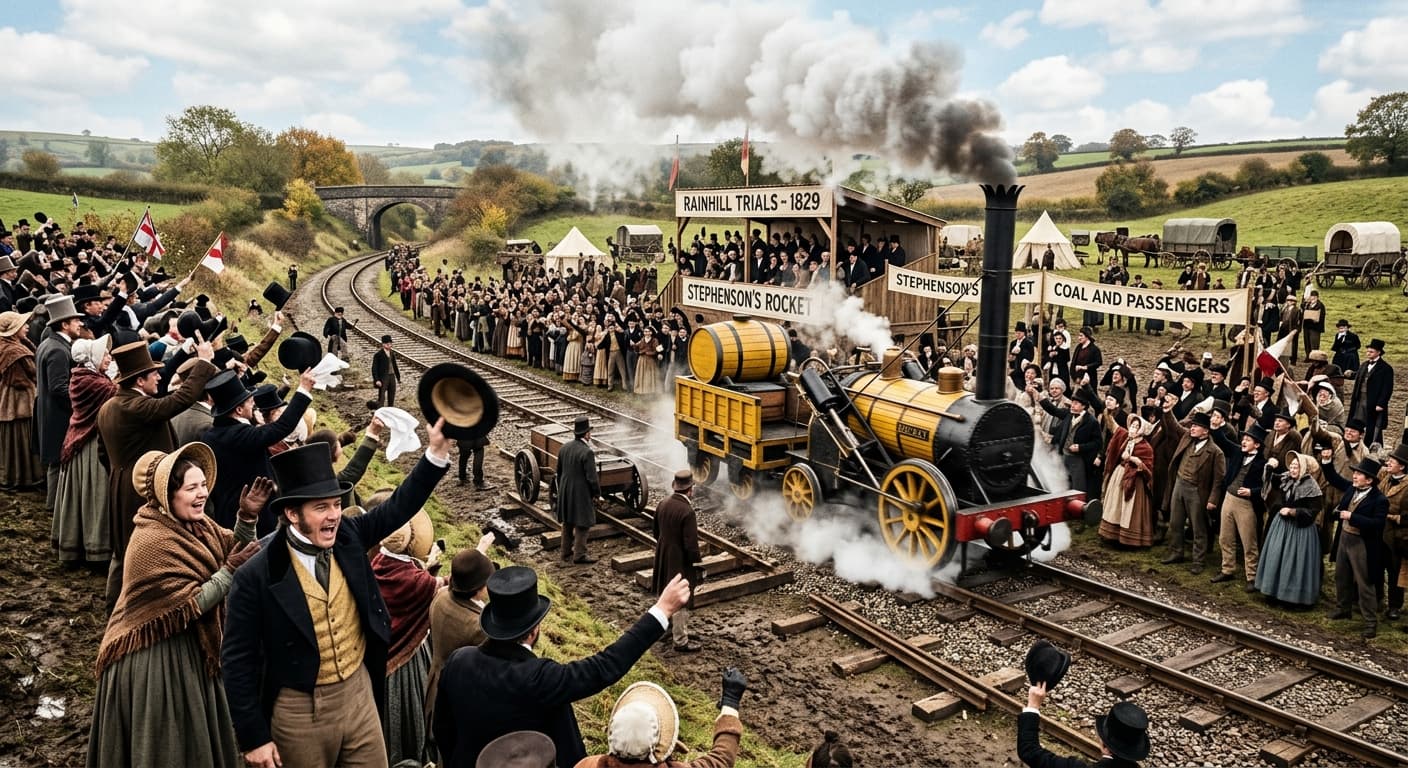
By October 1829, the village of Rainhill, just outside Liverpool, was swarming with thousands of spectators, reporters, and wealthy industrialists. It was the engineering equivalent of the Kentucky Derby. Grandstands were erected, brass bands played, and the crowds eagerly awaited the mechanical beasts. Only five engines ultimately arrived to compete in the trials, and they were a bizarre and eclectic mix.
The strangest entry, and the first to be eliminated, was the Cycloped, an invention that hilariously misunderstood the assignment. It wasn't powered by steam at all; rather, it featured a horse walking on a treadmill connected to the wheels. It was unceremoniously disqualified after the horse crashed through the wooden floorboards. Another engine, the Perseverance, was damaged in transit and proved far too slow to meet the minimum speed requirement.
That left three serious contenders: the Sans Pareil, the Novelty, and the Rocket. The Sans Pareil, built by Timothy Hackworth, was a sturdy beast of an engine, but it was dangerously close to the maximum weight limit and had a terrible thirst for fuel. The crowd’s absolute favorite was the Novelty, built by John Ericsson and John Braithwaite. It was a beautiful, sleek machine with shiny copper components. When it ran, it glided along the tracks at an astonishing 28 miles per hour, leaving the Victorian spectators in absolute awe.
Then there was the Rocket, designed by the father-son engineering duo of George and Robert Stephenson. Painted a striking yellow and black, the Rocket didn't look as sleek as the Novelty, but it possessed a revolutionary secret weapon: a multi-tubular boiler. Instead of a single large pipe running through the water tank to heat it, the Rocket had 25 narrow copper tubes. This exponentially increased the surface area for heating, allowing the engine to generate steam faster and more efficiently than any locomotive before it.
As the grueling multi-day trials wore on, the endurance tests began to take their toll on the machines. The beautiful Novelty suffered a series of burst pipes and catastrophic boiler failures, forcing its creators to drop out of the race. The sturdy Sans Pareil put up a valiant fight, but a cracked cylinder and excessive fuel consumption ultimately doomed its chances of taking the prize.
The Rocket, however, was virtually unstoppable. When its turn came for the final endurance runs, the Stephensons' machine performed flawlessly. It hauled its heavy payload back and forth along the Rainhill track, maintaining an average speed well above the required 10 mph and hitting breathtaking top speeds of 30 mph. The crowds, initially terrified of these fire-breathing monsters, erupted into wild cheers as the Rocket tore past the grandstands.
The Stephensons walked away with the £500 prize, but they had won something far more valuable: the future of transportation. The Rainhill Trials irrevocably proved that steam locomotives were not only viable but vastly superior to any other form of transport. The Rocket’s multi-tubular boiler became the standard for nearly every steam locomotive built over the next century. When the Liverpool and Manchester Railway officially opened a year later, it ushered in the global railway age, shrinking the world and accelerating the Industrial Revolution—all thanks to a high-stakes mechanical horse race in the English countryside.