The Raft of the Medusa: The Incompetence, Cannibalism, and Cover-Up That Shocked 19th-Century France
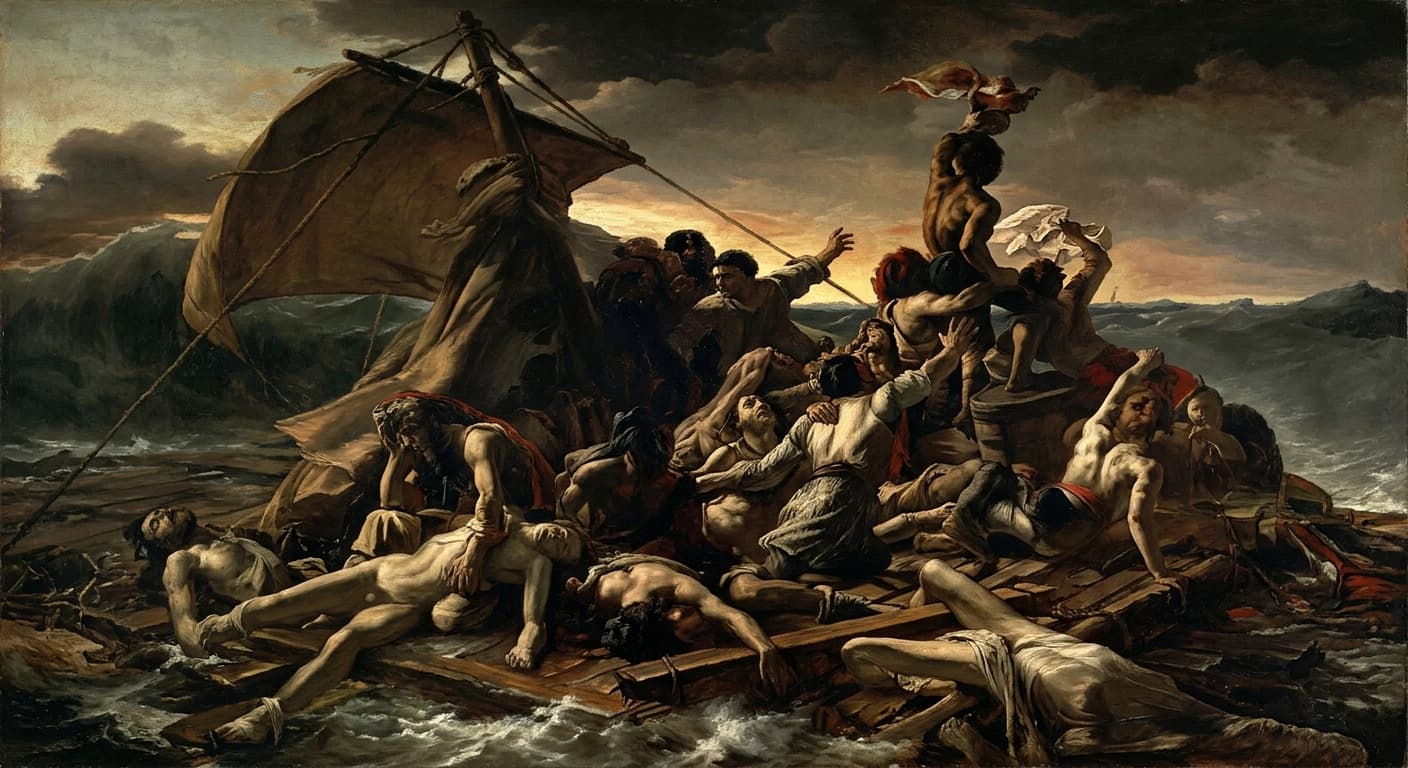
If you wander the vast, gilded halls of the Louvre in Paris, you will inevitably stumble upon one of the most arresting and visceral images of the 19th century: Théodore Géricault’s masterpiece, The Raft of the Medusa. The massive canvas depicts a tangled, desperate mass of dying men atop a battered wooden raft, straining to reach out toward a tiny, almost invisible ship on the horizon. While the painting stands today as a triumph of French Romanticism, the true story behind the brushstrokes is far more horrifying. It is a tale of astonishing incompetence, political corruption, and the absolute darkest depths of human desperation.
In June 1816, the French frigate Méduse set sail for the port of Saint-Louis in Senegal. Following the final defeat of Napoleon Bonaparte, the British were returning Senegal to the newly restored French monarchy. To lead this critical diplomatic and military mission, the French crown appointed Viscount Hugues Duroy de Chaumareys as the ship's captain. There was just one massive, glaring problem: de Chaumareys was a wealthy aristocrat who had not commanded a ship—or even been to sea—in twenty years. He was the ultimate "nepotism hire," granted command entirely due to his royalist sympathies rather than his maritime competence.
Almost immediately, the captain’s arrogant ignorance clashed with reality. Ignoring the advice of his seasoned officers, de Chaumareys insisted on navigating by the amateur calculations of a civilian passenger. Driven by a desire to reach Senegal in record time, he sailed the Méduse recklessly close to the treacherous African coastline. On July 2, 1816, the inevitable happened: the frigate violently ran aground on the Arguin Bank, a notorious, shallow sandbank off the coast of modern-day Mauritania.
Realizing the ship could not be freed and was slowly breaking apart in the waves, the crew began to evacuate. However, there was a fatal flaw in the escape plan. The Méduse carried 400 people, but the ship's six lifeboats could only comfortably hold about 250. To compensate, a massive wooden raft was hastily constructed from the ship's timbers. Roughly 65 by 23 feet, this unwieldy platform was dubbed "La Machine." It was decided that 147 soldiers, sailors, and lower-class passengers would board the makeshift raft, which would then be safely towed to the African coast by the lifeboats carrying the captain, the politicians, and the wealthy dignitaries.
As soon as the evacuation began, sheer cowardice took hold. The heavily laden raft sat dangerously low in the water, dragging the lifeboats backward and slowing their progress. Fearful that the desperate men on the raft would pull them under, the elite officers in the lifeboats made a devastating and unforgivable choice: they cut the tow ropes. Captain de Chaumareys and his privileged passengers sailed away to the safety of the coast, intentionally abandoning 147 souls to the unforgiving Atlantic Ocean with only a single bag of ship's biscuit, two casks of water, and several casks of wine.
What followed on the raft was a rapid descent into pure, unimaginable hell. By the very first night, twenty men had been swept away by the churning sea or violently crushed between the shifting logs of the raft. By the second night, terrified and drunken soldiers mutinied against their officers, leading to a brutal, bloody melee of swords and bayonets in the pitch black. Within a week, starvation severely set in. Those who survived the initial violence were forced to commit the unthinkable, turning to cannibalism to stay alive. As days turned into a blur of madness and despair, the strong began actively tossing the weak, wounded, and dying into the ocean to conserve the meager rations of wine.
On July 17, after thirteen grueling days adrift, the raft was accidentally spotted by the Argus, a sister ship from the original convoy. The rescue crew was met with a scene out of a nightmare. Of the original 147 people placed on the raft, only 15 remained alive—and five of them were so frail they would die shortly after reaching land. The survivors were emaciated, sun-scorched, and psychologically shattered by what they had done and witnessed.
When news of the disaster eventually reached France, the restored Bourbon government attempted a massive cover-up to protect the monarchy's fragile reputation. However, two brave survivors—surgeon Henri Savigny and engineer Alexandre Corréard—refused to be silenced. They published a terrifying, unfiltered account of the ordeal that sparked a monumental, international scandal. Their testimony exposed the fatal consequences of prioritizing aristocratic privilege over merit, sending shockwaves through French society. Today, the tragedy of the Méduse remains a stark historical reminder of the deadly cost of hubris, forever immortalized on canvas as a harrowing warning to the ages.