The QWERTY Conundrum: How a 19th-Century Jammed Machine Shaped the Digital World
Look down at your hands, or at the screen you are using to read this. The arrangement of letters on your keyboard makes absolutely no sense. The most common letters are scattered, and your fingers are forced to perform awkward acrobatics to type even the simplest sentences. Why do we start with Q-W-E-R-T-Y? To solve this everyday mystery, we have to travel back to the late 1860s and look at a clunky, deeply flawed 19th-century invention that accidentally locked in the future of human communication.
The story begins with Christopher Latham Sholes, a printer, newspaper editor, and politician from Milwaukee, Wisconsin. In 1867, Sholes, alongside his colleagues Carlos Glidden and Samuel W. Soule, was tinkering with a machine designed to automatically number the pages of books and tickets. During their experiments, they realized that the mechanical concept could be expanded beyond numbers to print the entire alphabet. The trio quickly pivoted, setting out to build a machine that could print words faster than a person could write them with a pen.
Their early prototypes were bizarre contraptions. The first models looked and operated much like small pianos. They featured a row of black and white keys, and the letters were arranged alphabetically. A, B, C, D, E... It made perfect logical sense. Anyone walking up to the machine for the first time could easily find the letter they were looking for. However, this intuitive layout harbored a fatal mechanical flaw that would plague the inventors for years.
The early typewriter relied on a complex system of metal arms, known as typebars. When a key was pressed, its corresponding typebar would swing upward, strike an ink-soaked ribbon, and imprint the letter onto the paper. But there was a massive problem with the alphabetical layout: if a typist pressed two neighboring keys in rapid succession, their typebars would collide mid-air and jam together. Untangling these jammed, ink-covered metal arms was a messy, frustrating, and time-consuming nightmare.
Sholes realized that to make his machine commercially viable, he had to solve the jamming problem. He partnered with Amos Densmore, an educator, and began to study the frequency of letters and letter pairings in the English language. They noticed that common pairings—like "S" and "H", or "T" and "H"—were physically too close together on the alphabetical keyboard. To fix this, Sholes began to deliberately scatter these common pairings across the keyboard, physically separating the mechanical arms that were most likely to swing at the same time.
Another crucial influence came from telegraph operators. In the late 19th century, telegraph operators were the very first beta-testers of the typewriter. They needed a machine that could keep up with the incoming barrage of Morse code. Letters that often sounded similar in Morse, and were frequently confused, were moved closer together on the keyboard to allow for split-second corrections. Through years of trial, error, and feedback from these early operators, the logical alphabetical layout morphed into the seemingly chaotic arrangement we know today.
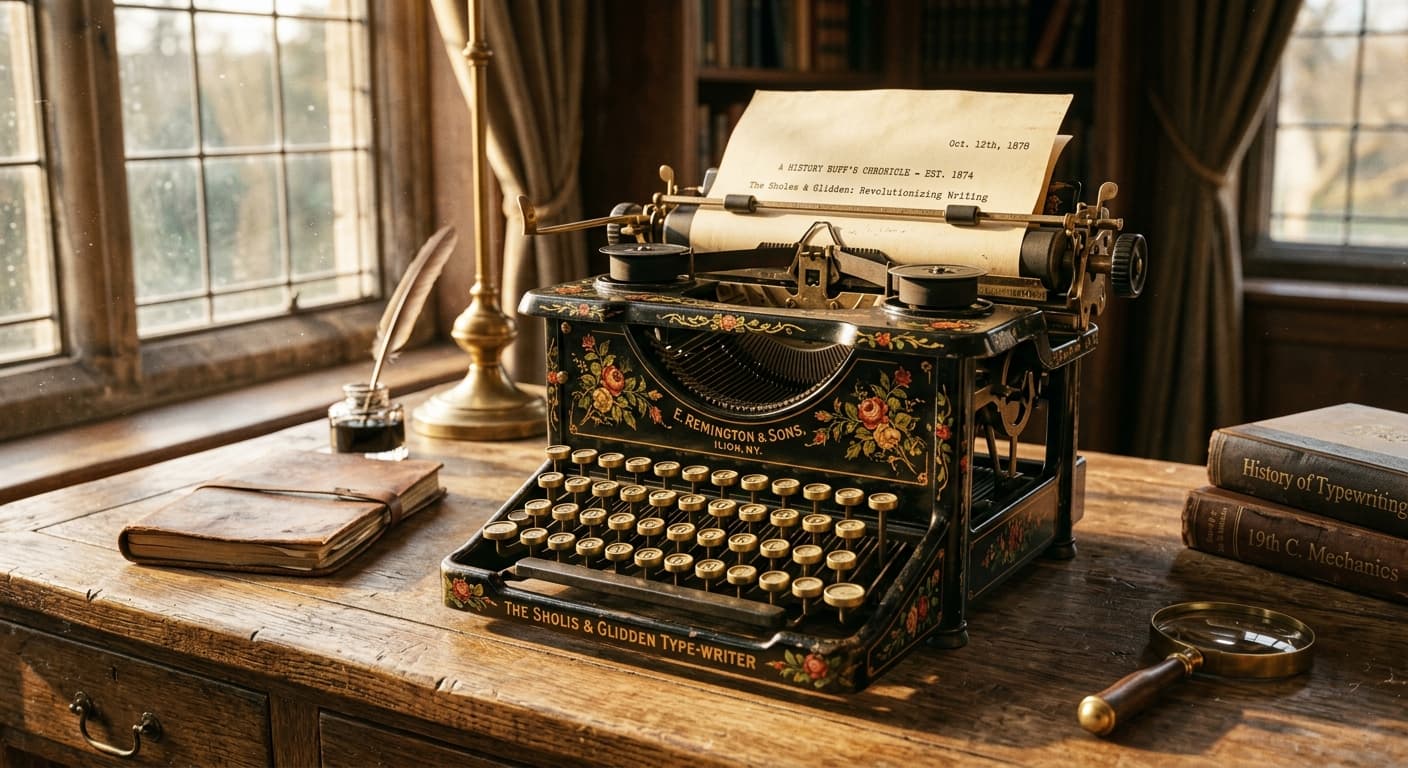
Exhausted by years of tinkering and lacking the massive capital required for mass production, Sholes eventually sold the rights to his invention. In 1873, the design was acquired by E. Remington and Sons, a New York-based company famous for manufacturing sewing machines and firearms. The following year, they released the "Sholes and Glidden Type-Writer." It was an extravagant, heavy machine adorned with hand-painted floral motifs, and it was the very first product to feature the QWERTY keyboard layout. It typed only in uppercase and was notoriously expensive, but it caught the eye of a famous early adopter: author Mark Twain. Twain famously purchased one, later claiming that his masterpiece, The Adventures of Tom Sawyer, was the very first book ever submitted to a publisher as a typed manuscript.
Beyond its mechanical quirks, the typewriter became an incredibly powerful agent of social change. Before its invention, clerical and office work was an almost entirely male-dominated field. The typewriter cracked that ceiling, opening the door for millions of women to enter the corporate workforce. In fact, in the late 19th century, the female clerical workers were actually referred to as "typewriters," sharing the name of the revolutionary machines they operated.
Today, the mechanical necessity for the QWERTY layout has vanished. Typeballs, daisy wheels, and digital touchscreens made the concept of "jamming typebars" a relic of the distant past. Tech engineers have created dozens of alternative, highly efficient layouts, such as the Dvorak keyboard, designed specifically for speed and ergonomics. Yet, none have been able to dethrone QWERTY. The muscle memory of the world had already been set in stone. Christopher Latham Sholes died in 1890, never fully realizing that his quirky, anti-jamming layout—born out of a desperate need to fix a broken, 19th-century machine—would one day dictate how billions of people interact with computers, smartphones, and the digital universe.