The Glorious, Doomed Sprint: How the Pony Express Conquered America and Died in 18 Months
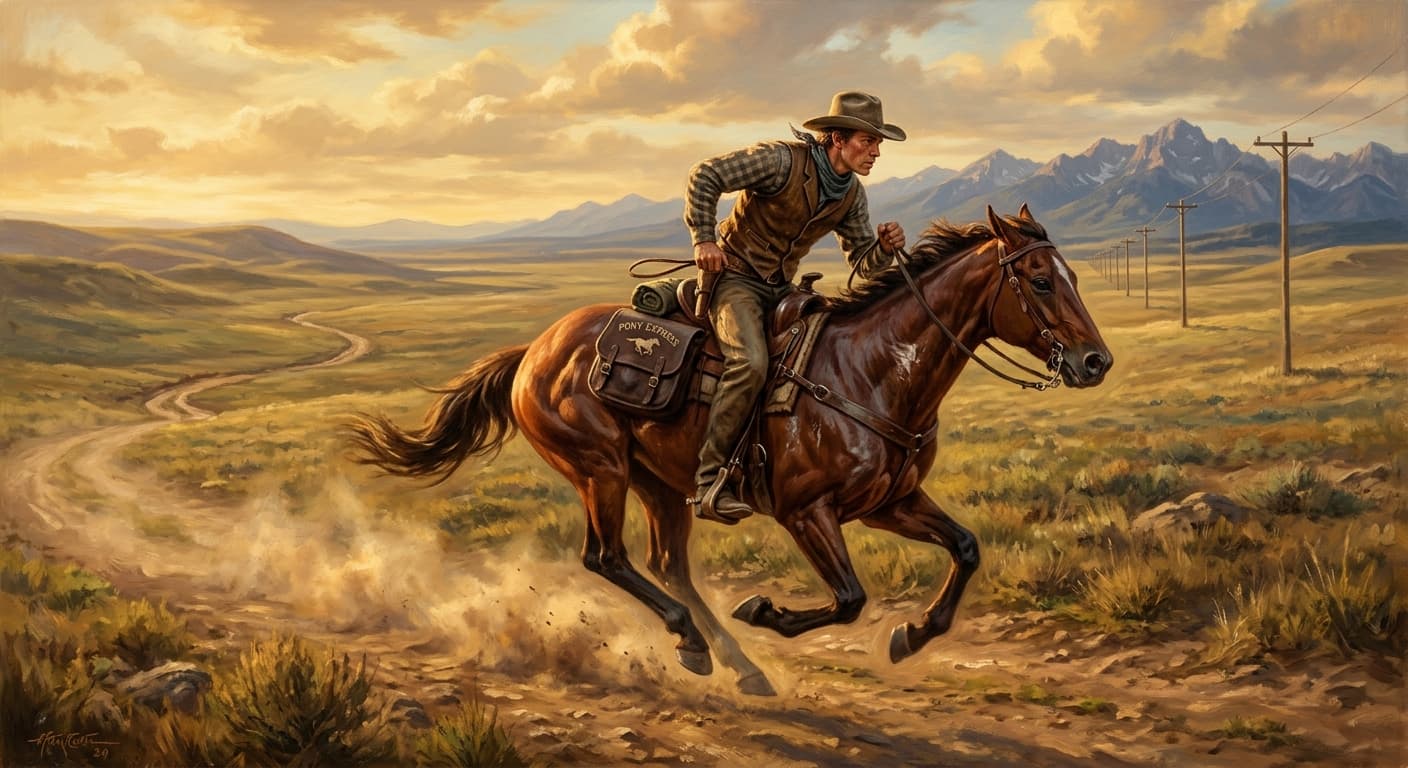
When you picture the American West in the mid-19th century, a few iconic images immediately spring to mind: the creaking covered wagon, the grizzled gold prospector, and, undeniably, the solitary rider of the Pony Express, galloping desperately across the plains. It is an institution burned into the mythology of the United States. Yet, if you were to ask the average person how long this legendary mail service actually operated, they might guess a decade. Perhaps two?
The stunning reality is that the Pony Express existed for a mere 18 months. It was a spectacular, breathtakingly audacious flash in the pan—a colossal financial disaster that managed to etch itself into history precisely because of its doomed, romantic brilliance.
In the spring of 1860, America had a massive geography problem. California had recently exploded in population and wealth thanks to the Gold Rush, yet it remained wildly disconnected from the East Coast. Sending a letter from New York to San Francisco meant loading it onto a steamship down to Panama, dragging it across the isthmus, and shipping it back up the Pacific coast—a journey that could take an agonizingly long month. The overland stagecoach wasn’t much better, grinding through the dust over a grueling 24-day trek. With the clouds of the American Civil War gathering on the horizon, the federal government desperately needed rapid communication with its westernmost state.
Enter three ambitious freighting magnates: William H. Russell, Alexander Majors, and William B. Waddell. They proposed a radical, almost absurdly simple solution. Instead of heavy, lumbering wagons, they would use a massive, synchronized relay system of solitary riders on fast horses, sprinting day and night across 1,900 miles of unforgiving terrain from St. Joseph, Missouri, to Sacramento, California.
The logistical execution of this vision was nothing short of miraculous. In just a few months, the trio's company built nearly 160 relay stations spaced 10 to 15 miles apart—roughly the maximum distance a horse could gallop at full speed before exhaustion set in. They purchased 400 of the finest, fastest horses available and hired 80 of the toughest, lightest riders they could find. Legend has it that one newspaper advertisement famously laid out the grim reality of the job: "Wanted: Young, skinny, wiry fellows not over eighteen. Must be expert riders, willing to risk death daily. Orphans preferred."
To maximize speed, every single ounce of weight was meticulously scrutinized. The riders carried almost no weapons, typically relying on the sheer speed of their mounts to escape hostile forces. The mail itself was not carried in heavy saddlebags, but in a specialized leather blanket called a mochila. This ingenious device draped directly over the saddle and was held in place by the rider's weight. When a courier thundered into a relay station, he would leap from his exhausted horse, tear the mochila off the saddle, throw it onto a fresh, waiting horse, and be back on the trail in less than two minutes.
The physical results of this system were staggering. The Pony Express slashed the transcontinental communication time down to an unprecedented 10 days. The riders braved blinding blizzards, scorching desert heat, and the very real dangers of the Paiute War. In March 1861, they achieved their crowning glory by delivering President Abraham Lincoln’s inaugural address to California in an astonishing 7 days and 17 hours—a speed record that remains deeply impressive for an era entirely reliant on muscle, bone, and willpower.
But underneath the thundering hooves, the business was quietly bleeding out. The overhead costs of maintaining 160 remote stations, hauling water to desert outposts, feeding hundreds of horses, and paying riders were astronomical. To offset these costs, the company initially charged $5 for every half-ounce of mail—the rough equivalent of over $160 today. Even at that exorbitant price, it simply wasn’t enough to turn a profit.
The true killer of the Pony Express, however, wasn't economics, weather, or bandits. It was the unrelenting, silent march of technology. Even as the riders were setting speed records, construction crews were busy planting wooden poles and stringing thin wires across the very same plains. The Pacific Telegraph Act of 1860 had subsidized the construction of a transcontinental telegraph line. Day by day, the wire crept westward, slowly but surely closing the gap that the riders were paid to gallop across.
On October 24, 1861, the eastern and western telegraph lines were finally spliced together in Salt Lake City, instantly bridging the continent with the speed of an electron. Two days later, the Pony Express officially announced its closure. Russell, Majors, and Waddell were left financially ruined by their grand experiment.
In the end, the Pony Express was a beautiful, desperate bridge between the age of horsepower and the dawn of the electrical era. It failed completely as a sustainable business venture, yet it succeeded wildly as an American legend, forever freezing in time the romantic image of a lone rider racing against the dying of an era.