The Pharaoh's Freight: The Harrowing 19th-Century Voyage of Cleopatra's Needle
The 19th century was an era defined by a ravenous appetite for the ancient world. Spurred by Napoleon's campaigns and the subsequent deciphering of the Rosetta Stone, a wave of "Egyptomania" swept through Europe. Victorian society was utterly obsessed with mummies, pyramids, and sphinxes. But there was one piece of antiquity that the British Empire coveted above all else: a genuine Egyptian obelisk. Getting it to London, however, would require one of the most absurd and perilous engineering feats of the era.
The monument in question is known today as Cleopatra's Needle, though the name is a historical misnomer. The towering red granite obelisk was actually commissioned by Pharaoh Thutmose III around 1450 BCE, well over a millennium before Cleopatra was even born. In 1819, the ruler of Egypt, Muhammad Ali Pasha, gifted the 224-ton, 68-foot-tall monolith to the British government to commemorate Lord Nelson's victory at the Battle of the Nile. It was an incredibly generous gesture, but it came with a colossal catch: the British had to figure out how to transport it themselves.
For decades, the priceless antiquity simply sat buried in the Alexandrian sand. The sheer cost and logistical nightmare of moving a 224-ton rock across the Mediterranean and the Atlantic deterred every proposed scheme. It wasn't until 1877 that a wealthy anatomist named Sir Erasmus Wilson pledged a staggering £10,000 to fund the transport, and an ingenious civil engineer named John Dixon devised a plan so crazy it just might work.
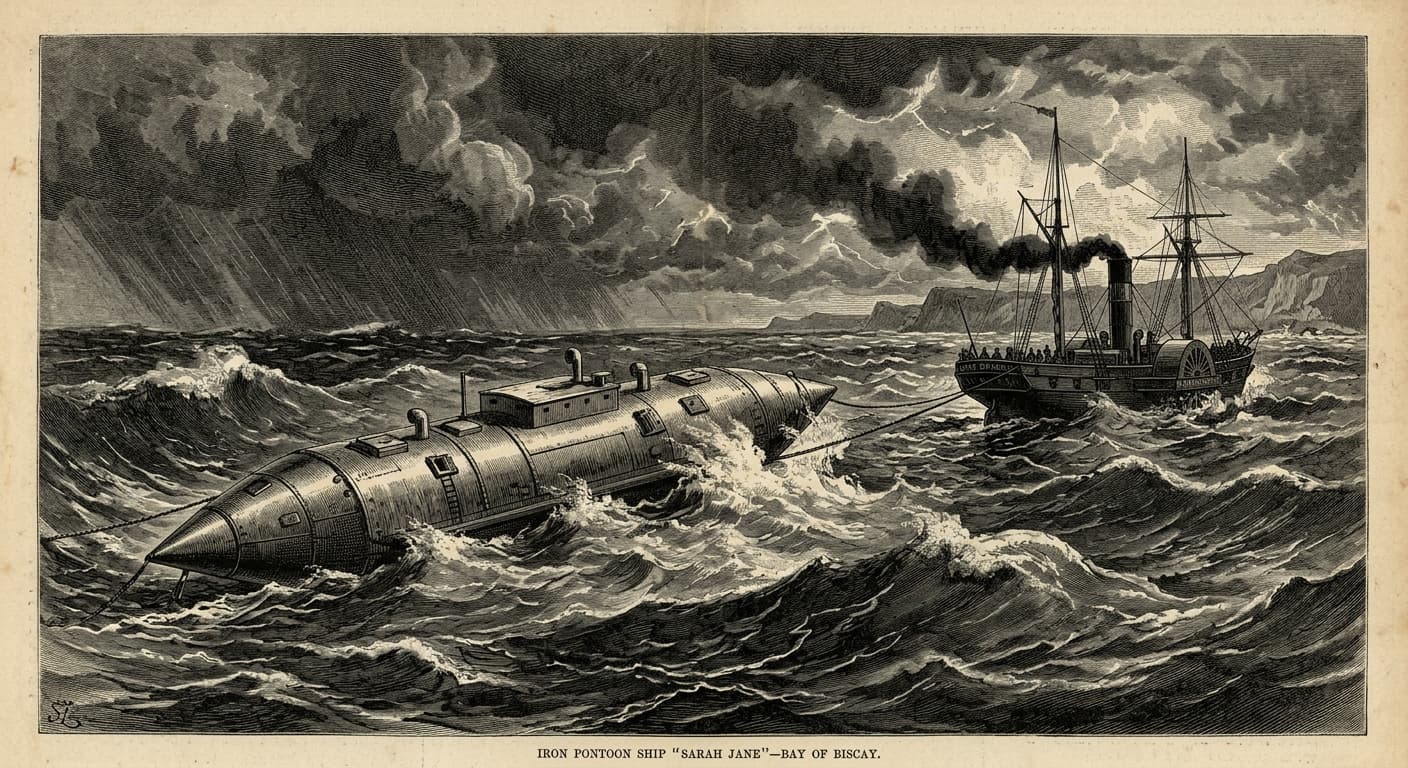
Dixon realized that hoisting the obelisk onto a conventional ship would be virtually impossible and would likely break the vessel's back. Instead, he decided to build a ship around the monument. Workers in Alexandria meticulously dug out the obelisk and encased it in a massive, cigar-shaped iron cylinder measuring 92 feet long. Once the monolith was sealed safely inside, they rolled the massive iron tube directly into the sea. Dixon then fitted the cylinder with a rudder, a small deck, a mast, and a tiny cabin for a crew of six. He christened this bizarre, Frankenstein-esque pontoon the Cleopatra.
The plan was to tow the Cleopatra behind a conventional steamship, the Olga, all the way to London. The voyage began in September 1877 and proceeded relatively smoothly until mid-October, when the ships entered the notoriously treacherous Bay of Biscay off the coast of France. A ferocious storm descended upon them, whipping the sea into a frenzy. The Cleopatra began to roll violently in the massive waves, its heavy cargo threatening to tear the iron shell apart.
In a desperate bid to save the pontoon's crew, the captain of the Olga sent out a rescue boat with six volunteer sailors. Tragically, the small wooden boat was quickly capsized by the monstrous waves, and all six men drowned. Eventually, the Olga managed to maneuver close enough to pull the Cleopatra's terrified crew aboard, but the heavy tow rope had to be cut. The custom-built pontoon, carrying its priceless ancient cargo, was abandoned to the raging sea.
When the Olga arrived in England bearing the tragic news, the British public mourned both the lost sailors and the sunken monument. But the obelisk wasn't at the bottom of the ocean. Miraculously, the airtight iron tube had stayed afloat. Days later, a passing Spanish trawler spotted the bizarre metal cylinder bobbing aimlessly in the Atlantic. A Scottish steamer soon arrived, captured the rogue antiquity, and towed it to a port in Spain, kicking off a fierce, months-long maritime salvage dispute.
After intense legal wrangling and a hefty payout of £2,000 to the salvagers, the Cleopatra was finally towed to the River Thames in January 1878. The obelisk was eventually erected on the Victoria Embankment, where it still stands today, flanked by two bronze sphinxes. In a classic Victorian blunder, the sphinxes were installed facing the monument rather than guarding it—an embarrassing mistake that remains uncorrected to this day.
To cement the obelisk's place in the 19th century, the Victorians buried a highly eccentric time capsule beneath its pedestal. Alongside standard items like a complete set of British coins, a translation of the obelisk's hieroglyphics, and daily newspapers, they included a box of hairpins, a baby bottle, a model of a hydraulic jack, and—perhaps most curiously—photographs of the twelve "best-looking Englishwomen of the day."
Today, Cleopatra's Needle bears the physical scars of German shrapnel from a World War I bombing raid, but its continued survival is a testament to its incredible journey. It stands not only as a marvel of the ancient world but as an enduring monument to the audacity, hubris, and relentless engineering spirit of the 19th century.