The Phantom Planet: How a 19th-Century Ghost World Baffled Astronomers
In the grand annals of scientific history, there are few tales as fascinating—and humbling—as the decades-long hunt for a planet that never actually existed. Welcome to the search for Vulcan, the ghost planet of the 19th century that captivated the world's greatest minds and sent astronomers on desperate, globe-trotting expeditions.
The story begins in the 1850s with a brilliant but famously arrogant French mathematician named Urbain Le Verrier. Le Verrier was already an international scientific celebrity, having recently achieved the impossible: he had predicted the existence and exact location of Neptune using nothing but mathematics and the observed wobbles in Uranus's orbit. Armed with Isaac Newton’s laws of gravitation, Le Verrier had essentially discovered a new world with his pen.
Looking for his next great triumph, Le Verrier turned his attention inward, toward our sun. For years, astronomers had been perplexed by the orbit of Mercury. The innermost planet didn't behave exactly as Newtonian physics dictated. Its perihelion—the point in its orbit closest to the sun—was shifting forward slightly more than the gravitational tugs from the other known planets could explain. The discrepancy was minuscule, but to a perfectionist like Le Verrier, it was a glaring flaw in the celestial mechanical clockwork.
Applying the exact same logic that had led him to Neptune, Le Verrier confidently announced his solution in 1859. There had to be another, undiscovered planet—or perhaps a ring of asteroids—orbiting between Mercury and the sun. The gravitational pull of this hidden mass was the culprit behind Mercury's orbital wobble. He named this theoretical world "Vulcan," after the Roman god of fire and the forge, a fitting moniker for a planet orbiting so close to the solar inferno.
Almost immediately, Le Verrier received a letter from a French country physician and amateur astronomer named Edmond Modeste Lescarbault. The doctor claimed that months earlier, he had witnessed a distinct, perfectly round black dot transiting the face of the sun. Intrigued but skeptical, Le Verrier took a train to Lescarbault’s rural home to interrogate him in person.
The physician’s observatory was notoriously crude; he recorded his observations on a wooden plank and timed them with a simple pendulum clock. Yet, after aggressively grilling the man and reviewing his rudimentary calculations, Le Verrier was convinced. He triumphantly announced the discovery of Vulcan to the world, and Lescarbault was rapidly awarded the prestigious Legion of Honor.
There was just one glaring problem: Vulcan refused to be seen again.
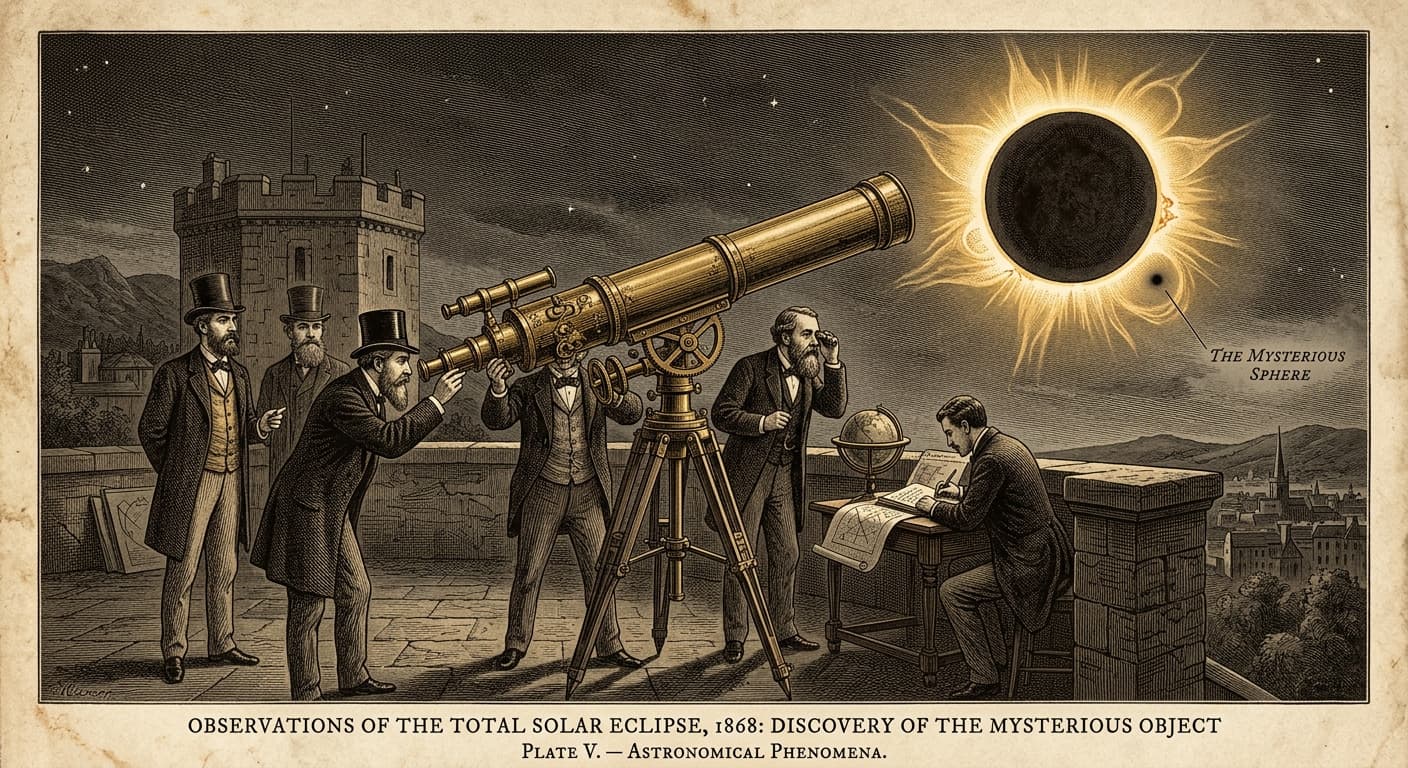
Because of its supposed proximity to the sun, Vulcan could only be spotted during a transit across the solar disc or during a total solar eclipse, when the blinding light of the sun was temporarily blocked. This kicked off a half-century of intense, high-stakes astronomical hunts. Throughout the latter half of the 19th century, professional astronomers mounted expensive, perilous expeditions to far-flung corners of the globe—from the sweeping plains of Wyoming to the remote islands of the Pacific—chasing total solar eclipses in the frantic hope of photographing Vulcan.
During the Great Eclipse of 1878, two highly respected American astronomers, James Craig Watson and Lewis Swift, separately claimed to have spotted the elusive world. Their reports sent shockwaves through the scientific community. Textbooks were updated, and charts of the solar system were redrawn to include Vulcan as the official first planet from the sun. But whenever other astronomers tried to verify these sightings during subsequent eclipses, the skies turned up empty. The mysterious dots Watson and Swift had seen were likely just background stars.
As the 19th century bled into the 20th, the mystery of Mercury's wobble remained unresolved, and the existence of Vulcan grew increasingly doubtful. The ghost planet had become an embarrassment to the astronomical community.
The final nail in Vulcan's coffin didn't come from a telescope, but from the mind of a young patent clerk named Albert Einstein. In 1915, Einstein presented his General Theory of Relativity, fundamentally rewriting the laws of physics. Einstein proved that gravity was not a pulling force across a distance, as Newton had theorized, but rather a warping of spacetime itself. Because Mercury was so massive and so close to the sun, it was moving through deeply curved spacetime. When Einstein applied his new equations to Mercury's orbit, they predicted the planet's shifting perihelion with breathtaking, perfect accuracy.
No hidden planet was needed. Vulcan was entirely a phantom, a figment of Newtonian physics pushed past its breaking point.
Today, the story of Vulcan serves as a powerful reminder of how the scientific method works. Even the most brilliant minds can be led astray when looking at the universe through an incomplete lens. The 19th century's ghost planet may have vanished into the ether, but its absence ultimately helped us uncover the true, bending nature of the cosmos itself.