The Penny That Shook the World: How a Frustrated Teacher Invented the Postage Stamp
Imagine a world where receiving a letter is a financial burden. Today, we might dread opening a steep electric bill, but in the early 19th century, just receiving a simple written "hello" from a distant friend could cost a working-class citizen a full day's wages. Before 1840, the British Royal Mail operated on a system that seems utterly backwards to modern sensibilities: it was the recipient, not the sender, who paid for postage. This completely flawed business model created an administrative nightmare that ultimately sparked one of the most important, yet widely underappreciated, revolutions of the Victorian era.
In the 1830s, sending mail was a luxury reserved almost entirely for the wealthy. The Post Office calculated fees based on two confounding metrics: the distance the letter traveled and the number of sheets of paper it contained. Weight was entirely irrelevant. To make matters worse, because the recipient was expected to foot the bill upon delivery, the Post Office essentially operated on an honor system. If the postman arrived and the recipient couldn't—or wouldn't—pay, the letter was returned, and the Post Office had effectively transported a piece of paper across the country for absolutely nothing.
Naturally, the public found ingenious, if exhausting, ways to cheat the system. To avoid the multi-sheet fee, people employed a dizzying technique known as "cross-writing." A person would write a letter normally, horizontally across the page, and then turn the paper 90 degrees and write over the existing text vertically. If they had more to say, they might even write diagonally across the same page. Reading these ink-smudged spiderwebs required immense patience and a magnifying glass, but it saved a small fortune.
An even more devastating cheat involved the outside of the letter. Because recipients were allowed to inspect the folded paper before paying the postman, senders began hiding coded messages on the exterior. A specific scribble, a uniquely placed wax seal, or a deliberate misspelling of a name might secretly communicate, "I arrived safely," or "The baby is healthy." The recipient would glance at the letter, decode the hidden message, and then cheerfully tell the postman, "No, thank you, I refuse to pay for this." The Post Office was hemorrhaging money.
Enter Rowland Hill, an unassuming schoolmaster and inventor with a knack for solving systemic inefficiencies. Hill was not a politician, nor was he a postal worker. He was simply a frustrated outsider who recognized that the Post Office's pricing model was suppressing communication and stifling commerce. In 1837, Hill self-published a wildly influential pamphlet titled "Post Office Reform: Its Importance and Practicability."
In his pamphlet, Hill proposed a radical, almost unthinkable solution: a uniform rate of one penny to send a letter of up to half an ounce anywhere within the United Kingdom. Distance would no longer matter. Furthermore, the fee would have to be paid in advance by the sender, completely eliminating the costly problem of refused mail. To prove that the sender had paid, Hill suggested the use of a "bit of paper just large enough to bear the stamp, and covered at the back with a glutinous wash." He had just invented the postage stamp.
The British establishment was horrified. Lord Lichfield, the Postmaster General at the time, scoffed at the idea in Parliament, declaring, "Of all the wild and visionary schemes which I have ever heard of, it is the most extravagant." William Maberly, Secretary to the Post Office, confidently predicted that if the scheme were implemented, the revenue would not even cover the cost of operations. They believed that cheap mail would collapse the entire system.
However, they severely underestimated the power of the public. Hill's pamphlet became a runaway bestseller. Merchants, bankers, and ordinary citizens realized the immense economic and social benefits of cheap, reliable communication. The public organized mass petitions, flooding Parliament with demands for the "Penny Post." The pressure became so intense that the government was forced to capitulate.
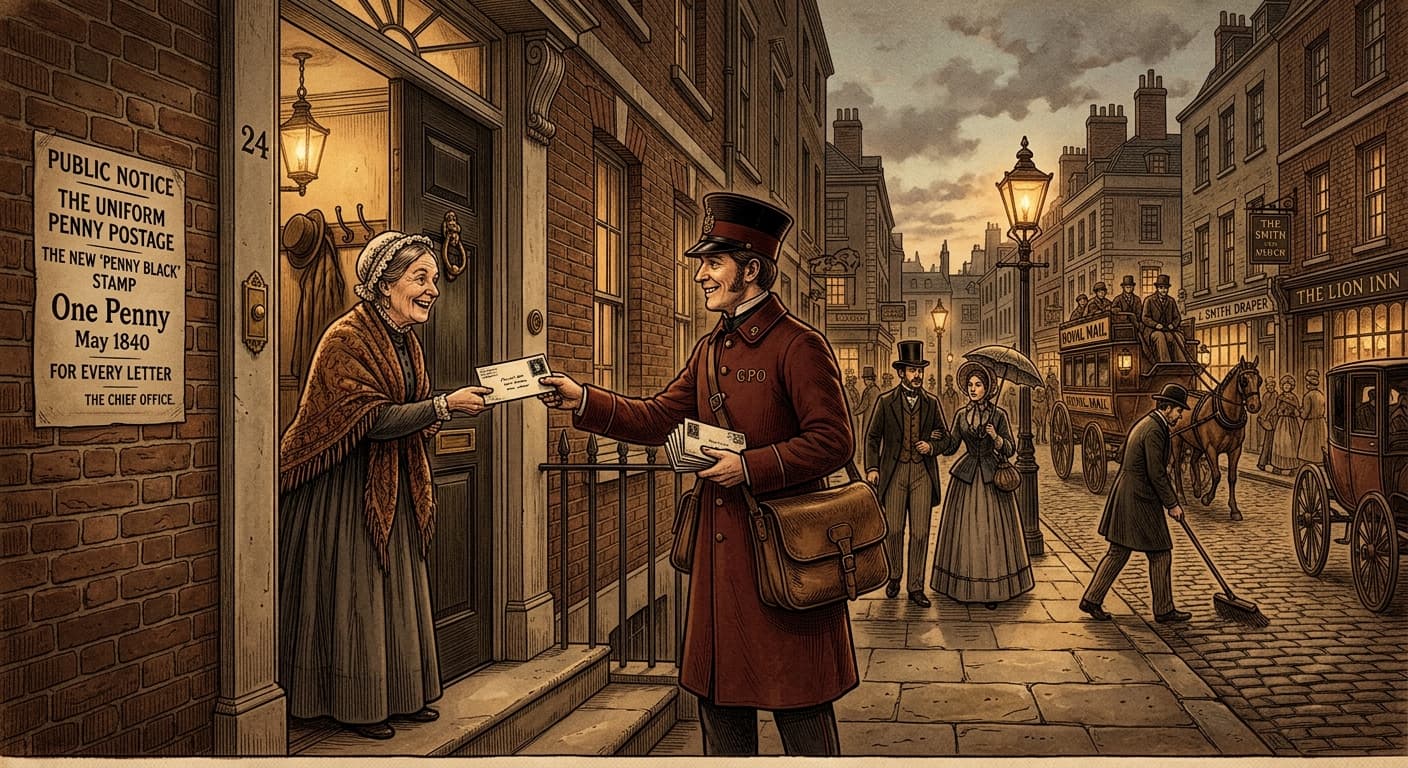
On May 1, 1840, the world’s first adhesive postage stamp was issued to the public, becoming valid for use on May 6. It featured a beautifully engraved profile of a young Queen Victoria against a dark background, earning it the enduring nickname: the "Penny Black." The effect was nothing short of explosive.
Overnight, the world shrank. In 1839, the year before the reform, the British public sent around 76 million letters. By 1850, that number had skyrocketed to nearly 350 million. The Penny Post democratized communication. For the first time in history, the working class could afford to stay in touch with loved ones who had moved away for work. It sparked the widespread tradition of sending Valentine's Day cards, birthed the mail-order catalog industry, and necessitated a brand-new architectural feature that we now take for granted: the mail slot in the front door, so the postman no longer had to wait for someone to answer.
Rowland Hill's stubborn crusade against a broken bureaucracy didn't just fix a struggling government department. It rewired the social fabric of the 19th century, laying the foundational infrastructure for the hyper-connected, globalized world we live in today. All for the price of a single penny.