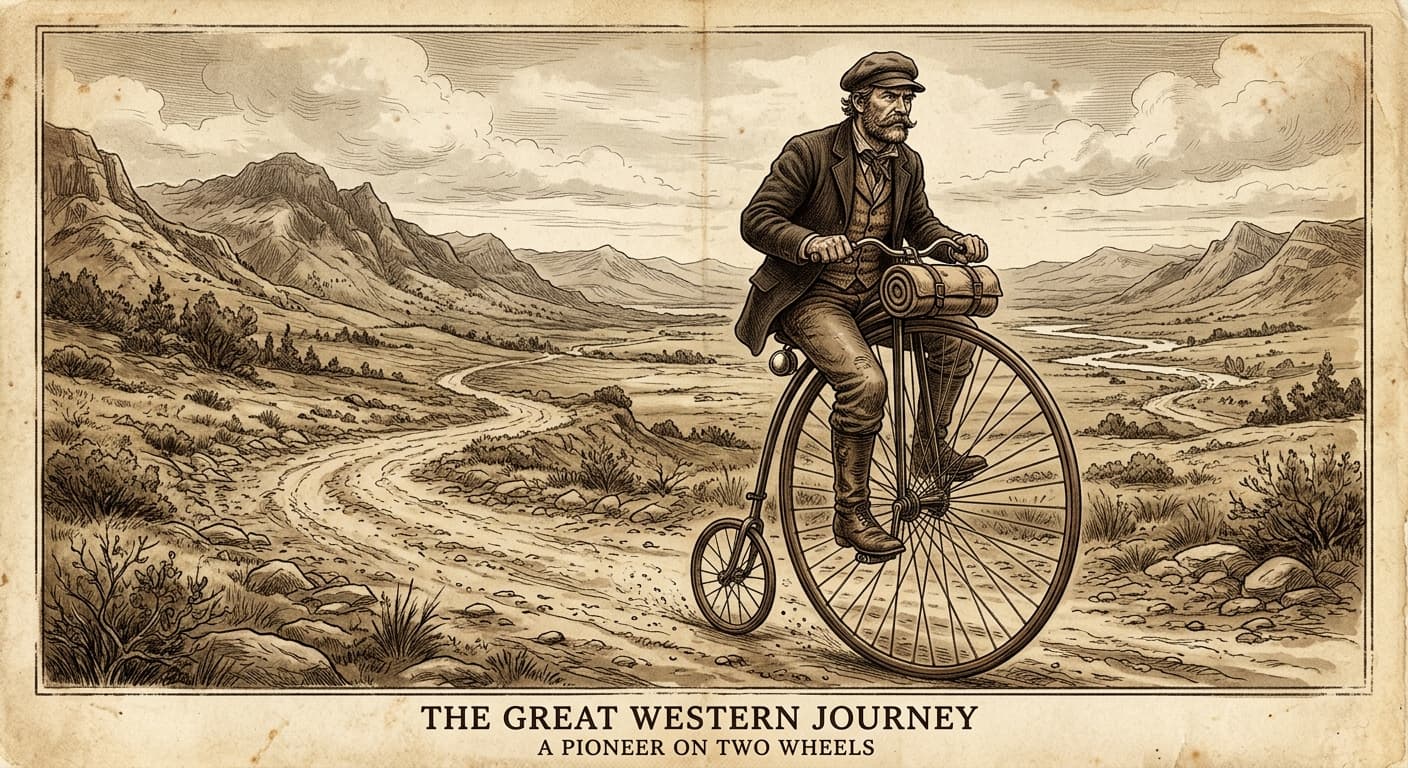
The Penny-Farthing Pioneer: How Thomas Stevens Bicycled Around the World
Imagine attempting to circumnavigate the globe on a bicycle today. Even with carbon-fiber frames, twenty-four gears, shock absorbers, and GPS navigation, it remains an incredibly grueling endeavor. Now, strip away all that modern technology. Remove the paved highways, the lightweight gear, and the concept of chain drives. Instead, picture yourself perched precariously atop a high-wheel "penny-farthing" bicycle, staring down a global journey of over 13,000 miles. In 1884, a man named Thomas Stevens did exactly that, embarking on one of the most audacious and forgotten adventures of the 19th century.
Born in England but living as a young immigrant in America, Thomas Stevens was an unassuming twenty-nine-year-old former miner who possessed a boundless appetite for adventure. In early 1884, he purchased a black-enameled Columbia Standard penny-farthing. The contraption was a marvel of Victorian engineering but a nightmare of ergonomics, featuring a massive fifty-inch front wheel and a tiny trailing rear wheel. With no suspension, hard rubber tires, and pedals directly attached to the front axle, every bump in the road was transferred directly to the rider's spine—earning these early bicycles the aptly grim nickname, "boneshakers."
Equipped with an oversized sense of optimism, Stevens packed extraordinarily light. He carried only a spare pair of socks, a spare shirt, a raincoat that doubled as a tent, a pocket revolver, and a sleeping roll. On April 22, 1884, he set off from San Francisco, heading east. The American West at this time was completely devoid of anything resembling a highway. Stevens spent the majority of his cross-country journey riding between the rails of the transcontinental railroad, vibrating over the wooden ties. He dodged oncoming trains, slept under the stars, fended off a mountain lion, and encountered Native American tribes who were entirely baffled by the strange man rolling past on a giant metal hoop.
After 103 grueling days, Stevens rolled into Boston. He had successfully completed the first documented transcontinental bicycle ride across the United States. For most men, this monumental achievement would have been enough. For Stevens, it was merely the warm-up act. Backed by Outing magazine, which agreed to fund the rest of his journey in exchange for serialized dispatches, Stevens boarded a steamer for England to begin the global leg of his odyssey.
Europe proved to be an absolute delight for the cyclist. He breezed through England, France, Germany, and the Austro-Hungarian Empire, enjoying relatively smooth roads and enthusiastic crowds. He was treated like a touring celebrity, with local cycling clubs often riding alongside him for miles. However, as he crossed the continent and entered the rugged terrain of the Balkans and the Ottoman Empire, the leisurely tour abruptly ended, and the true test of survival began.
In Anatolia, Stevens faced treacherous mountain passes and roads that were little more than rocky goat paths. He was routinely chased by feral dogs and confronted by heavily armed bandits. On one harrowing occasion, a group of highwaymen shot at him, but he managed to escape by out-pedaling them on a rare stretch of flat, hard-packed earth. Despite these dangers, his unusual mode of transport often acted as a diplomatic shield; many locals were so utterly bewildered by the giant wheel that their hostility quickly morphed into awe and curiosity.
Reaching Tehran at the onset of winter, Stevens was forced to halt his journey for several months. He spent the time as an honored guest of the Shah of Persia, who was utterly fascinated by the bicycle. When spring finally arrived in 1886, Stevens pushed eastward once more. His route took him through the unforgiving deserts of Afghanistan, where he was arrested and subsequently expelled by local authorities, forcing him to alter his course southward toward the British Raj.
The final stretch of his journey proved to be the most culturally and physically taxing. He traversed the length of India via the Grand Trunk Road, marveling at the vibrant landscapes while battling relentless heat. Continuing into China, he encountered his fiercest resistance yet. The sight of a foreigner atop a seemingly demonic machine sparked riots. Stevens was frequently pelted with stones and chased by furious mobs, forcing him to navigate the vast country under the constant threat of violence.
Salvation finally came when he reached Japan, a country he later described as a cyclist's paradise. The serene landscapes, polite locals, and relatively peaceful roads provided a triumphant and relaxing conclusion to his epic ordeal. In December 1886, Thomas Stevens boarded a steamship in Yokohama bound for San Francisco. He had traversed three continents and pedaled approximately 13,500 miles.
Stevens’ monumental feat was a testament to the sheer force of human endurance and the restless, boundary-pushing spirit of the 19th century. He had conquered the globe on a machine that most people could barely balance on, proving that the world was rapidly shrinking and that the golden age of individual exploration had reached a wildly inventive new frontier.