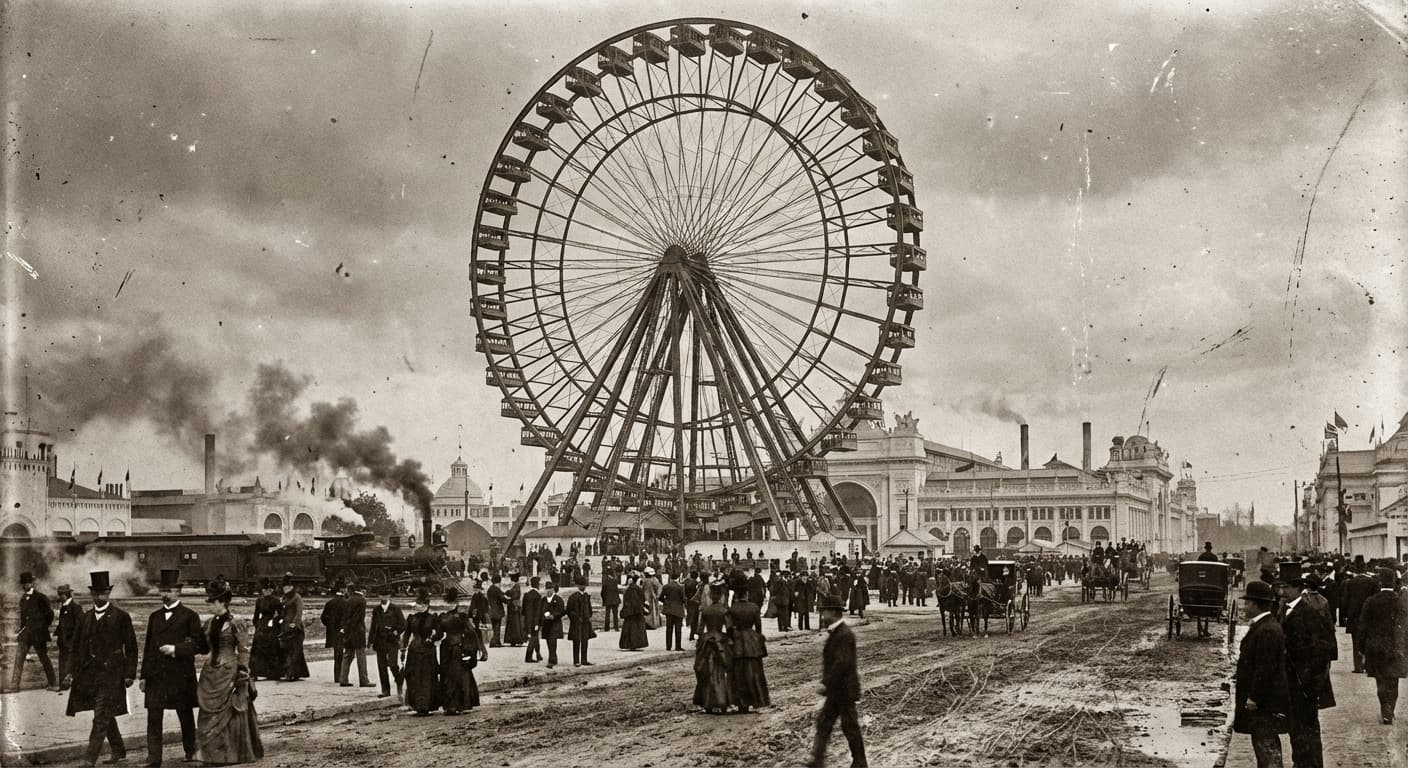
The Wheel That Challenged Paris: The High-Stakes Engineering of the Original Ferris Wheel
In the waning years of the 19th century, the United States was desperate to prove it had arrived on the global stage. The target of their ambition was the World's Columbian Exposition of 1893 in Chicago. While the fair promised to be a spectacular display of neoclassical architecture—dubbed the "White City"—the organizers faced a humiliating problem. Four years earlier, Paris had stunned the world with the Eiffel Tower, a wrought-iron marvel that redefined the limits of engineering. Chicago needed a monument that could not just match the French masterpiece, but surpass it in novelty and daring. The result was not a tower, but a movement: the world's first Ferris Wheel.
The call to action came from Daniel Burnham, the legendary architect and Director of Works for the fair. At a banquet for engineers and architects, Burnham chastised the crowd, complaining that their proposed towers were nothing more than derivative attempts to copy Eiffel. He demanded something unique, something that embodied the daring spirit of American industry. Sitting in the audience was George Washington Gale Ferris Jr., a 33-year-old bridge builder from Pittsburgh. Inspired by the tension spokes of a bicycle, Ferris sketched a design that seemed physically impossible: a rotating wheel of steel, 264 feet tall, capable of carrying thousands of passengers into the sky.
When Ferris presented his plans, the reaction was immediate and harsh. The fair’s committee dismissed him as a "man with wheels in his head." They argued that the structure would collapse under its own weight or crumple like a tin can in the "Chicago wind." The design relied on a relatively new concept for such a massive structure: tension. Unlike a rigid water wheel, the Ferris Wheel hung from its axle, supported by spoke rods that held the immense rim in place. Undeterred by the rejection, Ferris spent $25,000 of his own money to pay for safety studies and eventually secured a concession, though the delays meant he had to build the monster in the dead of a brutal Chicago winter.
The specifications of the "Chicago Wheel" remain staggering even by modern standards. The axle alone was a hollow forging of steel weighing 45 tons—at the time, the largest single piece of steel ever forged. The wheel carried 36 wooden cars, each the size of a Pullman railway carriage, fitted with plush velvet chairs and plate-glass windows. Each car could hold 60 people, giving the wheel a total capacity of 2,160 passengers at once. When the steam engines finally roared to life in June 1893, the skeptics were silenced. The wheel turned smoothly and silently, lifting visitors high above the soot and noise of the industrial city to view the shimmering white facades of the fairgrounds.
For the duration of the exposition, the Ferris Wheel was the undisputed king of the midway. It carried over 1.4 million passengers, each paying 50 cents—the same price as admission to the fair itself. It is widely credited with saving the exposition from financial ruin, generating enough profit to pull the organizers out of debt. Couples got married in the cars, dignitaries toasted with champagne at the apex, and for a few glorious months, George Ferris was the most famous engineer in America, having successfully outdone the Eiffel Tower in pure spectacle.
However, the story of the wheel, much like its creator, ended in tragedy. Despite the wheel's massive success, Ferris became embroiled in bitter litigation with the fair's organizers over his share of the profits. The stress and financial strain took a toll; his wife left him, and he contracted typhoid fever, dying alone and bankrupt in 1896 at the age of 37. The wheel itself suffered an ignoble fate. It was dismantled and moved to St. Louis for the 1904 World's Fair, but eventually fell into disuse. In 1906, deeming it an eyesore, demolition crews packed the base with dynamite. It took two attempts to kill the giant; on the second blast, the steel groaned and the once-mighty wheel crumpled into a twisted heap of scrap metal. Yet, Ferris’s legacy survived the dynamite. Today, from London to Singapore, giant observation wheels define city skylines, all owing their existence to the Pittsburgh engineer who dared to reinvent the horizon.