The Nile Duel: The Bitter Rivalry That Unlocked Africa's Greatest Mystery
For thousands of years, the source of the White Nile was the ultimate geographical holy grail. Egyptian pharaohs, Roman emperors, and the greatest minds of antiquity had all sought to map the origins of the world's longest river, only to be defeated by the vast, unforgiving expanse of the African continent. By the mid-19th century, this enduring mystery had become a fierce obsession for the British Empire, transforming cartography into a high-stakes, perilous blood sport. At the center of this Victorian frenzy were two men whose names would become inextricably linked—not just by their monumental discovery, but by a bitter, tragic rivalry that scandalized society.
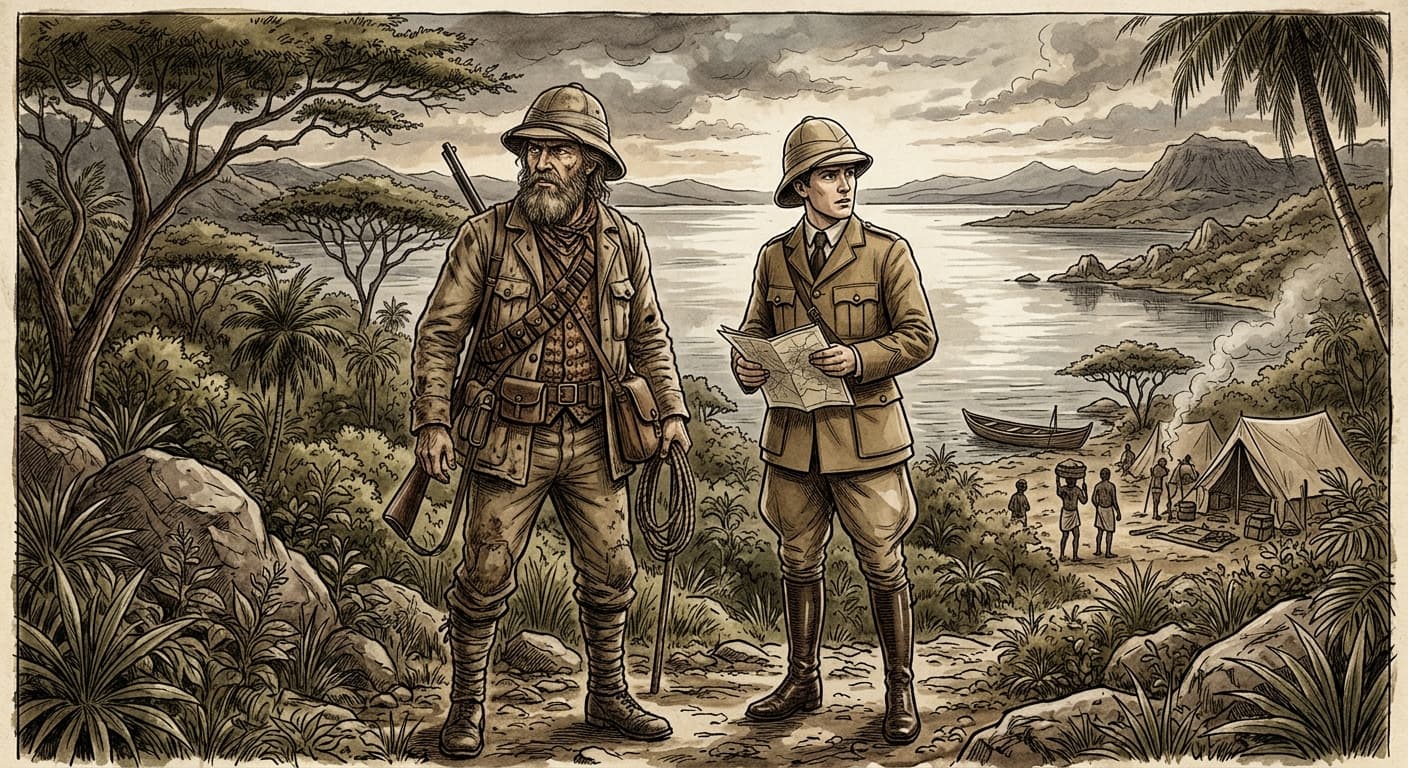
Captain Richard Francis Burton and John Hanning Speke were a study in absolute contrasts. Burton was the Victorian era's ultimate maverick—a brilliant, swaggering polyglot who reportedly spoke twenty-nine languages, a master swordsman, and an eccentric scholar who would later translate the Kama Sutra and The Arabian Nights. Speke, on the other hand, was the quintessential English aristocrat. Reserved, deeply ambitious, and strictly conventional, Speke was a military man and a passionate big-game hunter who possessed a rigid adherence to Victorian morals. Despite their fundamentally incompatible personalities, the Royal Geographical Society paired them up in 1856 for an unprecedented expedition to locate the elusive source of the Nile.
The journey began on the coast of Zanzibar in 1857 and quickly devolved into a masterclass in human suffering. As the expedition carved its way westward into the unmapped interior of East Africa, the men were continually hammered by malaria, dysentery, and exhausted supply lines. The terrain was brutal, and the physical toll was horrific. At one point, Speke suffered a terrifying ordeal when a local beetle crawled deep into his ear canal. In his desperate attempt to remove it with a penknife, he caused severe damage that led to temporary deafness. Shortly after, an aggressive ophthalmic infection left him temporarily blind. Burton fared no better; he was struck by a mysterious paralyzing illness and suffered from severely ulcerated legs that left him entirely unable to walk.
Despite the agony, in February 1858, the battered duo finally reached the magnificent shores of Lake Tanganyika. Burton, awestruck by the sheer size of the inland sea, was instantly convinced they had found the great prize. Speke, however, was highly skeptical. When Burton fell too ill to continue exploring, a recovering Speke took a small detachment and pushed northward, following local rumors of another massive body of water. On August 3, 1858, Speke stood before a vast, glittering expanse. He immediately christened it Lake Victoria, in honor of his sovereign, and intuitively deduced—without circumnavigating it or finding its northern outlet—that this was the true source of the Nile.
When Speke returned to camp and presented his theory, Burton dismissed it as unscientific guesswork and wishful thinking. This fundamental disagreement caused their simmering resentment to boil over into open hostility. The two men made a tenuous, uneasy pact to return to London and present their geographical findings together as a united front. However, Speke managed to return to England several weeks ahead of Burton. Breaking his promise, Speke rushed to the Royal Geographical Society, presented his findings, and claimed the lion's share of the glory for himself. By the time Burton finally arrived on British soil, Speke was the toast of London, and Burton was cast aside as a bitter, jealous also-ran.
The betrayal fractured the geographical world into feuding factions of "Burtonites" and "Spekeites." To settle the matter once and for all, the British Association for the Advancement of Science organized a grand public debate between the two men, scheduled for September 16, 1864, in the city of Bath. The Victorian public, always hungry for a scandal, salivated at the prospect of the two titans clashing on a public stage. The intellectual showdown promised to be the event of the decade, pitting Burton's eloquent rhetoric against Speke's steadfast stubbornness. But the showdown was never to be.
On the afternoon of September 15, the day before the highly anticipated debate, Speke went partridge hunting on a nearby country estate. While clumsily climbing over a low stone wall with his weapon, his shotgun discharged, firing a fatal blast directly into his chest. The news sent immediate shockwaves through the country. Burton, upon hearing of his bitter rival's death while waiting at the debate hall, was visibly shaken and reportedly wept for the man he had grown to despise. While the coroner quickly ruled the death a tragic accident, whispers of suicide—driven by Speke's alleged fear of facing the intellectually superior Burton and having his unverified claims torn apart—circulated through the parlors of London for decades.
In the end, subsequent expeditions by explorers like Henry Morton Stanley would ultimately prove that Speke's bold intuition had been largely correct; Lake Victoria is indeed the primary reservoir of the White Nile. Yet, the story of Burton and Speke remains one of the 19th century's most gripping tales of exploration. It is a stark, haunting reminder that the map of the modern world was drawn not just with compasses, sextants, and chronometers, but with unchecked ambition, broken promises, and the fragile, volatile nature of the human ego.