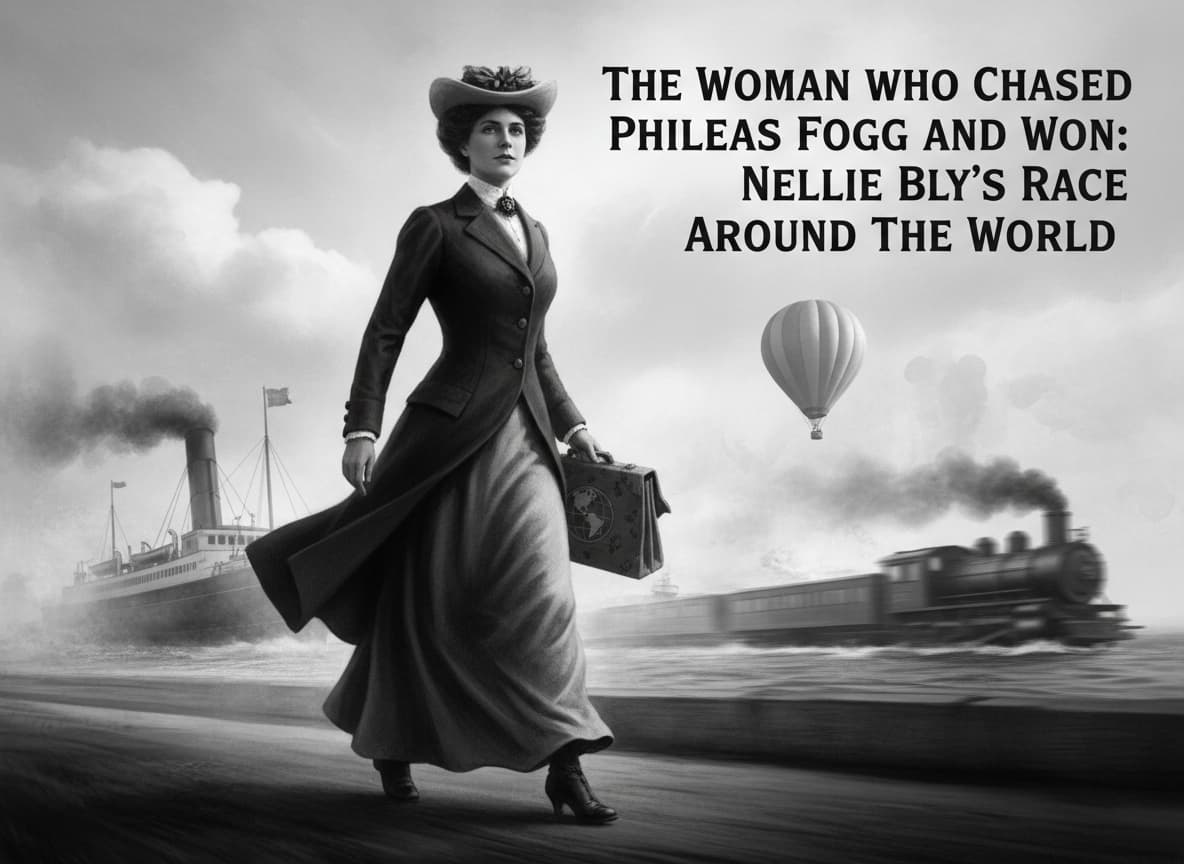
The Woman Who Chased Phileas Fogg and Won: Nellie Bly's Race Around the World
The clatter of steamships, the rumble of trains, the whir of rickshaws – these were the sounds of progress in the late 19th century, shrinking the globe for those daring enough to traverse it. But in 1889, a young woman, barely in her mid-20s, set out to not just traverse the globe, but to conquer it. Her name was Elizabeth Cochrane Seaman, better known by her pen name, Nellie Bly, and her audacious quest to circle the Earth faster than Jules Verne’s fictional Phileas Fogg would not only make her a legend but also redefine the limits of adventure and journalism.
Before she became the intrepid traveler, Nellie Bly was already a force to be reckoned with. Born in Pennsylvania, she began her career at the Pittsburgh Dispatch, challenging gender norms from the outset. Her move to New York City saw her join Joseph Pulitzer's New York World, where she pioneered "stunt journalism." Her most famous early exploit involved feigning insanity to get committed to Blackwell's Island Asylum, exposing its horrific conditions in a series of articles that led to significant reforms. Bly was not just reporting; she was experiencing, embodying the stories, and her fearless approach captivated the public.
The idea for her most famous adventure sparked from an unlikely source: a casual discussion inspired by Verne's Around the World in Eighty Days. Why not send a reporter to beat Fogg’s fictional record? The initial reaction from her editors at the World was typical of the era: a woman couldn't possibly undertake such a journey. It required too much baggage, too many chaperones, too many inconveniences. Bly, however, was undeterred. "Very well," she retorted, "start the man, and I'll start the same day for some other newspaper and beat him." Pulitzer, recognizing a golden opportunity and Bly’s indomitable spirit, finally relented.
On November 14, 1889, Nellie Bly boarded the Augusta Victoria, a steamer bound for Southampton, England. Her packing list was famously minimalist: a small satchel containing a change of underwear, toiletries, a few essentials, and a single dress – the one on her back. She carried most of her money in a pouch around her neck and had a New York World reporter's notebook. This wasn't a leisurely cruise; it was a race against time and against the very notion of what a woman was capable of.
Her journey was a whirlwind of steamships and trains. From England, she traversed Europe, making a crucial stop in Amiens, France, where she had the singular honor of meeting Jules Verne himself. The author, initially skeptical of her success, was charmed by her resolve and wished her well. Bly continued through the Suez Canal, across Ceylon (modern-day Sri Lanka), Singapore, Hong Kong, and Japan, always keeping a keen eye for stories and sending telegraph dispatches back to the World, which eagerly tracked her progress.
Unknown to Bly at the start, another American journalist, Elizabeth Bisland of Cosmopolitan magazine, had also embarked on a similar journey just hours after Bly, creating an unplanned, thrilling race. The public followed both women's progress with bated breath, fueling newspaper sales and igniting conversations about adventure and gender roles. Bly, however, remained blissfully unaware of her rival for most of the trip, focused solely on beating Phileas Fogg's fictional record.
After 72 days, 6 hours, 11 minutes, and 14 seconds, Nellie Bly arrived back in New Jersey on January 25, 1890, having circled the globe. She was met by roaring crowds, a brass band, and fireworks. The feat was a sensation, obliterating Fogg’s 80-day record and proving beyond doubt that a woman, traveling solo, with minimal fuss, could accomplish what was previously deemed impossible. She had not only traveled the world; she had captivated it.
Nellie Bly’s circumnavigation was far more than a stunt; it was a watershed moment in journalism and a powerful symbol of female empowerment. It showcased the nascent power of mass media to create global events and cemented "stunt journalism" as a legitimate, if sometimes controversial, reporting technique. More importantly, Bly demonstrated that women were capable of independence, bravery, and grand adventure, shattering prevailing Victorian stereotypes. Her legacy continues to inspire journalists and adventurers alike, a testament to the power of a daring spirit and a clear purpose, proving that sometimes, to make history, all you need is a ticket, a satchel, and an unshakeable will.