The Utopian Dreamer Who Built a Submarine to Save the Working Class
When we think of 19th-century submarine history, our minds usually drift toward the tragic, claustrophobic voyage of the H.L. Hunley during the American Civil War. We envision vessels of war, built to destroy blockades and sink enemy ships. But across the Atlantic, long before Jules Verne dreamed up Captain Nemo and the Nautilus in 20,000 Leagues Under the Sea, a brilliant, radically utopian Spaniard was building a submarine for an entirely different purpose: to save the lives of the working class.
His name was Narcís Monturiol, and his creation—the Ictíneo—remains one of the most astonishing and tragically overlooked engineering marvels of the Victorian era.
Born in 1819 in Figueres, Catalonia, Monturiol was not a naval architect, an engineer, or a military man. He was a lawyer, an anarchist, and a passionate follower of utopian socialism. Monturiol spent his early adulthood publishing radical pamphlets advocating for women’s rights, pacifism, and democratic ideals. His revolutionary activities eventually earned him the ire of the Spanish government, forcing him into exile in the remote coastal village of Cadaqués in the late 1850s.
It was here, gazing out at the Mediterranean, that Monturiol witnessed a tragedy that would change the course of his life. Cadaqués was a hub for coral divers, men who plunged into the crushing depths to harvest red coral for the jewelry trade. The work was brutal. Monturiol watched in horror as a diver drowned, and he witnessed the devastating effects of decompression sickness on the survivors. Driven by a deep empathy for these laborers, Monturiol decided that technology must be harnessed to protect them. He would build a ship that could safely explore the ocean floor.
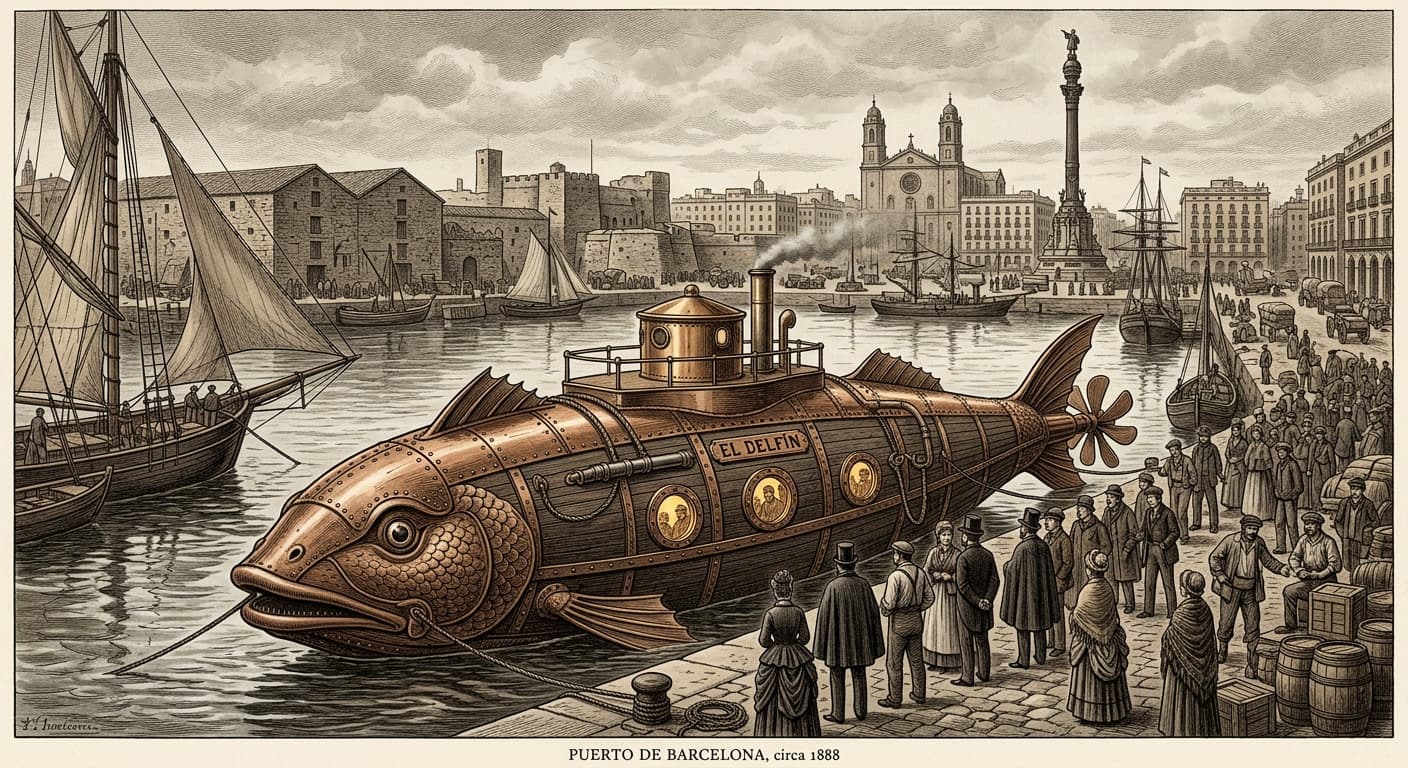
In 1859, after years of obsessive self-study and fundraising among his fellow radicals, Monturiol launched the Ictíneo I in the port of Barcelona. The vessel was a sight to behold. Shaped like a fish to mimic nature’s hydrodynamics, the submarine was constructed from olive and oak wood, sheathed in copper. It featured glass portholes, a sophisticated ballast tank system for diving and surfacing, and an interior chemical system to scrub carbon dioxide from the air. Powered by a crew of men cranking a propeller, the Ictíneo I made over 50 successful dives, astonishing crowds and proving that sustained underwater travel was possible.
However, Monturiol soon realized that human muscle was grossly insufficient for navigating ocean currents. He needed a larger vessel and a mechanical power source. Undeterred by the Spanish naval ministry’s refusal to fund his pacifist project, Monturiol turned to the people. In what might be considered one of the earliest examples of a successful crowdfunding campaign, he raised enough money from the citizens of Spain to build the Ictíneo II in 1864.
The Ictíneo II was a 46-foot-long leviathan, but it presented Monturiol with a seemingly impossible problem: how do you power a steam engine underwater without consuming all the oxygen and suffocating the crew?
Monturiol’s solution was nothing short of genius. He developed an anaerobic steam engine. He created a chemical reaction using a mixture of zinc, manganese dioxide, and potassium chlorate. When ignited, this mixture produced immense heat to boil water for the steam engine. But crucially, the chemical reaction also produced a byproduct: pure oxygen. Monturiol was effectively generating power and creating breathable air for his crew at the same time. He had cracked the code for air-independent propulsion, a concept that modern navies wouldn’t fully realize until the mid-20th century.
On October 22, 1867, the Ictíneo II successfully made its first underwater voyage powered by steam. It was an unparalleled triumph of engineering, born not from the military-industrial complex, but from the mind of a peaceful revolutionary trying to save coral divers.
Tragically, Monturiol's brilliant vision was undone by the mundane reality of economics. His crowdfunding money ran out, and his creditors came calling. In 1868, the Ictíneo II was seized, dismantled, and sold for scrap metal to pay off his debts. The incredible anaerobic steam engine was removed, and the wooden hull was ultimately destroyed. Monturiol returned to publishing and writing, eventually dying in obscurity and poverty in 1885.
Today, Narcís Monturiol is a national hero in Catalonia, though he remains largely unknown to the rest of the world. His story stands as a profoundly unique chapter of 19th-century history—a reminder that some of our greatest leaps in technology were driven not by the desire to conquer enemies, but by a visionary’s profound love for humanity.