The Tea-Drinking Tomboy Who Conquered Africa: The Unsinkable Mary Kingsley
When we picture the quintessential Victorian lady, a specific image usually comes to mind: corsets, fainting couches, polite parlor conversation, and a constitution supposedly too delicate for strenuous activity. But history is full of rule-breakers. Enter Mary Kingsley, a woman who casually shattered every 19th-century gender norm without ever once taking off her corset. Armed with little more than a fiercely sharp intellect, an iron will, and a sturdy umbrella, Kingsley spent the 1890s trekking through the most dangerous, uncharted regions of West Africa—and she did it all while wearing the heavy, ankle-length woolen skirts dictated by London high society.
For the first thirty years of her life, Mary Kingsley's world was suffocatingly small. Born in London in 1862, she was strictly confined to the domestic sphere. While her father, George Kingsley, traveled the globe as an eccentric doctor and travel writer, Mary was expected to stay home, serving as a full-time nursemaid to her invalid mother. She received no formal education, instead teaching herself by secretly devouring her father's extensive library of science, travel, and anthropology books. It seemed her destiny was to be a quiet, dutiful, and entirely forgotten spinster.
But in 1892, everything changed. Both of her parents passed away within six weeks of each other. Suddenly, at the age of thirty, Mary found herself untethered, unmarried, and in possession of a modest inheritance. Instead of settling into a quiet life of mourning, she made a decision that shocked her high-society peers: she booked passage on a cargo ship bound for the sweltering coast of West Africa. Her stated goal was to finish her late father's anthropological research on African religion and law, but her true motivation was a desperate, pent-up thirst for adventure.
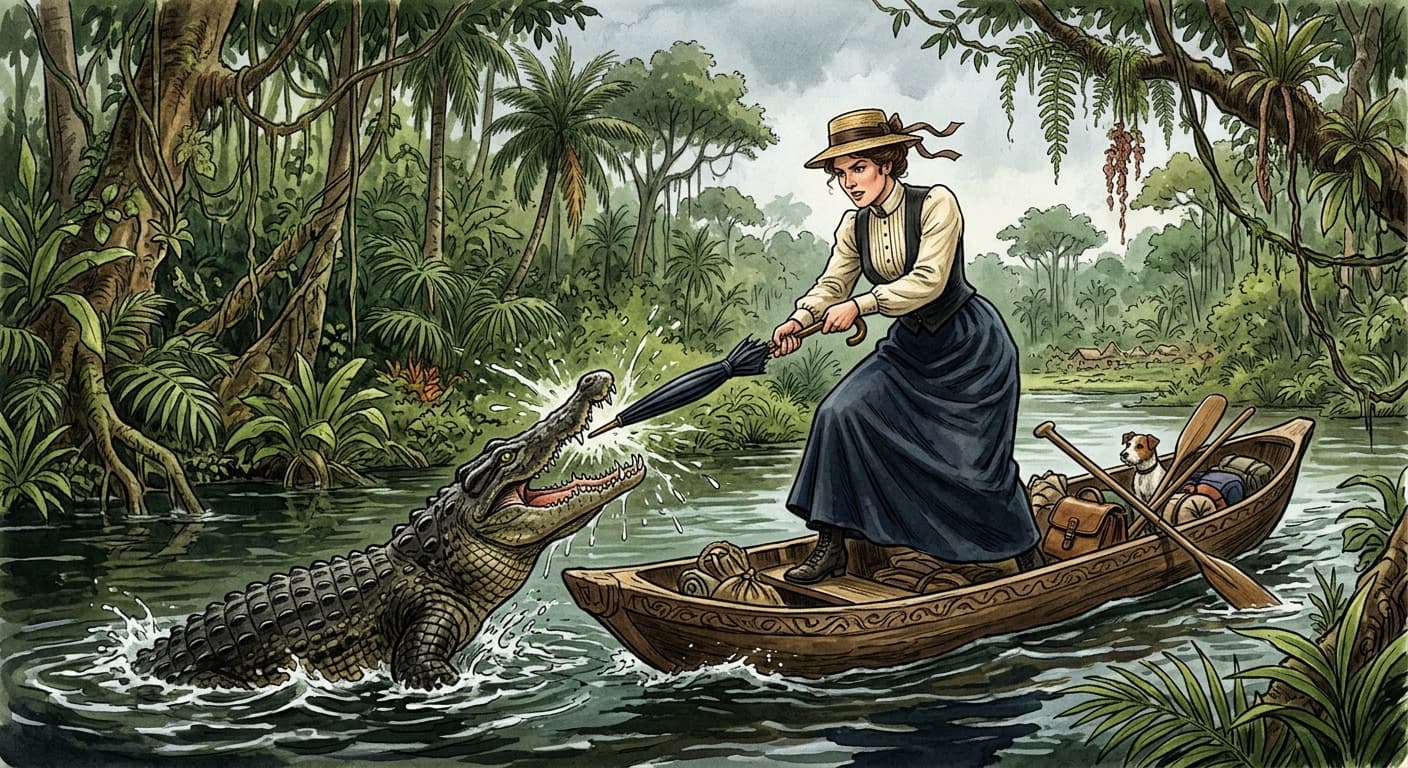
Kingsley's approach to exploration was entirely unique, starting with her wardrobe. Despite the suffocating heat, the dense jungle underbrush, and the constant threat of tropical disease, she absolutely refused to wear men's trousers. She believed strongly in maintaining the dignity of a British lady, which meant traversing crocodile-infested swamps in high-necked blouses, heavy petticoats, and thick black wool skirts. Paradoxically, this ridiculous fashion choice actually saved her life. On one occasion, while trekking through the jungle in the dark, she plummeted straight into a deep game pit lined with sharpened ebony spikes. Instead of being impaled, her heavy garments caught the spikes, and she bounced. 'It is at these times,' she later wrote with her trademark dry wit, 'you realize the blessing of a good thick skirt.'
Her physical courage was nothing short of legendary. Kingsley didn't travel with heavily armed military escorts like other European explorers of the era. Instead, she traveled lightly, often with only a small crew of local guides, financing her expeditions by trading British cloth and rum for rubber and ivory. This required her to negotiate directly with fiercely independent inland tribes, including the Fang people, who were widely feared by Europeans for their reputation as fierce warriors and alleged cannibals. Mary simply treated them with polite respect, learned their customs, and found them to be excellent trading partners and loyal protectors.
Beyond her diplomatic prowess, Mary was remarkably adept at handling the region's deadly wildlife. She famously awoke one night to find a leopard stalking around her jungle camp. Unfazed, she threw a heavy earthen water pitcher at its head, shouting at it to 'go home, you fool!' The confused predator promptly fled into the brush. On another occasion, while paddling a canoe up the rushing rapids of the Ogooué River, a large crocodile attempted to board her small boat. Kingsley calmly grabbed her ever-present umbrella and repeatedly whacked the massive reptile on the snout until it decided to seek an easier meal elsewhere.
But Kingsley was far more than just a Victorian daredevil with a parasol. She was a dedicated scientist and a keen social observer. She collected numerous previously unknown species of fish and insects, carefully preserving them and returning them to the British Museum (several species, including the fish Ctenopoma kingsleyae, still bear her name today). More importantly, she wrote two massively successful books about her travels: Travels in West Africa (1897) and West African Studies (1899).
In an era defined by aggressive European imperialism, Kingsley's writings were dangerously radical. She vehemently argued against the British government's attempts to westernize African societies. She openly criticized Christian missionaries for trying to strip Africans of their traditional cultures, arguing that African social and legal systems were complex, functional, and deeply tied to their environment. She urged the British public to see African people not as 'savages' needing 'civilization,' but as human beings with rich, valid cultures of their own.
Tragically, Mary Kingsley's extraordinary life was cut short just as the 19th century was drawing to a close. During the Second Boer War in 1900, she traveled to South Africa to volunteer as a nurse. While tending to sick prisoners of war in a typhoid-ridden hospital, she contracted the disease herself and died at the age of 37. As per her final wishes, she was buried at sea with full military honors—a fittingly unconventional end for a woman who refused to be anchored by the expectations of her time. Today, she remains a towering figure in the history of exploration: a brilliant, fearless rebel who conquered the unknown with empathy, intellect, and a good thick skirt.