The Macbeth Massacre: How a Rivalry Over Shakespeare Sparked the Deadliest Riot in New York History
When we think of deadly riots today, we usually attribute them to political upheaval, systemic injustice, or crippling food shortages. But on a humid night in May 1849, the streets of New York City ran red with blood for a vastly different, almost absurd reason: a dispute over who was the better Shakespearean actor.
The Astor Place Riot remains one of the most bizarre and tragic events of the 19th century. To understand how a theatrical critique escalated into a massacre that left over two dozen people dead, one must look past the stage and into the boiling cauldron of class warfare, xenophobia, and hyper-nationalism that defined antebellum America.
At the center of this cultural powder keg were two legendary actors. Representing the American working class was Edwin Forrest, a muscular, booming powerhouse of a man. Forrest was the first native-born star of the American stage, beloved by the rough-and-tumble "Bowery Boys" and the waves of Irish immigrants who despised the British. His acting was visceral, athletic, and unapologetically loud.
In the opposite corner stood William Charles Macready, the darling of the British theatrical establishment. Macready was cerebral, refined, and subtle. Naturally, he became the idol of New York's wealthy elite—the Fifth Avenue aristocrats who desperately wanted to emulate European high society and distance themselves from the unwashed masses.
The rivalry between the two men was deeply personal. A few years prior, Forrest had toured Great Britain and was allegedly snubbed by Macready. In retaliation, Forrest attended one of Macready's performances of Hamlet in Edinburgh and publicly hissed at him from the audience. The feud made international headlines, so when Macready announced an American tour in 1849, the workingmen of New York saw it as an invading British snob returning to insult their homegrown hero.
The tension snapped on May 7, 1849. In a move of staggering arrogance or brilliance, both men were scheduled to play the title role in Macbeth on the exact same night in theaters just blocks apart. While Forrest performed to roaring crowds at the Broadway Theatre, Macready's performance at the opulent, dress-code-enforced Astor Place Opera House was sabotaged. Hundreds of Forrest's supporters bought tickets and relentlessly pelted the stage with rotten eggs, pennies, lemons, and—according to some reports—half of a dead sheep. Humiliated, Macready stopped the play and booked a ticket back to London.
Had he left, history would have recorded a mere theatrical prank. However, a group of prominent wealthy New Yorkers—including literary giants Herman Melville and Washington Irving—signed a public petition begging Macready to stay. They assured him that the city would protect him and that mob rule would not dictate New York culture. Reluctantly, Macready agreed to perform Macbeth one last time on May 10.
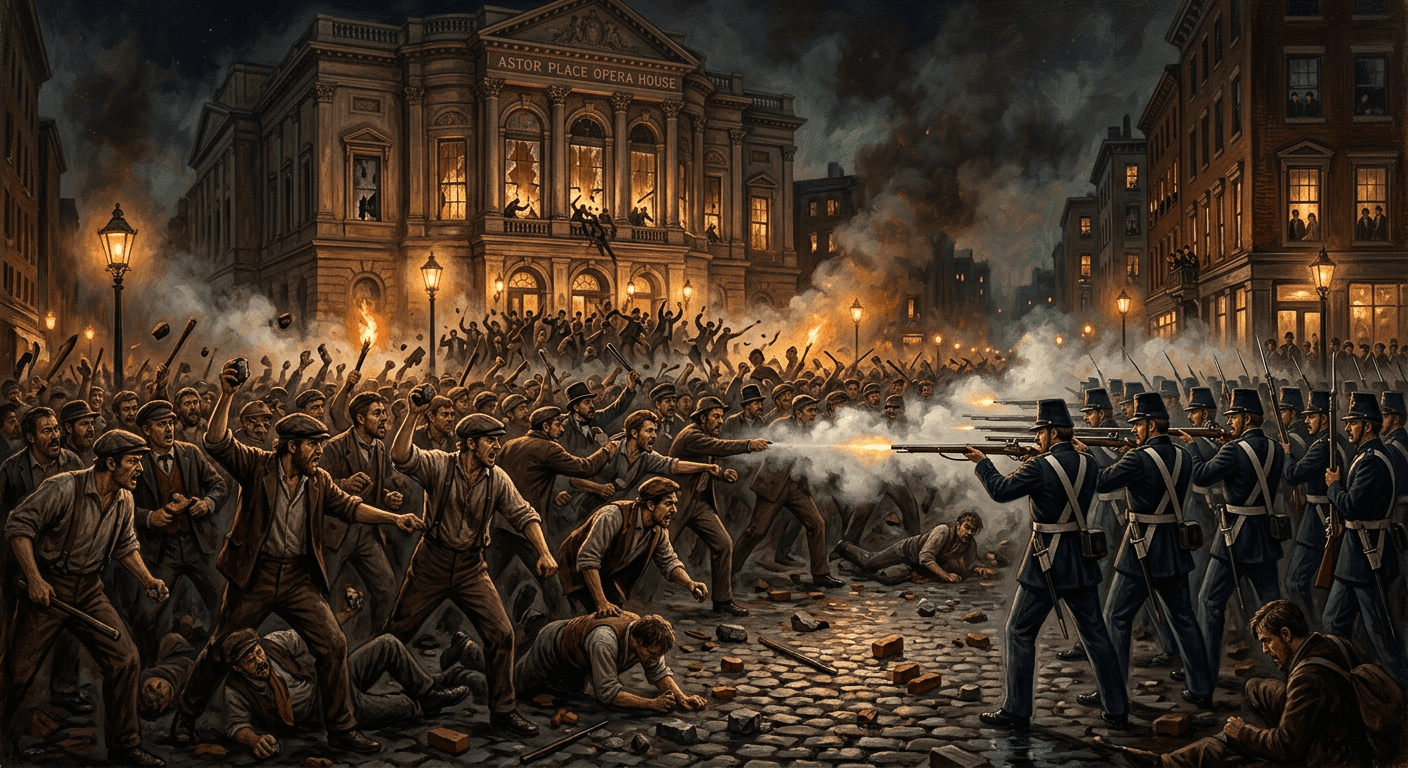
This decision was viewed as a declaration of war by the working class. Handbills were distributed across the city reading, "WORKINGMEN, SHALL AMERICANS OR ENGLISH RULE IN THIS CITY?" By the time the curtain rose at the Astor Place Opera House, a mob of over 10,000 angry citizens had surrounded the building. They tore up paving stones and hurled them through the theater's grand windows, shattering the gaslights inside and sending the aristocratic audience diving under their velvet seats.
The city's police force was vastly outnumbered and quickly overwhelmed. In a fatal escalation, the mayor called in the state militia. The soldiers arrived on horseback and on foot, but the crowd refused to disperse, instead turning their volley of bricks and stones onto the troops. Bloodied and panicked, the commanding officer gave the order to fire into the crowd.
Musket fire tore through the chaotic streets. When the smoke finally cleared, between 22 and 31 people lay dead, with over a hundred more severely injured. Most of the victims were working-class bystanders, adding a bitter sting to the tragedy. Inside the theater, Macready narrowly escaped the mob by donning a disguise and slipping out through a back door, fleeing to Boston and never returning to American shores.
The Astor Place Riot was a turning point in American history. It permanently cemented the divide between "high-brow" and "low-brow" entertainment, creating a cultural schism that arguably still exists today. But more hauntingly, it proved that the theater of the 19th century was not just a place of escapism. It was a mirror reflecting the deepest, most dangerous fractures of a growing nation—a stage where a play about a murderous, power-hungry king could spill out into the streets and become terribly, violently real.