The Man Who Filmed Life and Disappeared: The Solved and Unsolved Mysteries of Louis Le Prince
History is often written by the victors, but in the cutthroat world of 19th-century invention, it was frequently written by the survivors. When we think of the birth of the motion picture, the names that immediately spring to mind are Thomas Edison or the Lumière brothers. Their kinetoscopes and cinematographs define the late 1890s. However, the true father of cinema may well have been a French chemist and inventor named Louis Le Prince, a man who captured the world's first moving images years before his rivals—only to vanish from the face of the earth in one of the Victorian era's most baffling unsolved mysteries.
The Race to Capture Time
By the late 1880s, the industrial world was obsessed with the idea of moving pictures. Photography had already frozen time, but the race was on to make it flow again. While Edison was tinkering in New Jersey and the Lumière brothers were experimenting in Lyon, Louis Le Prince was hard at work in the unlikely setting of Leeds, England. A tall, genial man with a background in chemistry and art, Le Prince had developed a revolutionary single-lens camera capable of capturing motion on paper film.
In October 1888, Le Prince gathered his family in the garden of his father-in-law’s home in Roundhay, Leeds. He asked them to walk in a circle. The resulting footage, known today as the Roundhay Garden Scene, lasts only two seconds, but it is indisputably the oldest surviving motion picture film in existence. It predates Edison’s public display of the Kinetoscope by nearly three years and the Lumière brothers' famous train arrival by seven. Le Prince had done it. He had solved the technical puzzle of cinema. All that remained was to share it with the world.
The Vanishing on the Dijon Express
In September 1890, Le Prince was preparing for a triumphant public debut of his invention at the Morris-Jumel Mansion in New York City. The stakes were incredibly high; whoever patented the technology first stood to gain a monopoly on a brand-new medium of entertainment. Before leaving for America, Le Prince traveled to France to visit his brother in Dijon and settle some family financial matters.
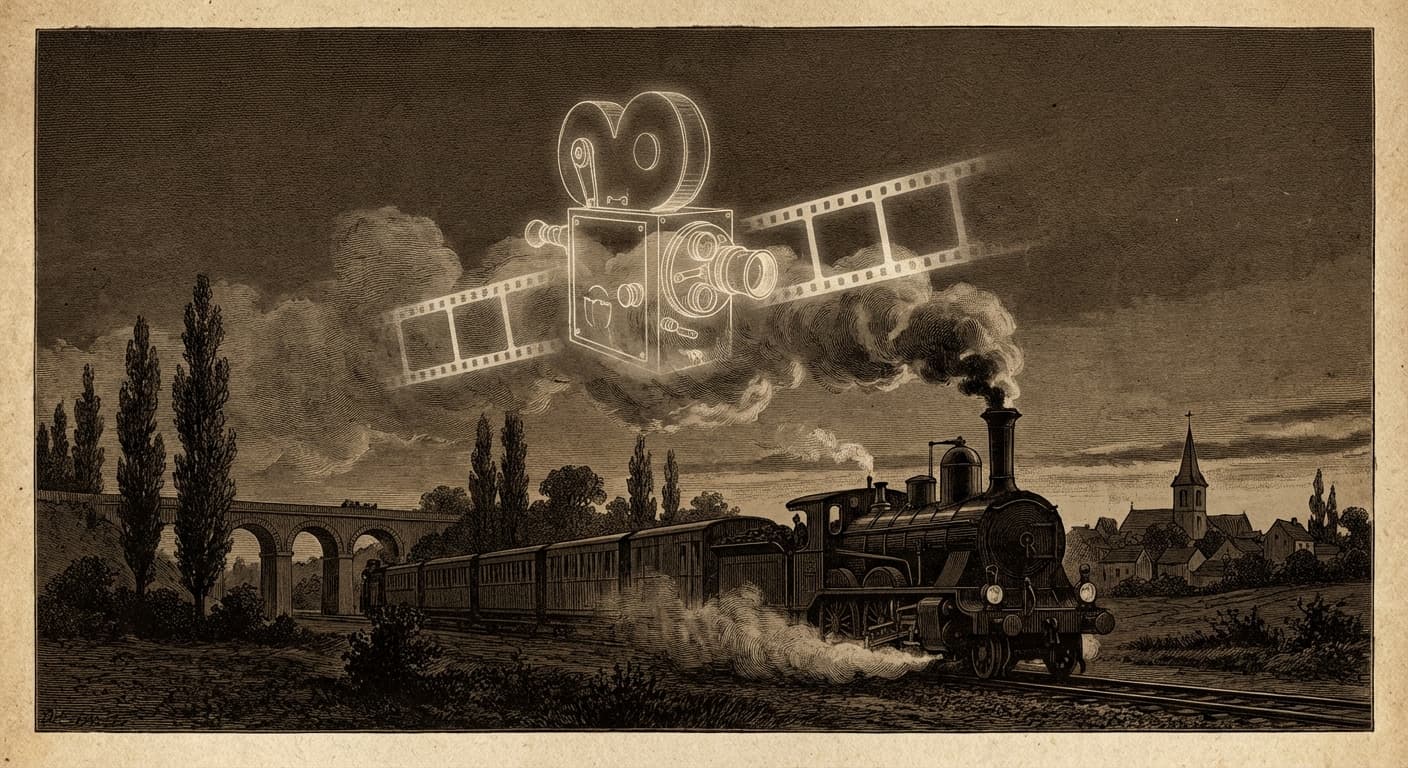
On September 16, 1890, Le Prince’s brother saw him off at the Dijon train station. Le Prince boarded the express train bound for Paris, where he was scheduled to meet friends and continue his journey to London and then New York. He checked his luggage, which contained his precious camera and the blueprints for his projection device.
The train arrived in Paris on schedule. But Louis Le Prince did not get off.
When friends went to meet him, he was nowhere to be found. A search of the train revealed no trace of him. His luggage had also vanished into thin air. The French police and Scotland Yard launched investigations, but they came up empty. There were no witnesses who saw him leave his compartment, no signs of a struggle, no body found along the tracks, and no suicide note. A man, standing on the precipice of global fame, had simply ceased to exist between two stops.
Suicide, Fratricide, or Corporate Assassination?
In the vacuum of evidence, theories began to fester. The French police eventually closed the file, leaning toward suicide, though Le Prince was described by family as happy and professionally optimistic. Another theory suggested his brother had killed him over an inheritance dispute, though no evidence ever supported this.
However, the darkest and most enduring theory involves the "Wizard of Menlo Park," Thomas Edison. Le Prince's widow, Lizzie, was convinced that her husband had been assassinated by agents working for rival inventors. While there is no concrete proof linking Edison to a hitman, the timing was suspicious. Le Prince disappeared just as he was about to beat Edison to the patent office. With Le Prince out of the way, Edison moved forward aggressively, eventually claiming to be the sole inventor of motion pictures.
The Tragedy Continues
The mystery took another grim turn years later. In 1898, Le Prince’s eldest son, Adolphe—who had appeared in the Roundhay Garden Scene—was called as a witness in a lawsuit against Edison’s motion picture monopoly. Adolphe testified that he had seen his father’s invention work years before Edison’s. Two years after giving this testimony, Adolphe was found dead in a duck blind on Fire Island, New York, shot through the head. The official ruling was a hunting accident, but the family believed the long arm of the patent wars had struck again.
A Legacy Reclaimed
For over a century, Louis Le Prince was a footnote, a ghost haunting the history of film. However, modern historians have largely vindicated his claim. The two seconds of grainy footage shot in a Leeds garden stand as irrefutable proof that he crossed the finish line first. While we may never know what happened on that train from Dijon, Louis Le Prince remains the cinema’s lost pioneer—the man who taught pictures how to move, just before he himself moved out of history’s frame forever.