The Teenager Who Conquered the Darkness: How Louis Braille Unlocked the Written World
In the early 19th century, to be born blind—or to lose your sight as a child—was often an unwritten sentence to a life of destitution. For most, it meant begging on the streets, relying on the charity of strangers, or being shuttered away in grim, underfunded asylums. Books, the greatest vessels of human knowledge and imagination, were entirely closed off to the visually impaired. Yet, in a cramped workshop in a small French village, a tragic accident involving a simple leatherworking tool would ultimately unlock the written word for millions. This is the remarkable story of Louis Braille, the brilliant teenager who brought light to the darkness through the power of touch.
The story begins in 1812 in Coupvray, a modest town situated just east of Paris. Three-year-old Louis was playing in the workshop of his father, a successful and highly skilled harness maker. Imitating his father's precise work, the toddler grabbed an awl—a sharp, pointed metal tool used to punch holes in thick, tough leather. As he leaned into the material, the heavy tool slipped and struck him directly in the eye. Medicine at the time was woefully ill-equipped to handle such severe trauma; the wound became severely infected, and the bacterial infection soon spread to his other, healthy eye. By the time he was five years old, Louis was completely and irreversibly blind.
Despite this devastating physical setback, Louis possessed a voracious, unyielding intellect. His parents and the local parish priest, recognizing the young boy's incredibly sharp mind, fought to keep him in the local village school, where he learned strictly by listening and memorization. But the young boy hungered for independence and, above all, for books. In 1819, at the age of ten, his undeniable brilliance earned him a highly coveted scholarship to the Royal Institute for Blind Youth in Paris, which was one of the very first schools of its kind in the entire world.
The Institute itself was a bleak, damp, and dilapidated building, functioning more like a strict prison than a place of enlightenment. Yet, it housed a treasure Louis desperately sought: a library. The school's visionary founder, Valentin Haüy, had invented a system of reading for the blind by pressing heavy, wet paper over thick copper wire letters, creating raised, embossed text. But the system was deeply flawed. The books were massively heavy, fragile, and astronomically expensive to produce. A single short sentence could take up an entire page. Worse still, while the students could read these massive tomes by meticulously and slowly tracing the giant letters, they had absolutely no way to write using the system. It was a frustrating one-way street of information.
The pivotal turning point arrived in 1821, when a retired artillery captain named Charles Barbier visited the Institute. Barbier had invented a unique system called "night writing" for the French military. It used raised dots and dashes punched into thick paper so soldiers could silently read complex orders on the battlefield in pitch darkness, without lighting a lantern and exposing their positions to enemy fire. The military had ultimately rejected the system as too complicated for panicked soldiers to learn, but Barbier believed it might be highly useful for the blind students at the Institute.
Barbier’s system was phonetic, based on sounds rather than letters, and relied on a massive, 12-dot cell structure. It was incredibly cumbersome. The 12-dot cell was simply too large to be read with a single touch of the fingertip, requiring the reader to move their finger around extensively just to decipher a single syllable. But while the adults in the room saw a flawed novelty, twelve-year-old Louis Braille saw raw, revolutionary potential in those raised dots.
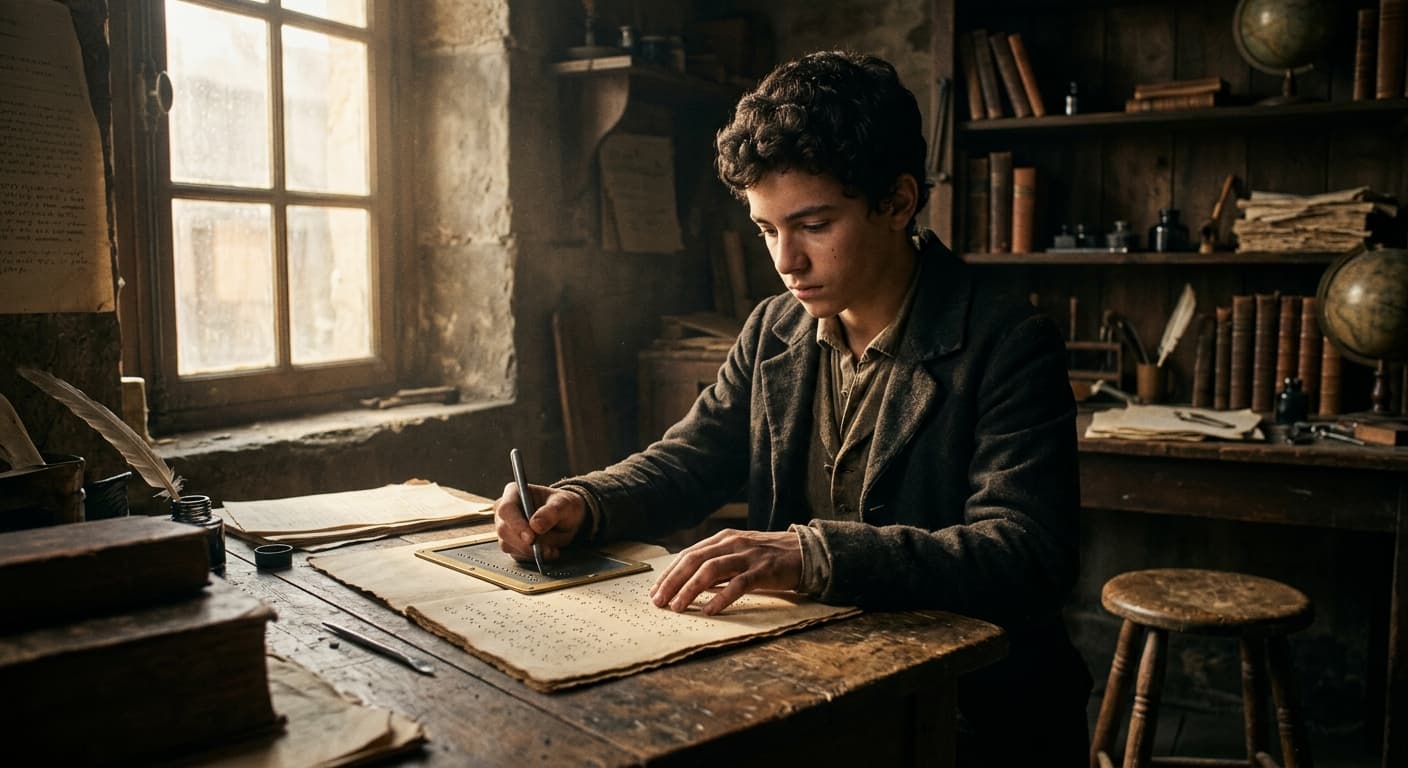
For the next three years, during every spare moment between his rigorous classes and his time playing the cello and organ, the teenager obsessively experimented with Barbier's code. He sat in the dark, punching holes into paper, mapping out endless mathematical variations. By 1824, at the astonishing age of fifteen, Louis had achieved utter perfection. He abandoned the phonetic approach in favor of the standard alphabet and brilliantly slashed Barbier’s 12-dot cell in half, creating a highly efficient 6-dot cell structured in two neat columns of three.
This seemingly simple mathematical reduction was a stroke of absolute ergonomic genius. A six-dot cell is small enough to be felt in its entirety by the sensitive pad of a single human finger with just one rapid touch. There was no longer any need to trace out the complex shape of a letter or painstakingly navigate a massive grid of dots. The alphabet could now be read at a smooth, rapid pace, rivaling the reading speed of sighted individuals. Furthermore, using a simple metal slate and a blunt stylus, a blind person could finally write for themselves, opening the door to independent note-taking, music composition, and letter writing.
Yet, the path to a global revolution is rarely smooth. While the students at the Institute immediately recognized the brilliance of the system and quickly adopted Louis's code, the school's conservative, sighted directors inexplicably fought against it. In one infamous incident, an authoritarian new director even had all the school's Braille books burned and confiscated the students' writing slates, fearing that a separate, distinct alphabet would isolate the blind students from the sighted world. The students quietly rebelled, writing in secret using smuggled styluses, and eventually, their undeniable academic success forced the stubborn administration to relent.
Despite giving the world one of the most liberating and important inventions in human history, Louis Braille did not live long enough to see its global triumph. A lifelong sufferer of severe respiratory illness, heavily exacerbated by the damp, unhealthy conditions of his youth at the Parisian Institute, he passed away from tuberculosis in 1852 at the young age of 43.
It was only two years after his tragic death that the French government finally officially adopted his system. By the late 19th century, Braille had swept across the globe, transcending languages, borders, and cultures. It remains a monumental victory for human accessibility, a permanent legacy born not in a grand, well-funded laboratory, but from the relentless, unstoppable determination of a teenage boy who simply wanted to read.