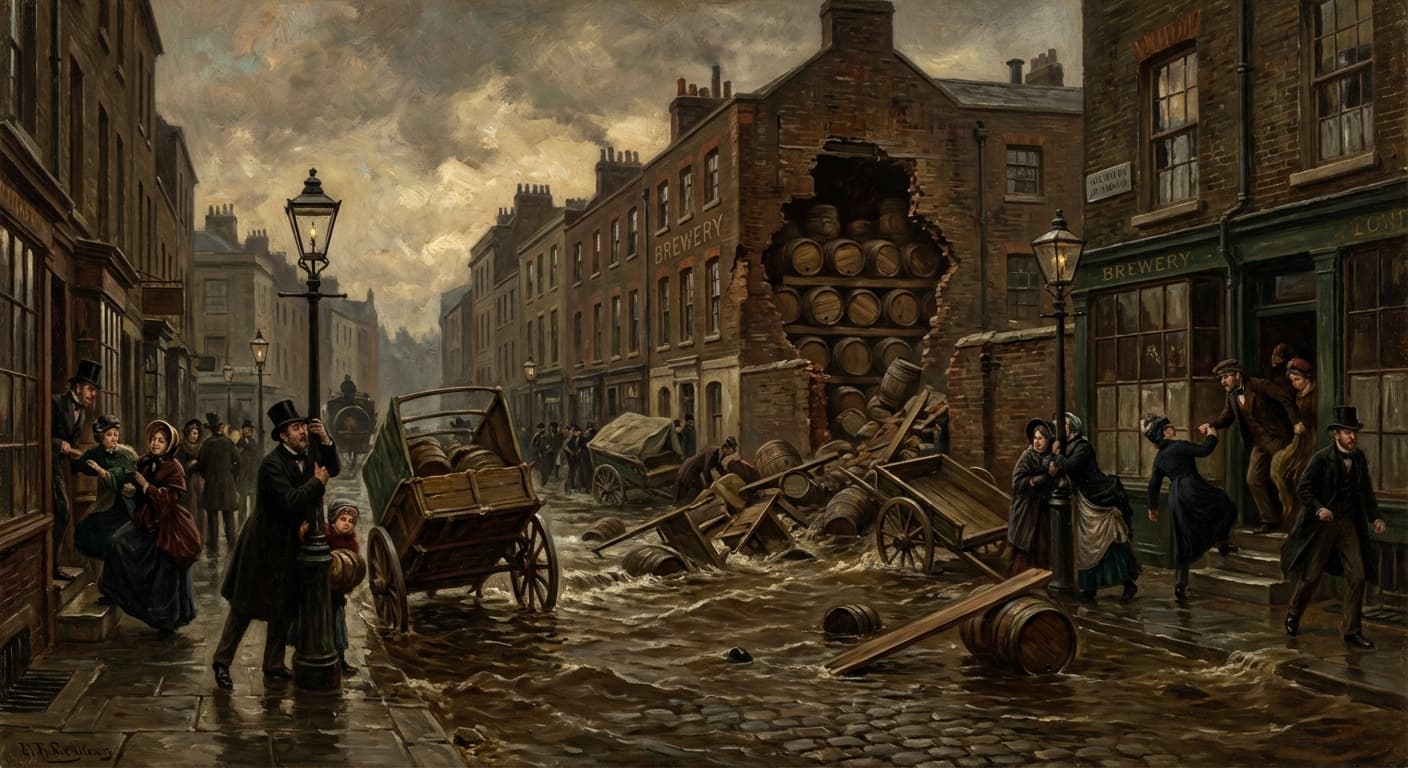
The Day London Drowned in Beer: The Bizarre Tragedy of 1814
When we imagine the perils of living in 19th-century London, our minds usually drift toward the thick, choking pea-soup fog, the rampant spread of cholera, or the soot-stained machinery of the Industrial Revolution. We rarely imagine looking up to see a fifteen-foot tidal wave of dark, fermenting alcohol barreling down the street. Yet, on a cool October afternoon in 1814, that is exactly what happened in the heart of the St. Giles rookery.
This was the era of the industrial brewery. In the early 1800s, Londoners had a voracious appetite for porter, a dark, aged beer that required massive storage capacity. To meet this demand, breweries engaged in a sort of architectural arms race, building gigantic wooden vats held together by massive iron hoops, each capable of holding thousands of barrels of liquid. These vats were the skyscrapers of the fermentation world, symbols of British industrial prowess and thirst. One such establishment was the Horse Shoe Brewery on Tottenham Court Road, owned by Meux & Co. Inside stood a vat that was truly monstrous: twenty-two feet high and capable of holding over 135,000 gallons of porter.
On the afternoon of October 17, 1814, storehouse clerk George Crick noticed a familiar but ominous sight: one of the seven-hundred-pound iron hoops holding the giant vat together had slipped off. This wasn't entirely uncommon, and Crick wasn't immediately alarmed. He wrote a note to a cooper to have it fixed later and went about his business. It was a decision that would lead to one of the strangest disasters in British history.
Around 5:30 PM, a thunderous boom shook the neighborhood, sounding to many like cannon fire or a gunpowder explosion. The compromised vat had burst. The force of the fluid release was so violent that it blasted the valve off a neighboring vat and shattered several hogsheads of porter, creating a chain reaction of destruction. In seconds, more than 320,000 gallons—over a million liters—of fermenting beer were unleashed.
The pressure of the liquid blew out the back wall of the brewery, hurling bricks and debris into the adjacent New Street. The beer, now a churning black tsunami mixed with timber and masonry, roared into the slums of St. Giles. This area was a "rookery," a densely populated district of crumbling tenements and cellar dwellings housing the city's poorest residents. The wave was merciless. It smashed into the Tavistock Arms pub, crushing the teenage barmaid, Eleanor Cooper, under the falling wall. It surged into basements where families lived, filling the rooms to the ceiling in seconds.
Perhaps the most tragic scene occurred in a cellar on New Street, where a wake was being held for a two-year-old boy who had died the previous day. The room, filled with mourners, was instantly flooded. The mother, Anne Saville, and four other attendees were killed by the rushing torrent. In total, the flood claimed eight lives, all women and children. The disaster was chaotic; people scrambled onto furniture to escape the rising tide of alcohol, while the smell of stale porter saturated the air for blocks.
In the immediate aftermath, a bizarre urban legend emerged that hundreds of people grabbed pots and pans to scoop up the free liquor, with some drinking themselves to death. However, historical records suggest the mood was far more somber. The local residents, though poor, were focused on rescuing survivors trapped in the rubble and the sticky, waist-deep mire. The watchmen and neighbors worked through the night, wading through the beer to pull victims from the wreckage.
The aftermath of the flood led to a court case that highlighted the legal limitations of the time. The coroner’s jury visited the site, viewing the devastation and the bodies of the victims. Despite the clear negligence of maintaining a vat that was known to be under immense stress, the jury returned a verdict that the event was an "Act of God." No one was held criminally responsible, and the victims' families received no compensation from the brewery.
Ironically, the only entity to receive financial reprieve was Meux & Co. The brewery petitioned Parliament, arguing that they had already paid taxes on the beer that was lost. In a move that surely stung the grieving families of St. Giles, the government agreed, granting the brewery a massive tax rebate that allowed them to avoid bankruptcy and continue operations. The Horse Shoe Brewery was eventually demolished in 1922, and the Dominion Theatre now stands on the site. Yet, for those who know where to look, the history of the ground beneath the theatre remains soaked in the strange, tragic legacy of the London Beer Flood.