The Irish Spider Dancer Who Toppled a King: The Wild, Untamed Life of Lola Montez
History is full of bold reinventions, but few figures tore through the 19th century with as much audacity, scandal, and sheer theatrical flair as Lola Montez. In an era when women were expected to be demure, obedient, and confined to the domestic sphere, Lola was none of those things. She was a stage performer, a political provocateur, and an international sensation who wielded a riding crop as fiercely as she wielded her charm. Most incredibly, the "Spanish" dancer who conquered the hearts of European intellectuals, toured the rugged American West with a pet grizzly bear, and caused the abdication of a Bavarian king, wasn't actually Spanish at all.
She was born Eliza Rosanna Gilbert in County Sligo, Ireland, in 1821. After an early childhood spent in India, she was sent back to Britain for a traditional upbringing. But Eliza was never destined for a quiet life. At sixteen, she eloped with a military officer to escape an arranged marriage to a much older man. The marriage quickly dissolved into misery and infidelity. Finding herself legally separated, financially stranded, and socially exiled by Victorian standards, Eliza realized that if polite society wouldn't have her, she would simply create a society of her own.
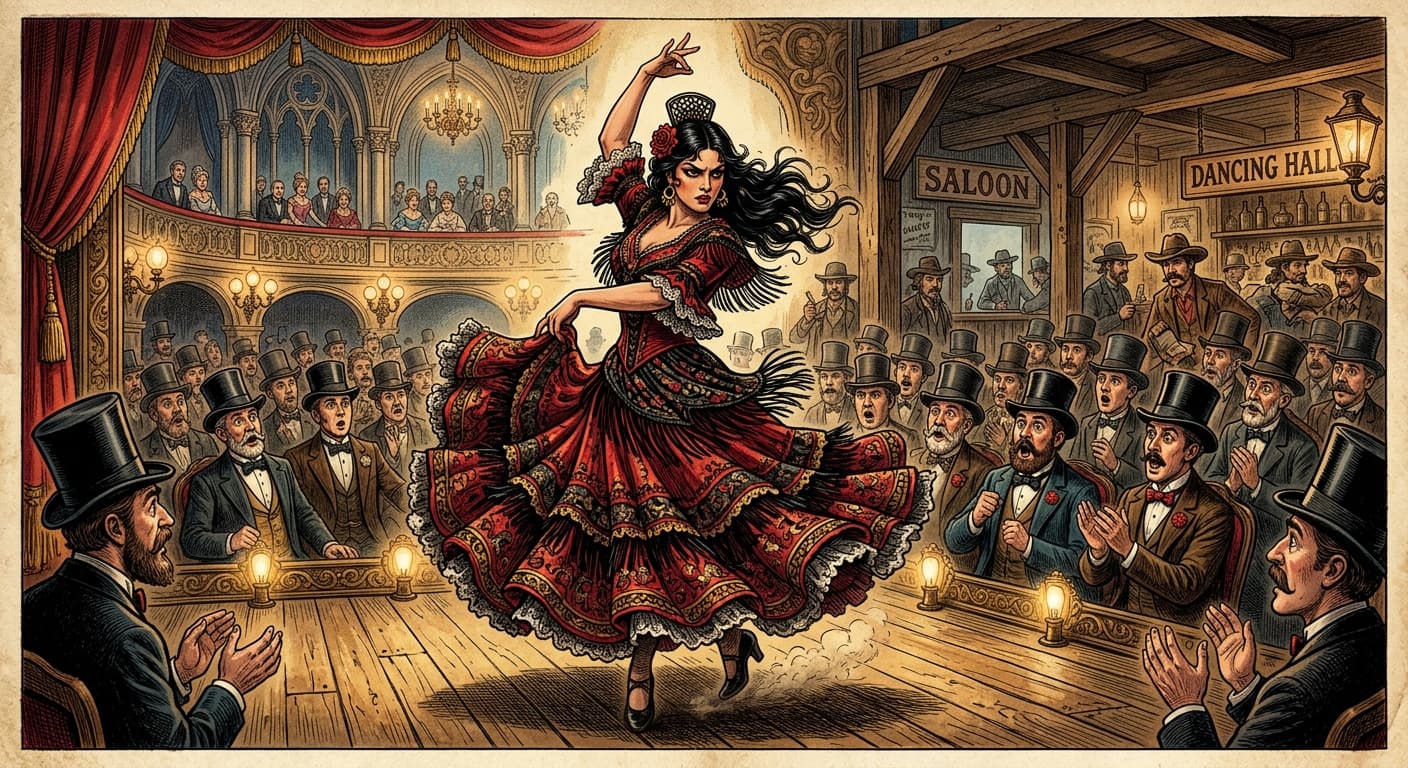
Following a brief stint studying traditional dance in Spain, Eliza completely eradicated her past. In 1843, she debuted on the London stage as "Doña María de los Dolores Porris y Montez," a fiery Andalusian aristocrat who had been driven to the stage by political turmoil. While her actual dancing technique was widely considered mediocre, her stage presence was magnetic. Her signature routine, the "Spider Dance"—in which she frantically searched her wildly layered petticoats for imaginary tarantulas—scandalized and captivated audiences in equal measure.
Her fame skyrocketed, not just for her performances, but for the trail of broken hearts and public brawls she left in her wake. Lola swept through the capitals of Europe, taking famous lovers like the composer Franz Liszt and the novelist Alexandre Dumas. She was a 19th-century tabloid dream, frequently challenging her detractors to duels or horsewhipping theater managers who didn't meet her demands.
But Lola's most spectacular and world-shaking conquest occurred in 1846, when she arrived in Munich seeking an audience with King Ludwig I of Bavaria. When the aging monarch asked if her spectacular figure was a work of nature or artifice, Lola famously ripped open the bodice of her dress with a pair of scissors to prove her authenticity. Ludwig, utterly enchanted, immediately made her his mistress.
The king's obsession was absolute. He showered her with wealth, granted her the title of Countess of Landsfeld, and began bending the kingdom's policies to her whims. For over a year, Lola Montez was the de facto ruler of Bavaria. However, her progressive, fiercely anti-clerical political stances—combined with her arrogant public behavior—infuriated the conservative Bavarian populace. When university students rioted against her influence in 1848, Ludwig stubbornly closed the university rather than exile his beloved Lola. The resulting public backlash was so severe that it sparked a full-blown revolution. To save the monarchy, King Ludwig I was forced to abdicate his throne, and Lola had to flee the country in disguise.
Never one to stay quiet, Lola took her act across the Atlantic. By 1851, she had reinvented herself again, performing her legendary Spider Dance on Broadway before setting her sights on the California Gold Rush. In the lawless mining towns of the American West, her brazen independence was practically revered. She settled for a time in the remote boomtown of Grass Valley, California, where she famously kept a pet grizzly bear on a chain and entertained the rough-and-tumble miners with her tales of European royalty.
Eventually, the relentless pace of her life caught up with her. After disastrous tours of Australia—where she once again horsewhipped a newspaper editor—she returned to America, her health failing. She spent her final years in New York, giving lectures on beauty and female empowerment, before dying of pneumonia in 1861 at just 39 years old.
Lola Montez was a woman completely out of her time. In an age that demanded women be silent, she was deafeningly loud. She lied, danced, and charmed her way into the highest courts of Europe, proving that sometimes, the most extraordinary lives belong to those bold enough to invent them from scratch.