The Valley of Death: How a Billionaire's Playground Unleashed the Johnstown Flood of 1889
In the late 19th century, America was riding the soaring highs of the Gilded Age. It was an era of unprecedented industrial growth, where titans of steel, coal, and railroads forged vast empires. But this rapid expansion often came with a staggering human cost. Nowhere was this more terrifyingly realized than in the industrial boomtown of Johnstown, Pennsylvania, where the unchecked hubris of the era's wealthiest men paved the way for one of the deadliest disasters in American history.
High above the working-class steel town of Johnstown sat Lake Conemaugh, a glittering, two-mile-long artificial reservoir. This idyllic body of water was the centerpiece of the South Fork Fishing and Hunting Club, a highly exclusive retreat for Pittsburgh’s elite. Its secretive membership roster boasted the names of industrial royalty, including Andrew Carnegie, Henry Clay Frick, and Andrew Mellon. Seeking a quiet escape from the soot and smog of the steel city, these magnates purchased the lake and its earthen dam in 1879.
To suit their luxurious needs, the club made a series of seemingly minor, yet fatal, modifications to the aging South Fork Dam. They lowered the dam's height to widen the road across its top, allowing their ornate carriages to pass comfortably. Crucially, they also removed the dam's drainage pipes to prevent their expensive imported game fish from escaping into the valley streams. The club ignored repeated warnings from engineers that these structural compromises, combined with a persistent lack of maintenance, had transformed the dam into a ticking time bomb.
The fuse was finally lit in late May 1889, when an unprecedented storm system stalled over Western Pennsylvania. For days, record-breaking rainfall pounded the Allegheny Mountains. By the morning of May 31, the water level in Lake Conemaugh was rising at a terrifying rate of an inch every ten minutes. A frantic crew of laborers desperately tried to dig a new spillway and pile mud on the weakening crest, but it was a futile battle against the sheer, overwhelming force of nature.
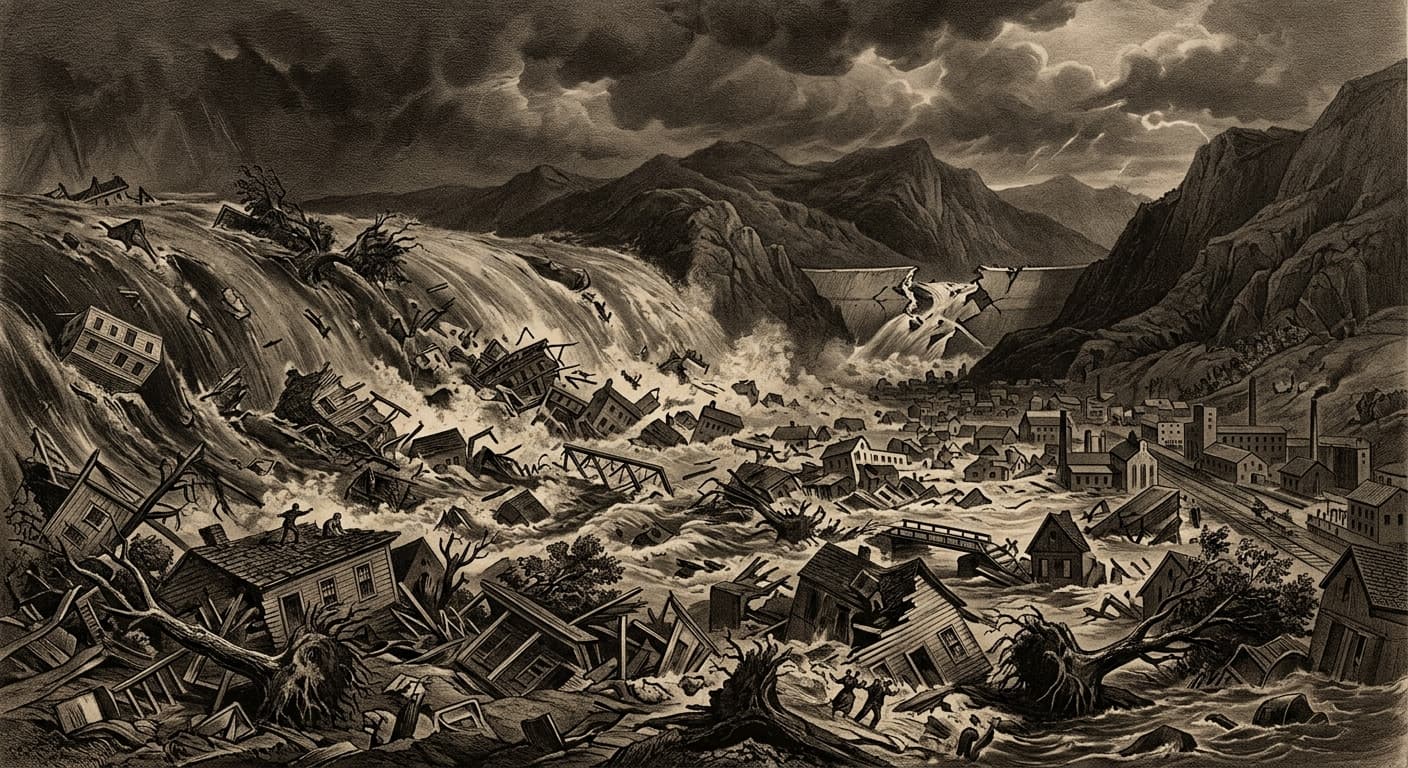
At 3:10 PM, the unthinkable happened. The South Fork Dam completely collapsed, unleashing 20 million tons of water into the narrow Conemaugh Valley. A towering, roaring wave—some witnesses claimed it was 60 feet high—tore down the mountain gorge at speeds reaching 40 miles per hour. This wasn't just a wave of water; it was a devastating battering ram of boulders, uprooted trees, pulverized houses, and miles of twisted railroad track.
Down in the valley, the 30,000 residents of Johnstown had largely ignored the telegraph warnings, having grown accustomed to minor spring flooding and years of false alarms about the dam. When the monster wave finally struck the city at 4:07 PM, it brought sheer apocalyptic fury. Entire neighborhoods were instantly scoured from the earth. The massive stone arches of the Pennsylvania Railroad Bridge finally stopped the flood's progress, but it created a horrific new nightmare. The bridge caught thousands of tons of debris—including homes with people still clinging to the roofs—which then caught fire, trapping survivors in a tragic inferno.
When the waters finally receded, the scale of the devastation horrified the world. Over 2,200 people lost their lives, making it the largest loss of civilian life in the United States up to that point. The tragedy immediately mobilized a massive charitable response. A 67-year-old Clara Barton arrived with her newly founded American Red Cross, marking the organization's first major peacetime disaster relief effort. Her team spent five gruelling months in the mud and ruin, providing shelter, supplies, and medical care to the shattered community.
Despite nationwide outrage, not a single member of the South Fork Fishing and Hunting Club was ever held legally or financially responsible. Astoundingly, the courts deemed the cataclysm an "Act of God," allowing the industrial titans to shield their fortunes behind corporate liability laws. The sheer injustice of the verdict eventually fueled a shift in American law toward strict liability, ensuring that future negligence could not be so easily dismissed. Today, the Johnstown Flood remains a chilling monument to Gilded Age inequality—a grim reminder of what happens when the leisure of a few outweighs the safety of the many.