The One-Armed Major and the Great Unknown: John Wesley Powell's Mad Dash Through the Grand Canyon
In the spring of 1869, the map of the United States was largely filled in. The American West was being rapidly tamed by telegraph lines, stagecoach routes, and the newly completed Transcontinental Railroad. Yet, one massive, menacing void remained: the Colorado River basin. Rumors of terrifying underground waterfalls, deadly rapids, and unscalable rock walls kept cartographers at bay. To the American public and seasoned explorers alike, this treacherous stretch of the country was simply called the "Great Unknown."
Enter John Wesley Powell, a man who defied every convention of the rugged Western explorer. Standing just five-foot-six, Powell was a 35-year-old geology professor from Illinois. Even more remarkably, he was missing his right arm, having lost it to a Confederate Minié ball at the Battle of Shiloh. Powell was not a seasoned frontiersman, but he possessed an iron will, a brilliant scientific mind, and a burning curiosity to read the deep geologic history exposed in the canyon walls.
The audacious expedition began in May 1869 in Green River, Wyoming. Powell assembled a ragtag crew of nine men, mostly consisting of Civil War veterans, tough mountain men, and eager adventurers. Their fleet consisted of four custom-built, oak and pine rowboats: the Emma Dean, the Maid of the Canyon, Kitty's Sister, and the No Name. These boats were heavy, cumbersome, and completely unsuited for navigating volatile white-water rapids. To make matters worse, they loaded the boats with ten months' worth of heavy rations, including flour, bacon, coffee, and dried apples, along with delicate scientific instruments.
Almost immediately, the river showed its fangs. Within weeks, the crew encountered roaring, churning rapids that shattered the No Name against the rocks at a treacherous bend they aptly named Disaster Falls. Along with the boat went a quarter of their precious rations and several critical barometers. As the crew watched their food and gear sink or float away, they quickly realized that the river was not just a magnificent geological wonder, but a brutal, unyielding adversary.
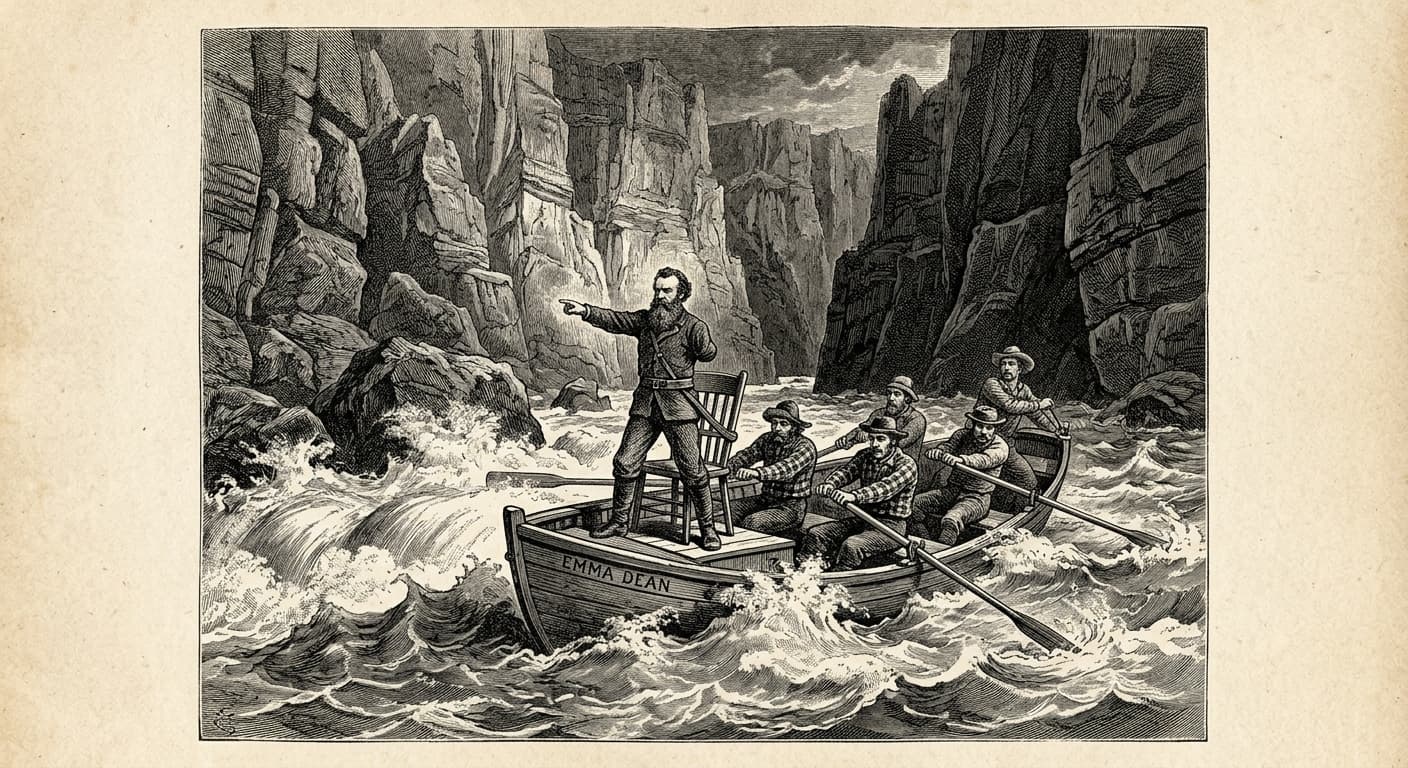
As they pushed further south, the canyon walls rose dramatically, plunging the men into deep, claustrophobic shadows. By August, they had entered the depths of the Grand Canyon. The heat was relentless, often soaring past 100 degrees Fahrenheit, while the icy river water continuously battered them. Their clothes literally rotted off their backs. Their remaining rations dwindled to spoiled bacon, moldy flour, and a handful of dried apples. Yet, Powell remained determined to map the route. To scout the rapids ahead, he would famously strap himself to a wooden chair bolted to the deck of the Emma Dean, shouting orders over the deafening roar of the river while his men furiously rowed.
The psychological toll on the crew was immense. The constant, thundering noise of the water echoing off the vertical stone walls frayed their nerves. They were trapped in a mile-deep gorge with absolutely no way out but downstream. By late August, the exhausted, starving crew reached a boiling, chaotic stretch of white water that looked like certain death. Today, this terrifying section is known as Separation Rapid.
For three of the men—Oramel Howland, his brother Seneca, and William Dunn—this ferocious rapid was the breaking point. They pleaded with Powell to abandon the river and hike out over the towering canyon rim. Powell, ever stubborn, refused to give up. In a solemn parting, the three dissenting men took a couple of rifles and their meager share of the rations, and began the grueling climb out of the canyon. They preferred their chances in the unforgiving Mojave Desert over the churning meat grinder of the river. Tragically, they were never seen alive again. Their fate remains one of the West's great enduring mysteries, though it is widely believed they were killed by a local Shivwits Paiute tribe who mistook them for hostile prospectors.
The next morning, Powell and the remaining five men pushed off into the terrifying rapid, bracing for the end. By a stroke of incredible luck and sheer determination, they rode the churning water and survived. Miraculously, just two days later, the towering canyon walls finally dropped away, and the river spilled out into the calm, slow-moving waters of the Virgin River. The expedition was over. They had conquered the Great Unknown.
John Wesley Powell returned to civilization as a national hero. He had mapped the last major blank spot on the map of the contiguous United States. His harrowing 95-day journey through the Grand Canyon forever changed our understanding of the American West, paving the way for future conservation efforts and geological studies. The one-armed major had stared down the belly of the beast and emerged victorious, providing a timeless testament to the relentless, unconquerable spirit of 19th-century exploration.