The Magician Who Stopped a War: How Jean-Eugène Robert-Houdin Conquered Algeria with a Box and a Bullet
When we think of the tools of 19th-century imperialism, we typically imagine the Maxim gun, the ironclad warship, or the telegraph. We rarely imagine a silk top hat, a tuxedo, and a wooden box. Yet, in 1856, the French government found itself facing a crisis in its colony of Algeria that neither diplomacy nor gunpowder seemed capable of solving. Their solution was one of the most bizarre diplomatic missions in history: they dispatched a retired clockmaker turned stage magician to suppress a rebellion using nothing but slight-of-hand and electromagnetism.
The man was Jean-Eugène Robert-Houdin, a name that would later inspire a young Erich Weiss to become Harry Houdini. By the mid-19th century, Robert-Houdin was already a living legend in Paris. He had revolutionized the art of magic, stripping away the goofy Merlin robes and pointy hats of his predecessors and replacing them with the elegant evening wear of the aristocracy. He treated magic not as occultism, but as a sophisticated performance of wit and engineering. However, he had retired to his country estate near Blois, intending to spend his remaining years working on electrical experiments. That retirement was interrupted by a summons from Colonel de Neveu, the head of the political office in Algiers.
The situation in North Africa was precarious. Local religious leaders, known as Marabouts, were inciting the tribes to revolt against French colonial rule. The Marabouts maintained their authority through displays of what they claimed were supernatural powers—eating glass, walking on coals, and seemingly possessing immunity to pain. The French government feared that a massive jihad was imminent. They reasoned that the only way to break the Marabouts' hold over the populace was to prove that France possessed superior "magic." They didn't need a general; they needed a wizard.
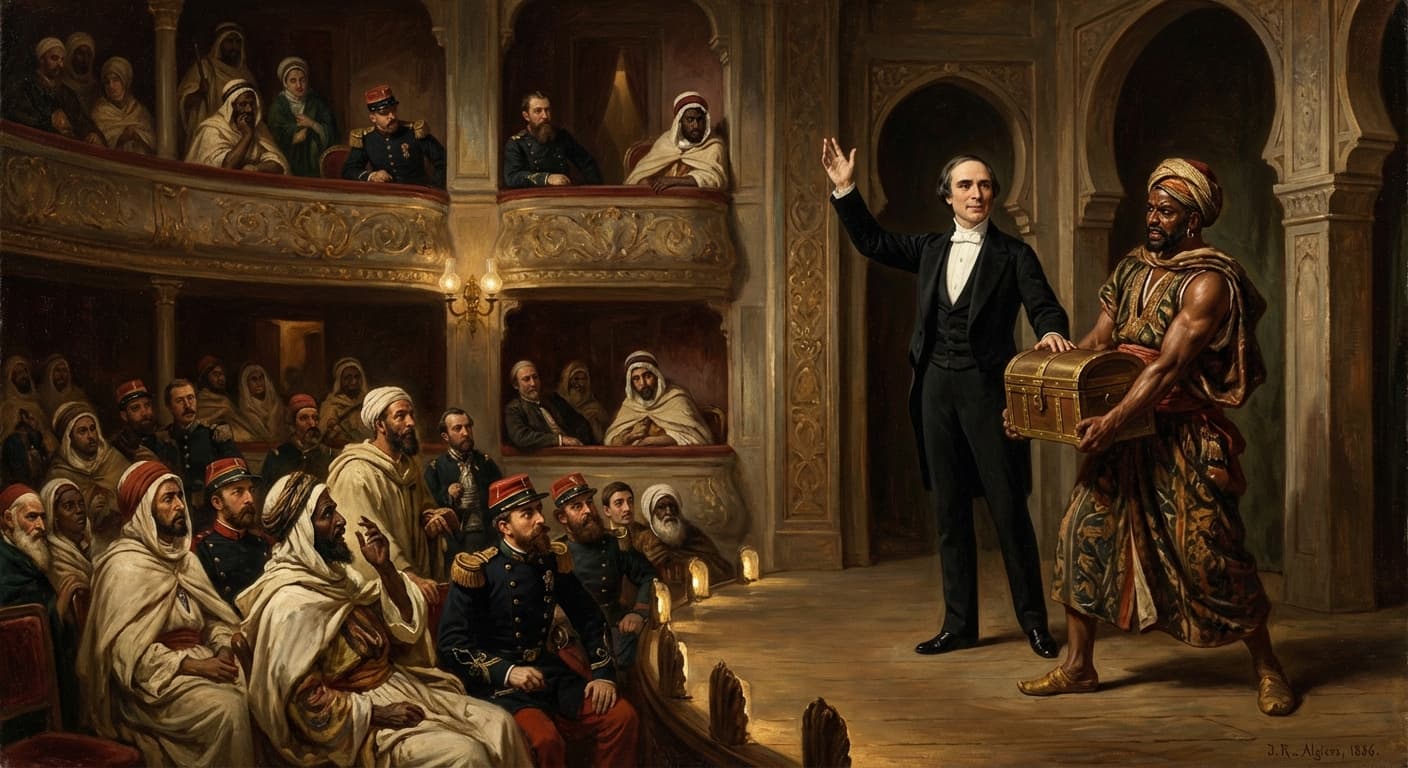
Reluctantly, Robert-Houdin accepted the mission and traveled to Algiers. The stage was set at the Bab Azoun Theatre, where the audience consisted of French officials and the most influential tribal chieftains and Marabouts. The atmosphere was tense; this was not a performance for applause, but a duel for psychological dominance. Robert-Houdin began with routine sleight-of-hand—producing cannonballs from hats and cornucopias of flowers—which amused the crowd but did not shake the Marabouts, who dismissed these as mere trickery.
Then, Robert-Houdin escalated the stakes with his masterpiece: "The Light and Heavy Chest." He brought out a small wooden box with a metal handle and placed it on the floor. He invited the strongest warrior from the audience to come up and lift it. The man did so easily, holding it aloft with a smirk. Robert-Houdin then announced that he would instantly rob the warrior of his strength. He waved his wand and claimed to cast a spell. In reality, he had remotely activated a powerful electromagnet hidden beneath the stage, which pulled the iron-bottomed box to the floor with immense force. The warrior pulled and strained, his muscles bulging and sweat pouring down his face, but the small box would not budge. Finally, the man let out a scream and fled the stage—Robert-Houdin had sent a strong electric shock through the handle, convincing the warrior that an invisible demon was biting him.
To seal the victory, the magician performed a variation of the bullet catch. He invited a Marabout to mark a lead bullet and load it into a pistol. Robert-Houdin then stood across the stage and caught the fired bullet between his teeth (in reality, a wax duplicate was fired and disintegrated, while the marked bullet was sleighted into his mouth). He then handed the marked bullet back to the terrified holy man. The message was clear: French magic could strip a warrior of his strength and make a man invulnerable to gunfire.
The psychological impact was devastating. The tribal leaders, convinced that the French possessed supernatural powers far beyond their own, withdrew their support for the rebellion. The imminent uprising dissolved without a single battle being fought by the army. Robert-Houdin returned to France a hero, having proven that in the Victorian age, the line between advanced engineering and sorcery was thin enough to stop a war. He later explained the secrets of his tricks to the chieftains to show them it was science, not demons, but the legend of the French wizard had already secured the peace.