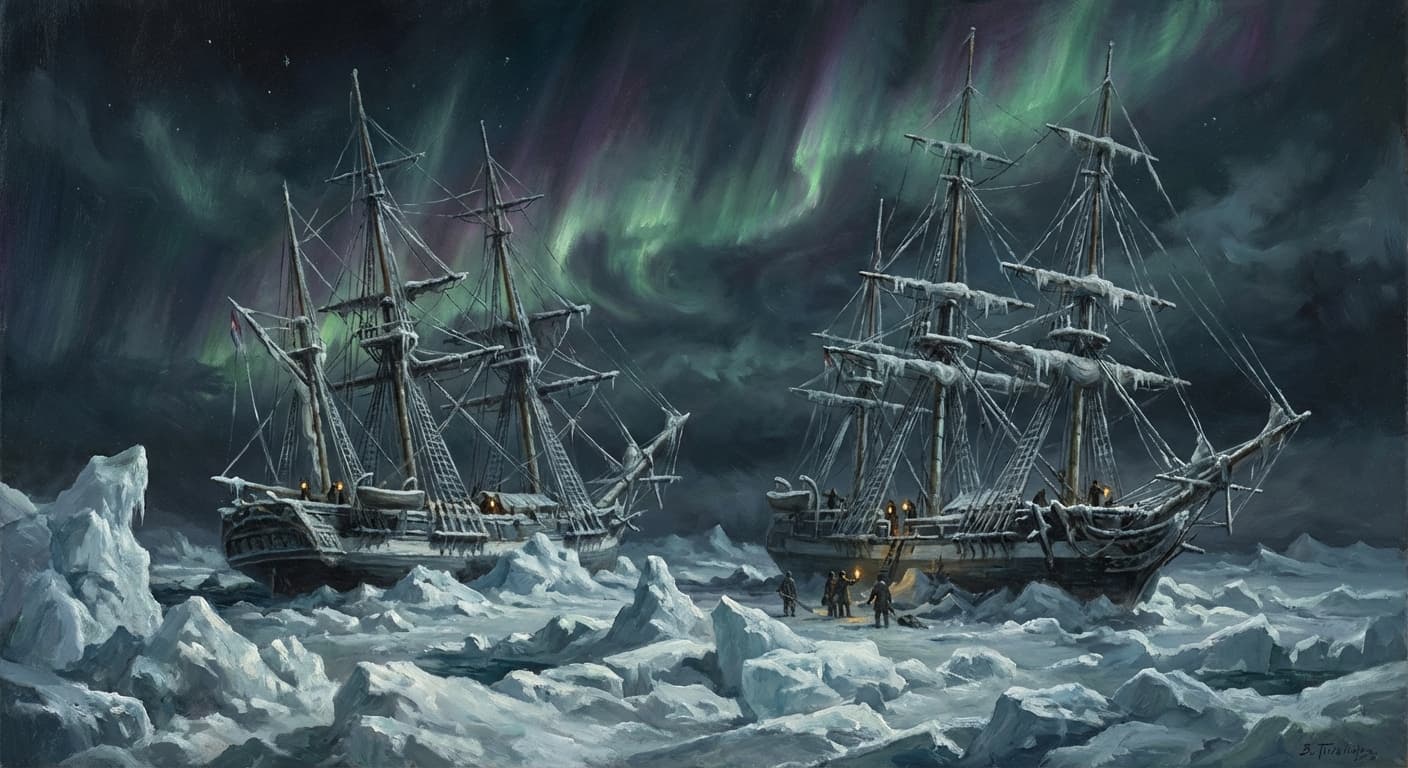
Into the White: The Haunting Mystery of Franklin's Lost Expedition
In the mid-19th century, the British Empire was the undisputed master of the waves. Its navies mapped the globe, its trade routes spanned oceans, and its scientific prowess was the envy of the world. Yet, there remained one prize that eluded the Admiralty: the Northwest Passage. This theoretical shipping route, winding through the frozen archipelago of the Canadian Arctic to connect the Atlantic and Pacific, was the Holy Grail of exploration. In 1845, Britain decided to seize it once and for all with a mission defined by technological hubris and Victorian optimism. It became known as Franklin’s Lost Expedition, and it remains one of history’s most chilling tales of survival and disappearance.
The Unsinkable Fleet
The Admiralty spared no expense. They selected two bomb vessels, HMS Erebus and HMS Terror, ships originally designed to fire mortars but reinforced with heavy timber and iron plating to withstand the crushing grip of polar ice. These were the space shuttles of their day. For the first time, Arctic exploration ships were fitted with auxiliary steam engines—converted from railway locomotives—allowing them to navigate through pack ice when the wind failed. They boasted internal steam heating systems to combat the Arctic freeze and a library of thousands of books to entertain the 129 officers and crew.
Commanding the expedition was Sir John Franklin, a 59-year-old veteran of three previous Arctic voyages and a hero of the Napoleonic Wars. Though perhaps past his physical prime, Franklin was a beloved figure, known for his kindness and experience. The ships were stocked with three years' worth of preserved food, including 8,000 tins of meat, soup, and vegetables. Confidence was so high that no relief plans were put in place. It was assumed they would simply sail through to the Pacific and return as heroes.
Into the Void
The expedition set sail from Greenhithe, England, on May 19, 1845. They made a stop in Greenland to offload letters home—the last words their families would ever read. In late July, two whaling ships spotted Erebus and Terror in Baffin Bay, waiting for the ice to clear to enter Lancaster Sound. That was the last time Europeans saw the men alive.
As the years passed with no word from Franklin, anxiety in Britain turned to dread. By 1848, the Admiralty launched the first of many search expeditions. Over the next decade, more ships and men were lost searching for Franklin than had been on the original expedition itself. Driven by the tireless campaigning of Franklin’s wife, Lady Jane Franklin, the search became a national obsession, captivated by the mystery of how two state-of-the-art ships could simply vanish.
The Crumbs of Disaster
Slowly, the Arctic yielded its grim secrets. In 1850, searchers found three graves on Beechey Island, the site of Franklin’s first winter encampment. The preserved bodies of John Torrington, John Hartnell, and William Braine suggested tuberculosis, but later analysis hinted at something more insidious: lead poisoning.
However, the true horror was revealed in 1859, when a search party led by Francis McClintock discovered a cairn on King William Island containing a standard Admiralty form. The document contained two messages. The first, dated May 1847, was optimistic: "All well." The second, scrawled in the margins just a year later in April 1848, was a frantic epitaph. It stated that the ships had been trapped in ice for a year and a half, Sir John Franklin had died in June 1847, and the survivors—105 souls—were abandoning the ships to walk south toward the Back River. It was a death march across hundreds of miles of desolate frozen wasteland.
The Heart of Darkness
What happened to the men of the Franklin expedition is a tragedy compounded by irony. Inuit oral histories, initially dismissed by British authorities as unreliable, told of starving white men pulling massive sledges filled with useless silver cutlery and heavy items, falling down and dying as they walked. They spoke of "long pig"—evidence that in their final, desperate days, the officers and crew had resorted to cannibalism.
Modern forensic analysis of bone fragments found on King William Island confirmed these accounts, showing cut marks consistent with de-fleshing. The theories regarding their downfall are numerous. The canned food, intended to save them, was likely sealed with lead solder that leaked into the contents, slowly poisoning the crew's minds and bodies, causing paranoia and weakness. Combined with scurvy, hypothermia, and starvation, the men were physically and mentally undone by the very technology meant to sustain them.
A Mystery Solved
For over 160 years, the location of the ships remained a mystery. It wasn't until 2014 and 2016 that Parks Canada, guided by Inuit testimony that had been ignored for a century, located the wrecks of Erebus and Terror. They were found in remarkably shallow water, preserved by the freezing temperatures. The Terror was found with her hatches battened down and glass windows intact, suggesting the ship was shut up for winter when she sank.
The Franklin Expedition serves as a haunting memento mori for the Victorian Age. It is a story of man’s ambition crashing against the indifference of nature, a reminder that no amount of iron plating, steam power, or imperial confidence can negotiate with the ice.