The Ship That Stood Still: How the Tragedy of the HMS Birkenhead Birthed the Ultimate Maritime Code
When disaster strikes on the open ocean and a vessel begins to slip beneath the waves, there is an unwritten law of the sea that dictates who is saved first: 'women and children first.' Today, this chivalric code is so deeply ingrained in our cultural consciousness that we often assume it is an ancient maritime law, dating back to the earliest days of seafaring. It is not. In fact, this legendary protocol was born on a dark, shark-infested night in the mid-19th century, forged not in a courtroom, but on the slanting deck of a doomed British warship. It was an event characterized by a display of discipline so awe-inspiring that it moved rival empires to tears and redefined heroism for the modern age.
The HMS Birkenhead was a technological marvel of its era. Built in 1845, the iron-hulled paddle steamer was one of the first of its kind to be commissioned by the Royal Navy. By early 1852, she had been repurposed as a troopship. Her final, fateful mission was to transport reinforcements to the Eighth Xhosa War in South Africa. Aboard the vessel were roughly 643 souls, comprising the ship's crew, seasoned officers, and hundreds of raw recruits from various British infantry regiments. Also aboard were approximately two dozen women and children—the wives and offspring of the men below decks.
In the early hours of February 26, 1852, the sea was perfectly calm, and the sky was clear. The Birkenhead was steaming at a brisk eight knots off the coast of South Africa, near a rocky outcrop ominously named Danger Point. At exactly 2:00 AM, the tranquility of the night was shattered by a deafening crash. The ship had struck an uncharted, submerged pinnacle of rock. The impact tore a massive gash into the iron hull, and the freezing ocean violently rushed in. Within moments, hundreds of sleeping soldiers in the lower troop decks were drowned in their hammocks.
The situation topside rapidly descended into chaos. The ship was hopelessly impaled and beginning to break apart. Captain Robert Salmond rushed to the deck and ordered the lifeboats to be prepared. However, as would later happen on the Titanic, the arithmetic of survival was bleak. Due to poor maintenance and layers of thick paint, the mechanisms for the lifeboats were jammed. Out of the ship's entire compliment of boats, only three could be successfully launched. Together, they could hold no more than 150 people. There were nearly 500 survivors currently scrambling onto the tilting deck.
It was in this terrifying crucible that Lieutenant-Colonel Alexander Seton of the 74th Highlanders made a decision that would echo through history. He recognized the fatal mathematics at play. If the terrified soldiers panicked and rushed the few available lifeboats, the small vessels would be swamped and capsize. Everyone would drown. Seton drew his sword and loudly summoned his officers. Above the screaming of the ship's frightened cavalry horses and the groaning of tearing iron, Seton commanded his men to fall into ranks.
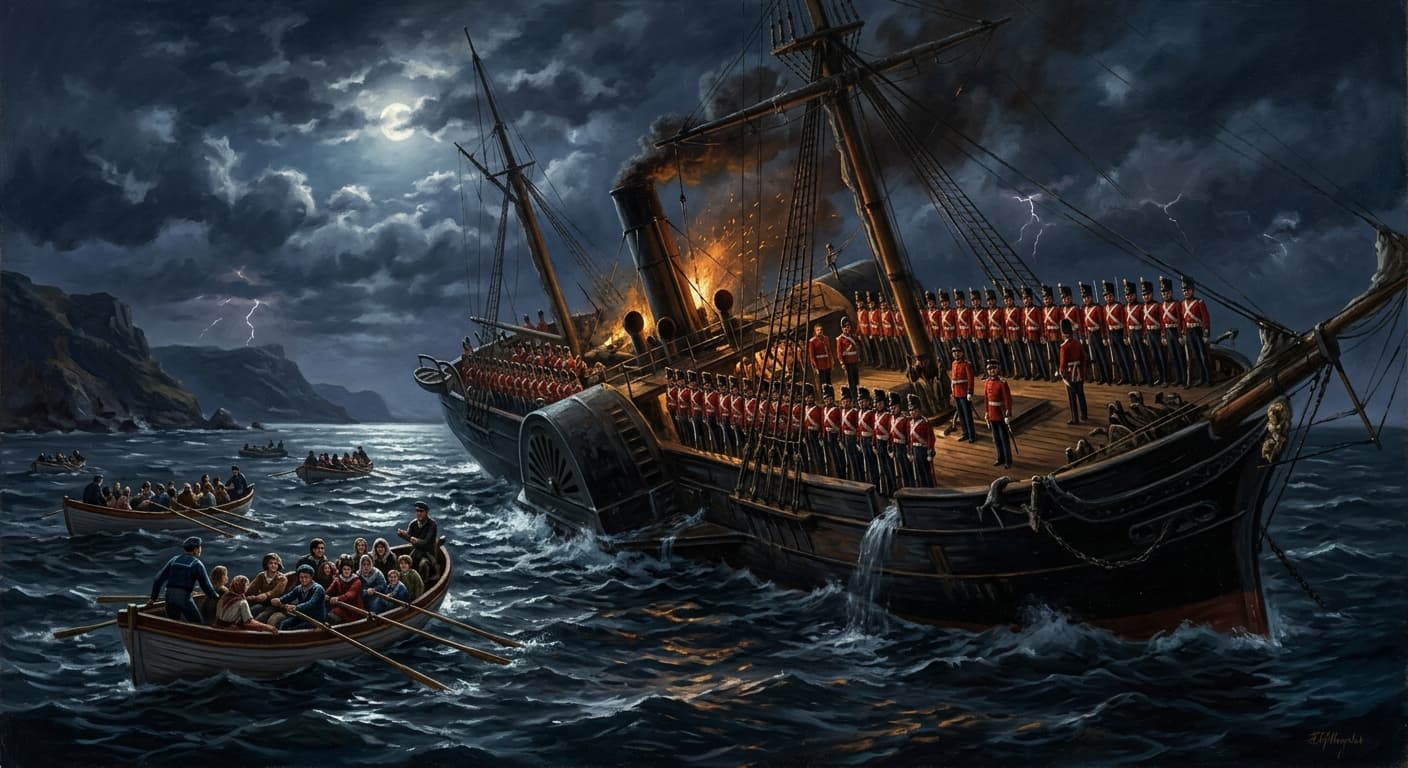
Astoundingly, the soldiers obeyed. Amidst the terror of a sinking ship, the men formed up in perfect, immaculate lines, standing at attention just as they would on a regimental parade ground. Seton gave the strict order that the women and children were to be lowered into the boats first. When Captain Salmond yelled out that anyone who could swim should make a desperate dash for the lifeboats as they pulled away, Seton quickly countermanded him. He bellowed to his men that to do so would doom the families. He implored them to stand fast.
The men did not move. Not a single soldier broke ranks. They stood shoulder to shoulder in absolute silence as the lifeboats, carrying every single woman and child aboard, safely rowed away into the darkness. Just twenty minutes after striking the rock, the HMS Birkenhead broke completely in two. The mainmast snapped, and the ship slipped beneath the waves. The men remained at attention as the water swallowed them.
The aftermath was gruesome. Those who survived the initial sinking were left thrashing in the icy waters, miles from shore. The area around Danger Point was a notorious feeding ground for Great White sharks, and blood in the water quickly attracted a frenzy. Over 400 soldiers and sailors perished that night. Yet, because of their sacrifice, all the women and children survived.
When news of the Birkenhead's demise reached Europe, the public was left astounded. The tragedy transcended the loss of life, transforming into an enduring myth of ultimate duty and sacrifice. The King of Prussia was so profoundly moved by the accounts of the soldiers' bravery that he ordered the story to be read aloud to every regiment in his army as the supreme example of military discipline. Decades later, Rudyard Kipling immortalized the men in his poetry, cementing their legacy. The 'Birkenhead Drill' was born, ensuring that for centuries to come, the phrase 'women and children first' would serve as a living monument to the men who stood still while their world sank beneath them.