The Hideous Skeleton: How the Parisian Elite Tried to Kill the Eiffel Tower
In 1887, the city of Paris was preparing to host the 1889 Exposition Universelle, a grand world's fair intended to celebrate the centennial of the French Revolution. The organizers wanted a centerpiece that would dazzle the globe and assert France's position at the bleeding edge of industrial engineering. Out of over a hundred competing proposals, they selected a daring, almost absurdly ambitious design submitted by the engineering firm of Gustave Eiffel: a colossal iron lattice tower that would stretch a staggering 300 meters (984 feet) into the sky. It would be the tallest man-made structure in the world, dwarfing the newly completed Washington Monument. But before the first rivet was even struck, the project ignited one of the most vitriolic public backlashes in the history of architecture.
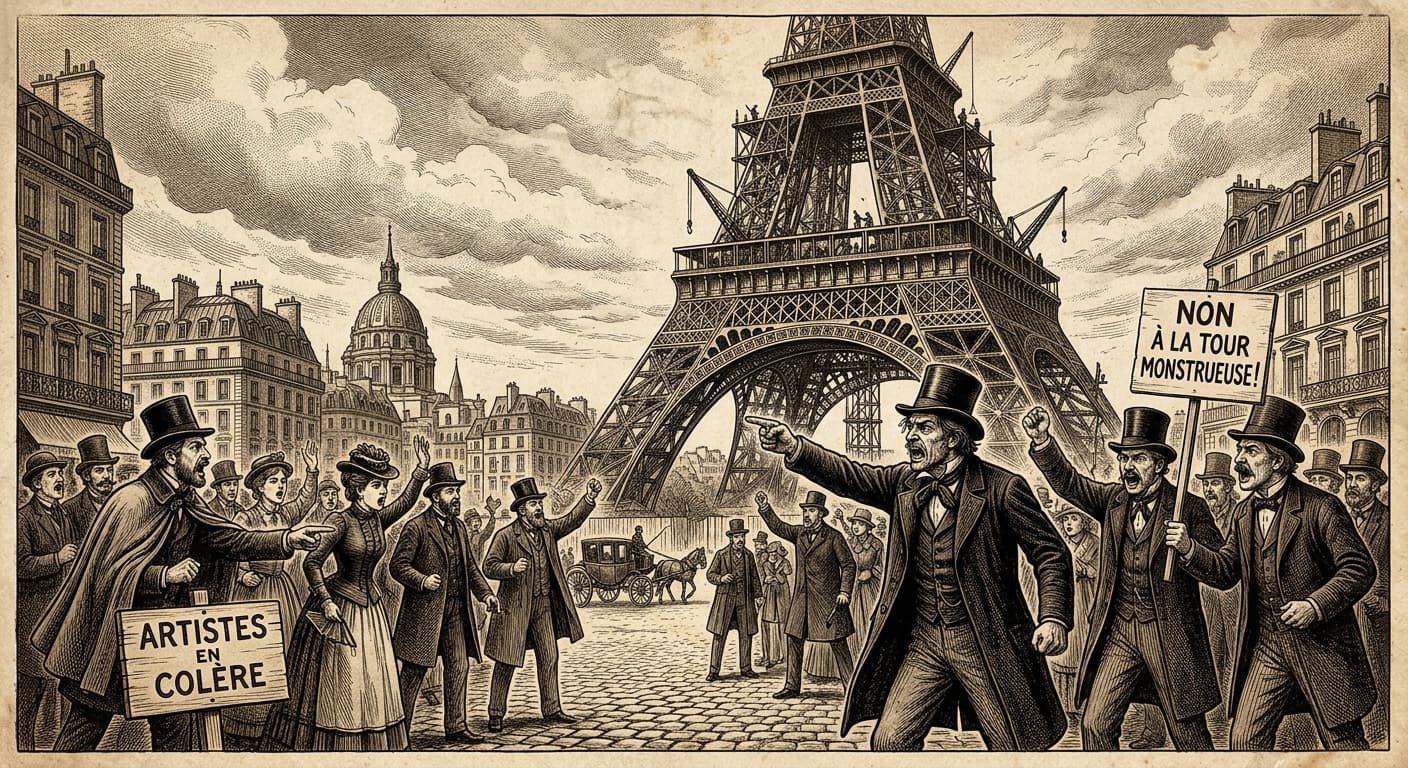
To the modern eye, it is impossible to separate Paris from the Eiffel Tower. Yet, to the 19th-century Parisian elite, Eiffel's iron behemoth was a grotesque insult to the city's meticulously curated aesthetic. As construction began, a coalition of the nation's most prominent artists, writers, and architects banded together to stop it. In February 1887, they published a blistering manifesto in the prominent newspaper Le Temps. Dubbing themselves the 'Committee of Three Hundred' (one member for every meter of the tower's proposed height), the group included literary giants like Guy de Maupassant and Alexandre Dumas fils, as well as Charles Garnier, the architect behind the magnificent Paris Opéra.
The language of the protest was nothing short of apocalyptic. The committee demanded to know if Paris would truly associate itself with the 'baroque, mercantile imaginings of a machine builder.' They described the proposed monument as a 'half-built factory pipe,' a 'gigantic black smokestack,' and a 'truly tragic street lamp.' They warned that the shadows of this 'hateful column of bolted sheet metal' would cast a dark, humiliating gloom over the timeless stone elegance of Notre-Dame and the Louvre. Gustave Eiffel, however, remained completely unfazed. He fired back in the press, comparing his tower to the Great Pyramids and arguing that the sheer, staggering scale of the structure possessed a unique, modern beauty all its own.
Ignoring the elite uproar, construction forged ahead. Eiffel's methodology was a marvel of 19th-century precision. Unlike traditional stone monuments that took decades to build, the tower was essentially a massive, intricate erector set. Over 18,000 individual iron pieces were forged at Eiffel's factory on the outskirts of Paris, each calculated to an accuracy of a tenth of a millimeter. When assembled on-site by a crew of just 300 daredevil workers, the pieces fit together with flawless perfection. Despite the fears of doom-sayers who predicted the tower would inevitably collapse and crush the surrounding neighborhoods, the massive structure rose with astonishing speed. Remarkably, only one worker died during the entire construction process—and that tragic accident occurred off-duty.
When the Exposition Universelle opened in the spring of 1889, the tower was an immediate, staggering triumph. Although the elevators were not yet functional on opening day, thousands of enthusiastic visitors—including French officials and European royalty—willingly hiked the 1,710 steps to the top to witness a view of Paris no human had ever seen before. By the time the fair concluded, nearly two million people had paid to ascend the tower. The public had spoken, and they were hopelessly enamored with the iron giant.
However, not all the critics were won over. The celebrated author Guy de Maupassant remained fiercely antagonistic toward the structure. According to famous literary lore, Maupassant began eating his lunch every single day at the tower's base restaurant. When asked why he frequented the very building he despised, the author wryly replied that it was the only place in the entire city of Paris where he didn't have to look at it.
Incredibly, the Eiffel Tower was never meant to be permanent. Eiffel's permit only allowed the structure to stand for twenty years, after which ownership would revert to the City of Paris, who fully intended to tear it down and sell it for scrap in 1909. As the deadline loomed, the tower's days seemed numbered. But Eiffel was a shrewd businessman and a man of science. He had spent years eagerly promoting the tower's utility for meteorological observations and aerodynamics. Its ultimate salvation, however, came from a cutting-edge 19th-century invention: the wireless telegraph.
Because of its unparalleled height, the tower proved to be the perfect antenna for early radio transmissions. By 1903, it was being used to send signals to French military posts, and by the time its demolition date arrived, it had become a vital node in Europe's growing communication network. It would eventually prove essential in intercepting enemy messages during the First World War. The 'hideous skeleton' was spared the wrecking ball. Today, it stands not just as a testament to Victorian-era engineering brilliance, but as a hilarious reminder that even the world's most beloved cultural icons were once the target of fierce, unbridled hatred.