The Man Who Mailed Himself to Freedom: The Astonishing Escape of Henry "Box" Brown
In the annals of human endurance and the relentless quest for freedom, few stories rival the sheer audacity, physical torment, and unbreakable resolve demonstrated by Henry Brown. Born into the brutal, dehumanizing machinery of American slavery in 1815, Brown’s life in Louisa County, Virginia, was entirely defined by the oppressive whims of his enslavers. But in the spring of 1849, his name would be forever etched into the annals of history—not for the heavy chains he was forced to wear, but for the astonishing, terrifyingly claustrophobic method he devised to break them. Henry Brown didn’t simply run to freedom in the dark of night; he mailed himself there.
For the first thirty-three years of his life, Henry Brown labored intensely in a Richmond tobacco factory. Despite the daily horrors and indignities of his reality, he miraculously managed to carve out a semblance of a life, marrying an enslaved woman named Nancy and fathering three children. But the fragile illusion of their family life shattered completely in August 1848. In a devastatingly cruel transaction, Nancy's owner sold her and their children to a distant plantation in North Carolina. Brown watched helplessly on the street, his heart turning to ash, as his pregnant wife and children were marched away in heavy iron chains. He would never see or hold them again.
Consumed by profound grief and realizing that he suddenly had nothing left to lose, Brown resolved to escape his bondage. However, the perilous journey North by foot or wagon was fraught with mortal danger, heavily patrolled by slave catchers and informants eager for a bounty. Inspiration struck him—a moment he later claimed was a direct divine revelation. He would build a wooden box and literally have himself shipped as dry goods via the postal service to Philadelphia, a city where slavery was outlawed.
It was an idea teetering on the absolute edge of madness. Brown quickly enlisted the help of a free Black man and choir member, James C. A. Smith, alongside a sympathetic white shoemaker named Samuel A. Smith. Together, they meticulously constructed a custom wooden crate. Its dimensions were terrifyingly small: three feet long, two feet eight inches deep, and exactly two feet wide. To prepare for the brutal journey and secure an excuse to leave the heavily monitored tobacco factory, Brown deliberately burned his own hand to the bone with sulfuric acid, feigning a workplace accident on a Tuesday morning.
On the fateful morning of March 23, 1849, Brown bravely folded his two-hundred-pound, nearly six-foot-tall frame into the cramped, pitch-black box. He carried with him only a minuscule container of water, a few small biscuits, and a gimlet—a small hand tool to frantically drill extra air holes if he began to suffocate in the darkness. The box was nailed completely shut, tightly tied with five strong hickory hoops, and boldly labeled for the express company: "Right side up with care."
Despite the clear and explicit instructions written on the crate, the journey was an agonizing, twenty-seven-hour nightmare of constant tumbling, dropping, and tossing. Brown was unceremoniously loaded onto a wagon, a train, a steamboat, another wagon, a second train, a ferry, and finally a delivery wagon. During a chaotic transfer to a steamboat in Washington, D.C., careless baggage handlers completely ignored the warning label and placed the box upside down on the deck. Brown remained inverted for countless excruciating hours. The blood aggressively rushed to his head, causing his eyes to swell so severely he genuinely feared they would burst from their sockets. He hovered precariously on the brink of unconsciousness, desperately fighting the overwhelming urge to cry out in agony and betray his hidden presence. Only the fortuitous repositioning of the box by two weary travelers seeking a makeshift place to sit saved his life.
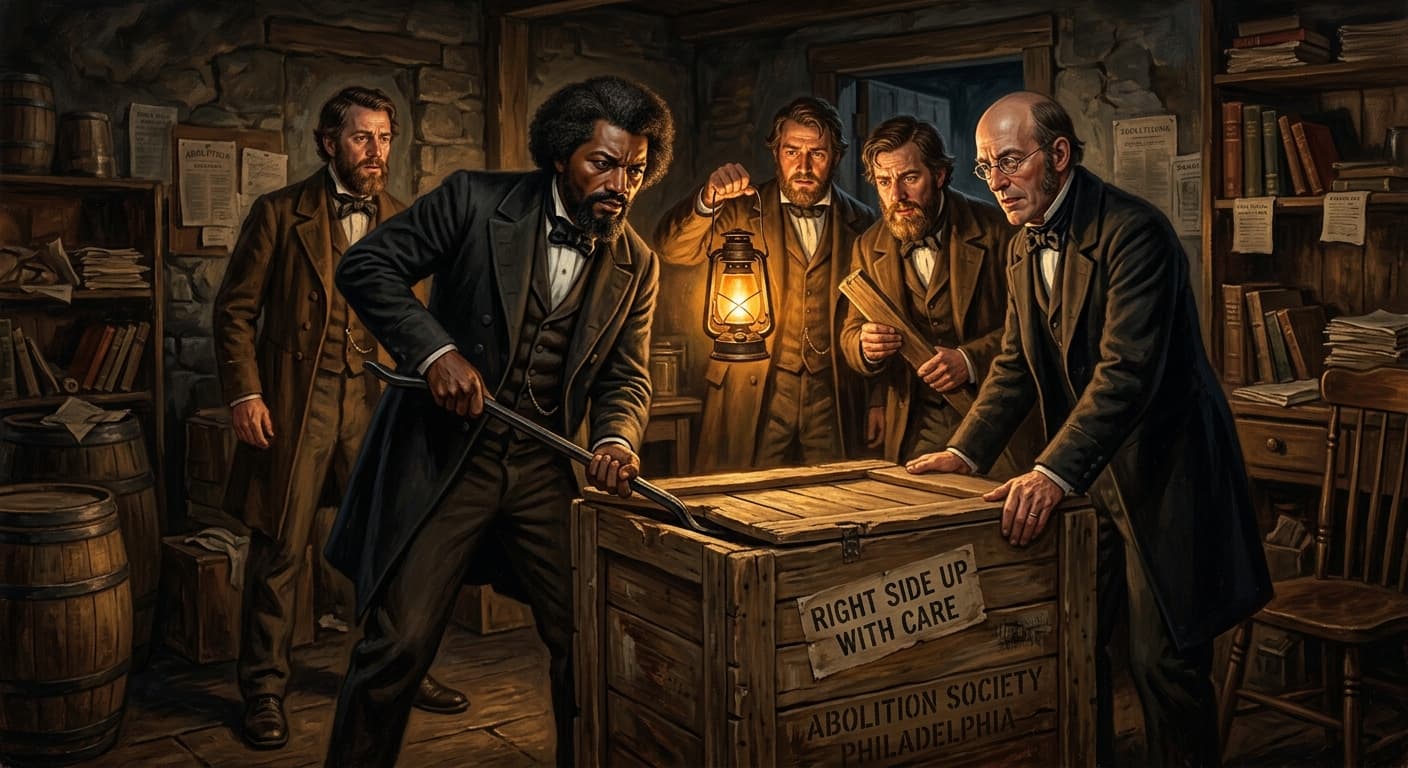
Finally, on the quiet morning of March 24, the battered crate arrived at the busy office of the Pennsylvania Anti-Slavery Society in Philadelphia. Prominent abolitionists, including the legendary William Still, gathered around the unassuming box in tense, breath-holding silence. They gently tapped on the wood and nervously asked if all was right within. From the absolute darkness, a weak, hoarse, but deeply triumphant voice replied, "All right."
The thick nails were swiftly pried loose, the hickory hoops were cut away, and Henry Brown emerged, utterly exhausted, completely drenched in sweat, but incredibly, miraculously alive. His very first act as a newly free man was to joyously recite a psalm of thanksgiving he had prepared specifically for the moment. From that day forward, he took on a unique middle name to forever honor his harrowing passage, becoming known to history as Henry "Box" Brown.
Brown’s incredible and wildly innovative escape made him an instant, legendary celebrity in abolitionist circles. He traveled extensively throughout the Northern states and eventually across Great Britain, loudly sharing his incredible story, performing as an illusionist and magician, and displaying a massive, custom-painted moving panorama of slavery to educate the wider public. While the 19th century is broadly replete with grand military battles, sweeping political movements, and monumental inventions, the deeply personal story of Henry "Box" Brown remains one of its most potent, enduring reminders of the unbreakable human spirit. It stands as a brilliant testament to the astonishing, unfathomable lengths to which a person will willingly go when driven by the fundamental, undeniable right to simply be free.