The Man Who Dynamited Troy: Heinrich Schliemann's Ruthless Quest for Homer's City
For centuries, the city of Troy was relegated to the realm of myth. Most 19th-century scholars believed that Homer's Iliad—with its epic tale of Achilles, Hector, and the face that launched a thousand ships—was nothing more than a magnificent work of fiction. But one man vehemently disagreed. Enter Heinrich Schliemann: a self-made German millionaire, a linguistic genius, and a relentless romantic who decided he was going to find the lost city of Troy. He succeeded, but in one of history’s greatest ironies, he largely destroyed the very city he spent his life searching for.
Born in 1822 in Mecklenburg, Germany, Schliemann was a man of extraordinary contradictions. He possessed an uncanny ability to learn languages, allegedly mastering 15 of them throughout his life. This talent, combined with a ruthless streak in business, allowed him to amass a vast fortune trading everything from indigo to Russian military supplies. But he was also a fabulist, often inventing grand stories about his own life. By 1868, in his mid-forties, he retired from business to pursue a childhood obsession: proving that Homer’s epic poems were historical fact.
Schliemann’s quest eventually brought him to the Ottoman Empire, specifically to a hill called Hisarlik in modern-day Turkey. He was not the first to suspect this site. A British expat and amateur archaeologist named Frank Calvert actually owned part of the hill and had already begun preliminary excavations, identifying it as the probable site of Troy. Schliemann, however, had the money, the ego, and the megaphone. He hijacked Calvert's theory, marginalized him entirely, and began a massive excavation in 1870.
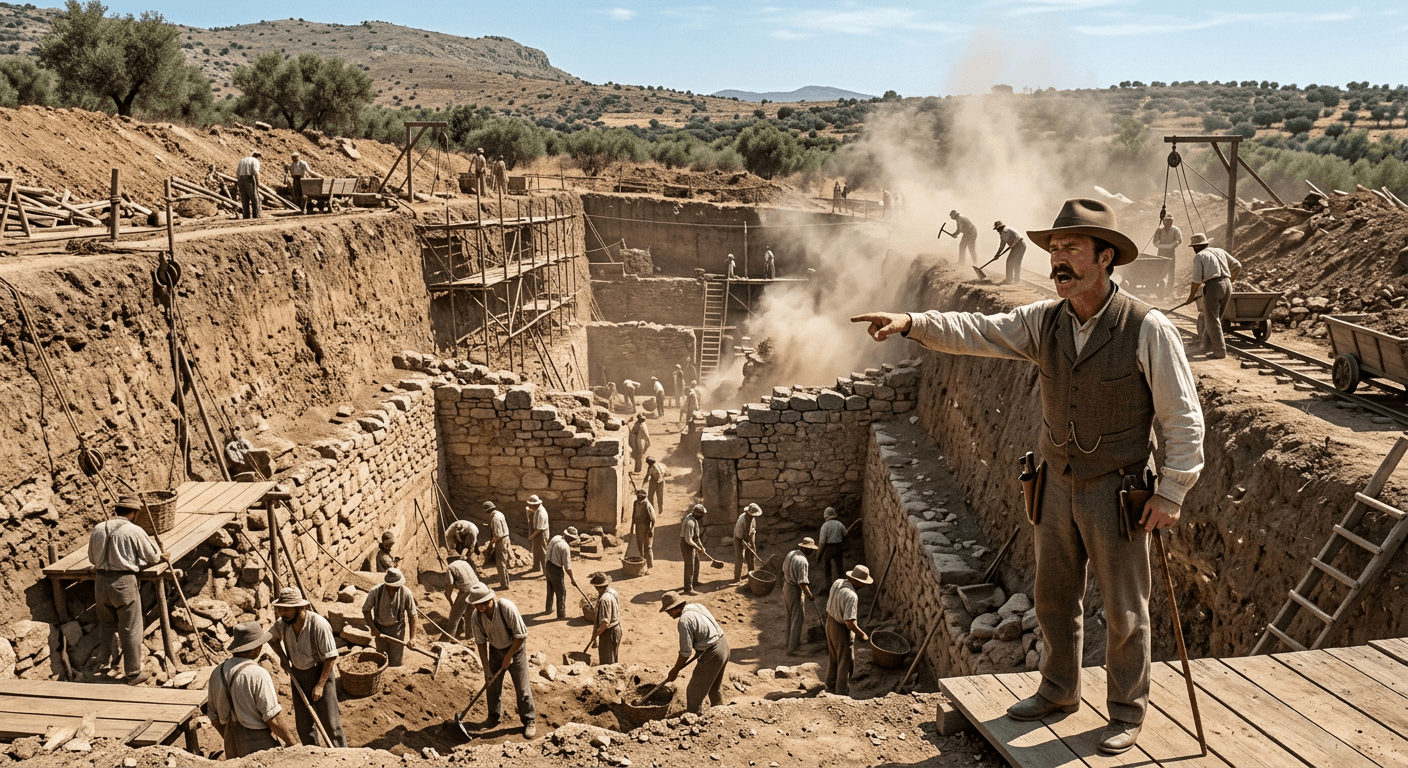
To call Schliemann’s methods 'unorthodox' by today's standards would be a profound understatement. Modern archaeology is a painstaking process of sifting through soil with brushes and dental picks. Schliemann, driven by a frantic desire to reach the deepest layers of antiquity where he believed King Priam’s city lay, approached the site like a mining operation. He hired hundreds of local laborers and ordered them to dig a colossal trench—70 feet deep and 130 feet wide—straight through the center of the hill.
When pickaxes and shovels proved too slow, Schliemann resorted to dynamite. In his blinding haste to find the Troy of the Trojan War, he blasted right through the actual Bronze Age layers that modern archaeologists now believe corresponded to Homer’s city (known today as Troy VI and VII). He completely obliterated the walls and artifacts he had set out to discover, throwing them onto the spoil heap as mere 'debris.'
Schliemann finally hit rock bottom—literally and archaeologically—at a layer now known as Troy II, a settlement that predated the Trojan War by over a thousand years. Here, in 1873, he struck literal gold. He uncovered a spectacular cache of copper shields, silver vases, and gold diadems, which he immediately and triumphantly dubbed 'Priam’s Treasure.'
Ever the showman, Schliemann didn’t just document the find; he smuggled the priceless artifacts out of the Ottoman Empire to Greece. He then arranged a global press campaign, most famously photographing his young Greek wife, Sophia, draped in the ancient gold jewels he claimed belonged to Helen of Troy. The photographs became an international sensation, capturing the imagination of the Victorian world and cementing Schliemann’s status as a legend.
The Ottoman government, understandably furious at the theft, sued Schliemann. He eventually paid a meager fine, kept the treasure, and later 'donated' it to the German government. In a twist of fate, the treasure was later looted by the Soviet Union at the end of World War II and remains in Russia today, a controversial artifact of a controversial excavation.
Heinrich Schliemann’s legacy remains one of the most polarizing in the history of science. He is rightfully credited with dragging the Bronze Age Aegean out of mythology and into the light of history. His later excavations at Mycenae were equally groundbreaking, uncovering the legendary gold 'Mask of Agamemnon.' Yet, his reckless enthusiasm and destructive methods earned him the eternal ire of modern archaeologists. He was a brilliant pioneer and a catastrophic blunderer—the man who proved Troy was real, only to blow it to pieces.