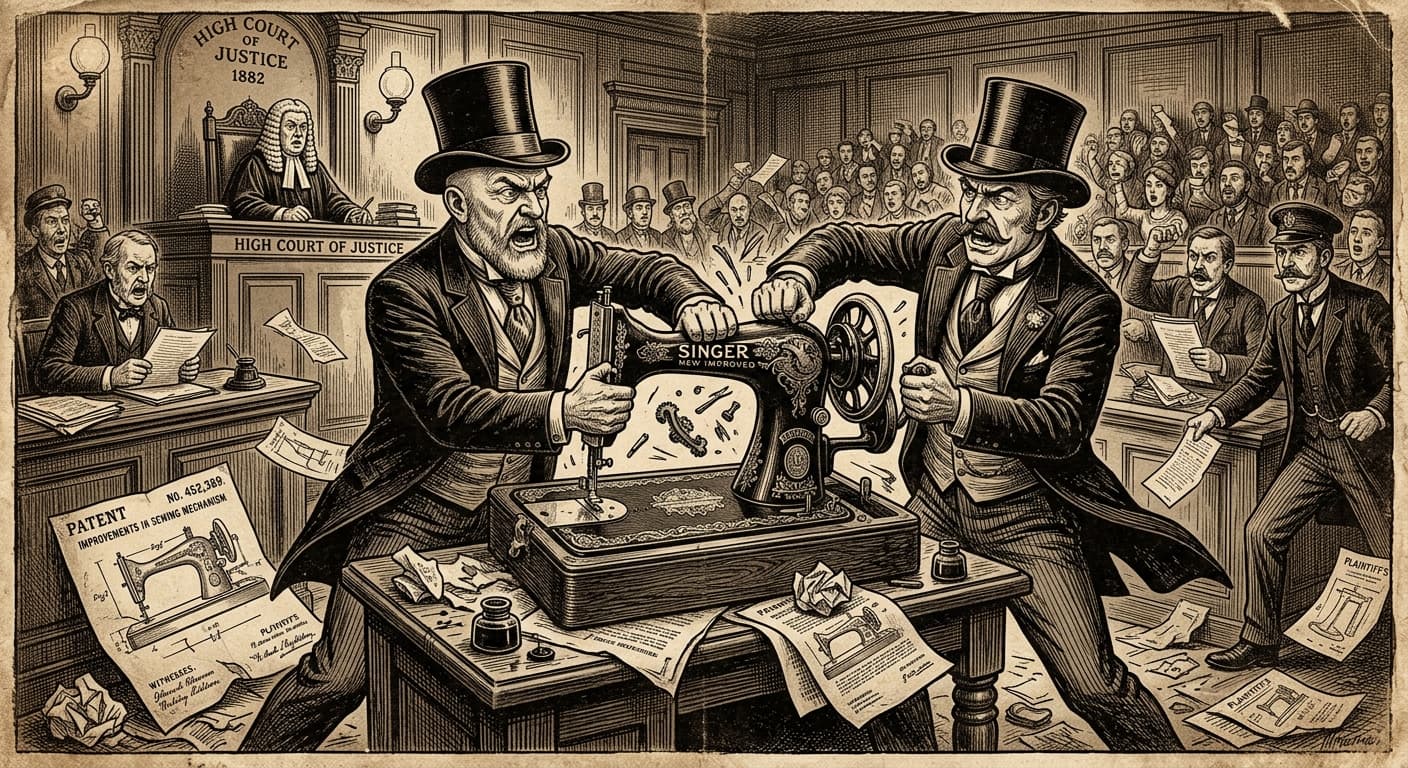
The Great Sewing Machine War: The Cutthroat Patent Battle That Stitched Modern America Together
Imagine a technological revolution so fiercely competitive that it triggered a labyrinth of brutal lawsuits, corporate espionage, and smear campaigns. It sounds like the early days of Silicon Valley or the smartphone wars, but this cutthroat battle took place in the mid-19th century. The prize? The domination of an invention that would fundamentally alter the global economy, reshape the textile industry, and emancipate millions from grueling manual labor: the sewing machine.
Before the 1850s, creating clothing was a staggering exercise in patience and endurance. A simple hand-sewn shirt could take an experienced seamstress up to fourteen hours to complete. Across the world, the demand for clothing was skyrocketing alongside growing populations, yet the method of production remained trapped in the Middle Ages. Inventors had spent decades trying to mechanize the motion of a needle and thread, usually resulting in clumsy, unreliable contraptions that tangled, broke, or failed to mimic the human hand.
The breakthrough came in 1846, courtesy of a struggling machinist from Massachusetts named Elias Howe. Howe achieved what others could not by completely rethinking the process. Instead of trying to replicate hand-sewing, he invented the lockstitch. Using a needle with the eye at the pointed end, his machine passed a loop of thread through the fabric, where it was caught by a second thread from a shuttle beneath, locking it into place. Howe patented his brilliant design, but he was a notoriously poor businessman. After struggling to find investors in America, he traveled to England, only to return years later penniless. To his shock, he found the American market suddenly flooded with unauthorized sewing machines that utilized his patented lockstitch.
Chief among these patent infringers was Isaac Merritt Singer. Singer was everything Howe was not: a flamboyant, silver-tongued former Shakespearean actor with a larger-than-life personality and a tangled, scandalous personal life. In 1850, Singer had examined a rudimentary sewing machine in a Boston repair shop and confidently declared he could improve it. In just eleven days, he completely redesigned the machine, adding a continuous feed mechanism and replacing the clumsy hand crank with a foot treadle. Singer's machine was robust, practical, and highly marketable—but it indisputably relied on Howe's eye-pointed needle and lockstitch.
Furious, Elias Howe sued Singer and a host of other rival manufacturers, plunging the nascent industry into what the press dubbed "The Great Sewing Machine War." For years, the major players dragged each other through the courts. Isaac Singer poured vast sums of money into fiercely defending his empire, digging up prior art and attempting to invalidate Howe's patent. Meanwhile, other inventors like Allen B. Wilson and Nathaniel Wheeler added their own patented innovations to the mix, such as the rotary hook. The result was a chaotic legal gridlock. No single manufacturer could build a truly modern, functional sewing machine without infringing on someone else's patent.
The stalemate was ultimately broken not by an engineer, but by a lawyer. In 1856, an attorney named Orlando B. Potter, representing the Grover & Baker sewing machine company, proposed a radical solution to the warring factions. Instead of bleeding themselves dry in court, why not pool their patents? Reluctantly, Howe, Singer, Wheeler & Wilson, and Grover & Baker agreed to combine their nine most crucial patents into the "Sewing Machine Combination." Anyone who wanted to manufacture a sewing machine could do so, provided they paid a licensing fee of $15 per machine to the Combination, a portion of which would go directly to Elias Howe.
This agreement was the first patent pool in American history, and it unleashed an economic juggernaut. Freed from legal paralysis, production skyrocketed. Isaac Singer, recognizing that the machines were still too expensive for the average household, pioneered the concept of the installment payment plan. By allowing families to pay a few dollars a month, Singer transformed the sewing machine into an indispensable household appliance, becoming outrageously wealthy in the process.
The Great Sewing Machine War may have begun in greed and hostility, but its resolution laid the groundwork for modern corporate collaboration. The machine itself went on to drastically reduce the time needed to make a garment from fourteen hours to just one. It sparked the ready-to-wear clothing industry, revolutionized women's domestic labor, and proved that sometimes, the most groundbreaking innovations are born not just from flashes of solitary genius, but from the messy, collaborative crucible of cutthroat competition.