The Bug That Almost Broke Bordeaux: How an American Aphid Brought French Wine to the Brink
In the mid-19th century, France's wine industry was an unstoppable juggernaut. It wasn't just an economic pillar; it was the very soul of the nation, steeped in centuries of tradition and pride. But in the 1860s, a silent, invisible invader arrived on French shores, one that would bring the world's greatest vineyards to their knees. It wasn't an invading army or a catastrophic weather event. It was a microscopic, sap-sucking aphid known as Phylloxera vastatrix. The ensuing crisis, known as the Great French Wine Blight, remains one of the most dramatic and devastating agricultural disasters in history.
The nightmare began subtly in the southern Rhône Valley around 1863. Vintners noticed their grapevines inexplicably turning a sickly yellow. The leaves withered, the fruit shriveled, and the vines died. When farmers pulled the dead plants from the earth, they found the roots had rotted into a blackened, decaying sludge. Whatever was killing the vines was doing so from the ground up. By the time the symptoms were visible above ground, the plant was already doomed. The mysterious blight spread with terrifying speed, radiating outward from the Rhône and marching relentlessly toward the legendary vineyards of Bordeaux, Burgundy, and Champagne.
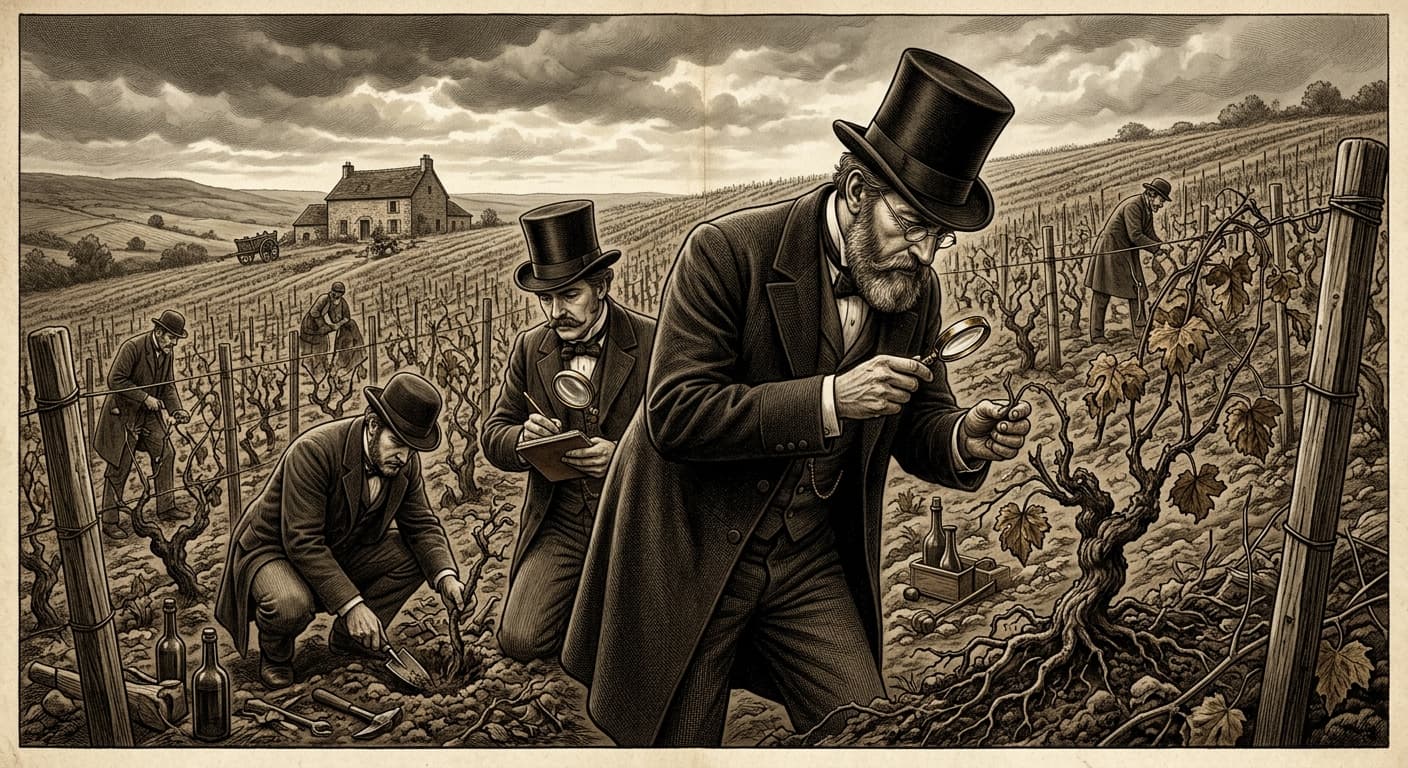
For years, French botanists and vintners were entirely baffled. It wasn't until 1868 that a team of scientists, led by Jules Émile Planchon, made a breakthrough. By uprooting a vine that was only in the early stages of the disease, Planchon discovered thousands of microscopic, yellowish insects swarming the roots. The aphid, Phylloxera, was feeding on the sap of the vine's roots, injecting a venom that caused fatal galls and rotting. But where had this devastating pest come from? The answer lay in a marvel of 19th-century engineering: the steamship.
For decades, European botanists had been importing American vine species (Vitis labrusca) for experimentation and cross-breeding. In the days of slow-moving sailing ships, any Phylloxera aphids stowing away on the roots died during the long Atlantic crossing. However, the advent of the steamship in the mid-19th century drastically cut travel times. The aphids now survived the journey. American vines had evolved alongside Phylloxera for millennia, developing thick, resistant roots that healed quickly from the insect's bites. The noble European vines (Vitis vinifera), however, had no evolutionary defenses. They were sitting ducks.
As the aphid devoured France's heritage, panic set in. Wine production plummeted by over 70%, devastating the French economy. The government offered a massive reward of 300,000 francs to anyone who could find a cure. The result was a wave of desperate, often bizarre remedies. Vintners tried burying live toads beneath the vines to draw out the "poison." Others watered their vineyards with white wine, hoping to cure the soil. Some even flooded their fields or injected the earth with highly flammable carbon disulfide. While the chemical treatments killed the aphids, they were prohibitively expensive, dangerous to apply, and ultimately unsustainable.
The true salvation of French wine came from a highly controversial, transatlantic collaboration. Planchon, along with American entomologist Charles V. Riley and Texas botanist T.V. Munson, proposed a radical idea: "reconstitution." If American roots were immune to the pest, and European vines produced superior wine, why not marry the two? They suggested grafting the aristocratic French scions onto the hardy, pest-resistant American rootstocks.
The proposal ignited a fierce ideological battle in France. The traditionalists, known as the "Chemists," were horrified. They viewed the American vines as coarse and barbaric. To graft their sacred terroir onto foreign roots felt like an unforgivable contamination of French culture. The "Americanists," however, argued it was the only way to save the industry from total annihilation. For years, the two factions waged a bitter war of words in scientific journals and village squares alike.
Eventually, the sheer devastation of the landscape forced the traditionalists' hands. Out of options, France began the monumental task of grafting billions of vines. It was a painstaking, labor-intensive process, but it worked. The newly grafted vines thrived, completely immune to the Phylloxera lurking in the soil. The vineyards rebounded, and the Great French Wine Blight was finally defeated. Today, with the exception of a few isolated patches of sandy soil, nearly every bottle of French wine—from the humblest table wine to the most expensive Bordeaux—owes its existence to the humble American root. It stands as a profound 19th-century lesson in the unintended consequences of global travel and the triumphant power of international scientific cooperation.