The Gravity Ride to Salvation: How a Sunday School Teacher Invented the Roller Coaster to Save America from Sin
If you were to stroll down the beaches of Coney Island in the late 19th century, you would be greeted by a cacophony of sights and sounds that thrilled the working class and utterly terrified the morally upright. During the Gilded Age, the booming industrial economy had finally afforded everyday Americans something they had rarely possessed before: leisure time. But to the dismay of religious reformers, this hard-earned free time was frequently squandered in saloons, gambling parlors, and bawdy houses.
Enter LaMarcus Adna Thompson, a successful businessman, staunch prohibitionist, and devout Sunday school teacher. To Thompson, the moral decay of the American public was a crisis of epic proportions. He believed that if he could provide people with a wholesome, family-friendly distraction, he could steer them away from the temptations of the tavern. His solution to humanity's sinful nature was as unorthodox as it was brilliant: he would invent the roller coaster.
Thompson’s inspiration did not come from a void, but rather from the mountains of Pennsylvania. The Mauch Chunk Switchback Railway, originally constructed in 1827 to haul coal down from the mountains to the Lehigh River, had evolved. When the coal mines began to dry up, operators realized that the thrilling, gravity-powered descent was a massive draw for thrill-seekers. For a small fee, tourists would ride the terrifying, high-speed runaway train down the mountain. Thompson realized that if he could harness this pure, visceral thrill and package it into a safe, controlled environment, he could capture the public's imagination.
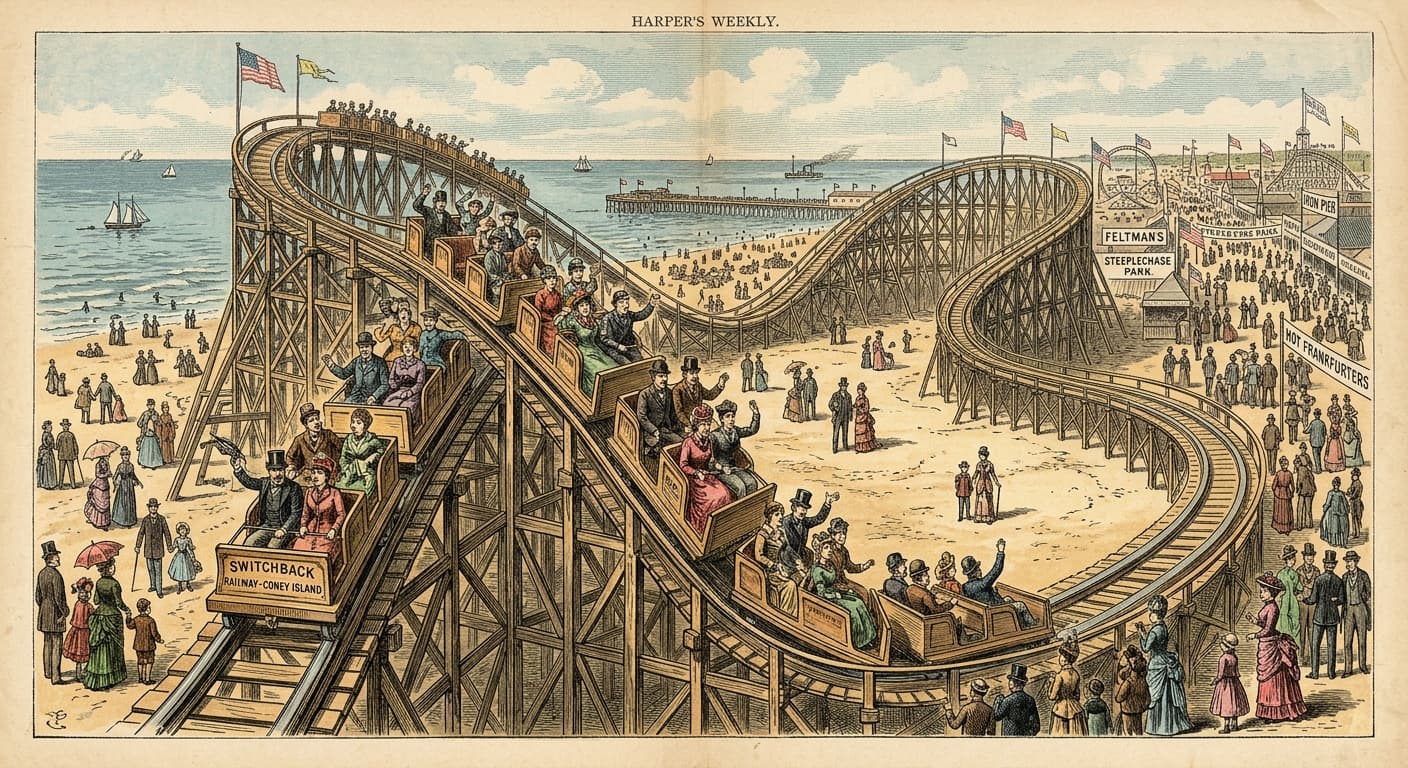
In the spring of 1884, Thompson unveiled his grand experiment on the sandy shores of Coney Island: the "Switchback Railway." By modern standards, Thompson's contraption was remarkably tame. It consisted of two parallel wooden tracks, roughly 600 feet long, undulating with gentle hills. Passengers would climb a 50-foot tower, board a bench-like car where they sat facing outward, and be given a gentle push. Gravity did the rest.
The cars rumbled along the wooden track at a blistering top speed of six miles per hour. When the car reached the opposite tower, the passengers disembarked, workers manually moved the vehicle to the return track, and the riders coasted back to the start. The cost for this grand adventure? A single nickel.
Despite its modest speed, the Switchback Railway was an overnight sensation. The sheer novelty of the experience left riders breathless, giggling, and eagerly lining up for more. Thompson's invention was bringing in an astonishing $600 a day—a massive fortune in 1884—and the ride paid for itself in a matter of weeks. More importantly to Thompson, every nickel spent on his railway was a nickel not spent on cheap whiskey.
However, the cutthroat world of Gilded Age capitalism waits for no man, not even a righteous one. Almost immediately, rivals sprang up to improve upon Thompson's design. A man named Charles Alcoke built a continuous oval track so passengers wouldn't have to get out and switch cars. Shortly after, Phillip Hinkle introduced a revolutionary concept: a steam-powered chain lift that hauled the cars up the initial incline, sparing riders the exhausting climb up the stairs.
Refusing to be outdone, Thompson pivoted. If he couldn't have the fastest or the most efficient ride, he would have the most spectacular. He began constructing "Scenic Railways." These elaborate coasters took riders through dark tunnels illuminated by newly invented electric lights, past painted dioramas of the Swiss Alps, and alongside dramatic biblical scenes. It was the world's first immersive theme park ride, perfectly aligning with Thompson's vision of wholesome, educational entertainment.
By the time of his death in 1919, LaMarcus Adna Thompson had built dozens of scenic railways across the globe, earning the moniker "Father of the Gravity Ride." Today, the global roller coaster industry is a multi-billion-dollar enterprise characterized by dizzying loops, magnetic launches, and heart-stopping drops. It is a wildly secular temple of adrenaline, far removed from its pious origins. Yet, every time a modern thrill-seeker straps into a coaster and screams at the top of their lungs, they are unknowingly participating in a 19th-century Sunday school teacher's master plan to save their soul.