The Corpse That Danced: Giovanni Aldini and the Electrifying True Story Behind Frankenstein
When Mary Shelley famously dreamed up a patchwork monster jolted into life on a stormy night in Geneva, she birthed the modern science fiction genre. But the terrifying concept at the heart of her 1818 masterpiece, Frankenstein, wasn’t pulled out of thin air. It was heavily inspired by the very real, very gruesome science of the early 19th century—specifically, the horrifying public demonstrations of an Italian physicist who quite literally made the dead dance.
To understand the true origins of Dr. Frankenstein's monster, one must first look to Luigi Galvani, an 18th-century scientist who discovered that applying an electrical spark to a dead frog's legs caused them to twitch. Galvani theorized the existence of "animal electricity," believing that electrical fluid was the biological life force itself. While Galvani was a serious and somewhat reserved academic, his nephew, Giovanni Aldini, was an eccentric showman who decided to take his uncle’s theories on a macabre tour across Europe.
As the 19th century dawned, Aldini realized that to capture the attention of both the scientific community and the general public, he needed a spectacle. He scaled up from frogs to larger mammals. Traveling through Europe, Aldini would set up early batteries—known as voltaic piles—and apply conducting rods to the severed heads of oxen, horses, and dogs. The electrical current would force the dead animals' eyes to roll, their jaws to snap shut, and their tongues to loll out. But to truly prove that electricity was the bridge between life and death, Aldini needed a human subject.
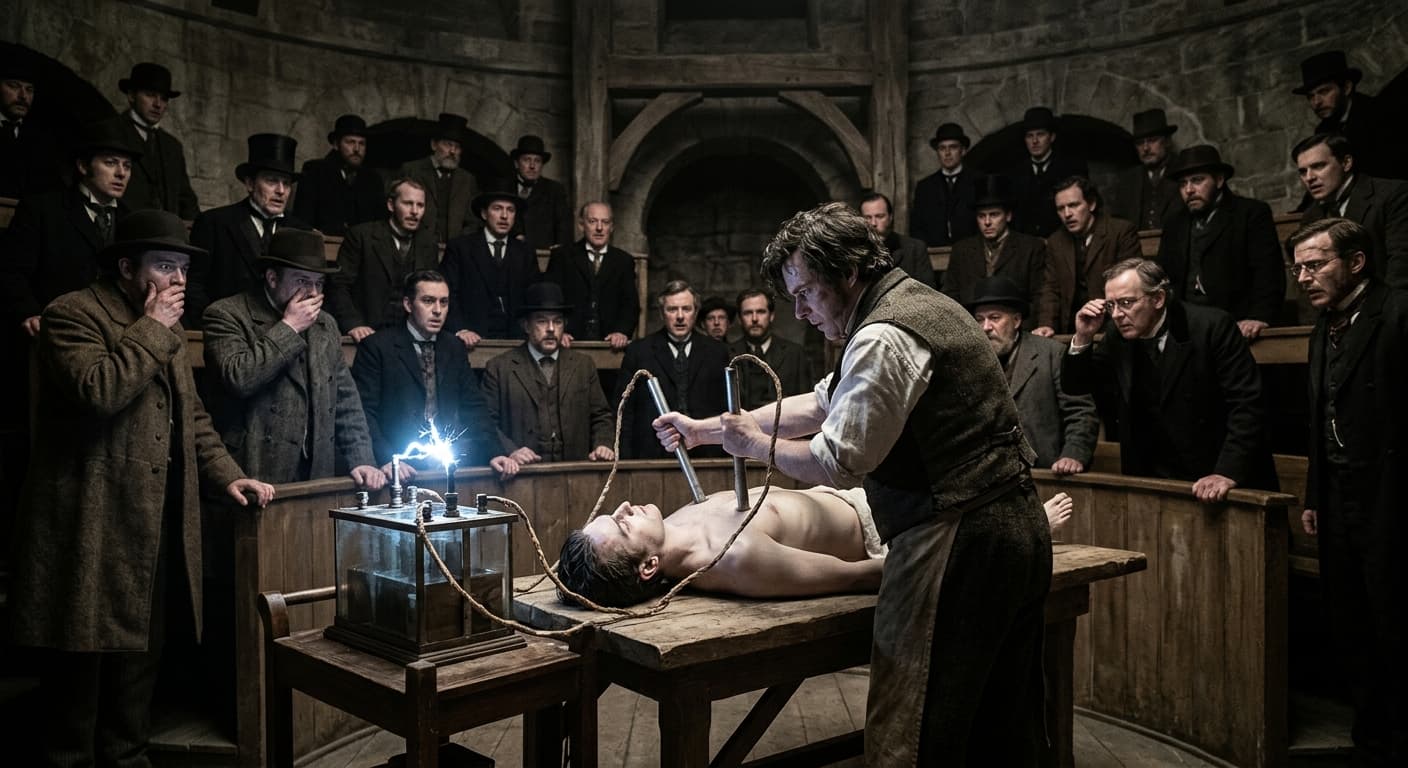
His golden opportunity arrived in London on January 18, 1803. A 26-year-old man named George Forster had been executed by hanging at Newgate Prison for the murder of his wife and child. Under the strictures of the Murder Act of 1752, the bodies of executed criminals were denied a Christian burial and instead handed over to surgeons for dissection. Freshly cut from the gallows, Forster’s lifeless body was rushed to the Royal College of Surgeons, where Aldini was waiting with his batteries primed.
What happened next is the stuff of genuine gothic nightmare. Before an audience of esteemed medical professionals, politicians, and curious aristocrats, Aldini began his gruesome work. When he applied the conducting rods to Forster’s mouth and ear, the corpse's jaw began to quiver violently. The adjoining muscles contorted in horrific grimaces, and one of the dead man's eyes suddenly snapped open.
Aldini then moved the current down the body. When he shocked Forster’s chest and limbs, the corpse’s right hand raised and clenched into a tight fist. The dead man's legs kicked and thrashed so violently against the wooden table that many in the room genuinely believed Forster was coming back to life. The audience was cast into a state of sheer panic. According to historical legend, Mr. Pass, the beadle of the Surgeons’ Company, was so thoroughly traumatized by the sight of the writhing murderer that he suffered a fatal heart attack shortly after returning home.
The press had a field day. Newspapers published sensational accounts of the event, sparking a fierce philosophical and theological debate across Britain. Had humanity discovered the literal spark of life? Could a scientist play God and reverse the finality of death? Aldini himself was relatively grounded about the implications. He noted in his journals that he was merely mapping the nervous system and lacked the power to restart a heart, but the public imagination had already caught fire.
The cultural fallout of Aldini's ghastly exhibition echoed for decades. Mary Shelley, whose husband Percy was deeply fascinated by the science of "galvanism," was well aware of these experiments. When she sat down to write her legendary ghost story, she channeled the spirit of Giovanni Aldini into the obsessive character of Victor Frankenstein, transforming a bizarre chapter of medical history into immortal literature.
Ultimately, Aldini’s dreams of reanimation faded into obscurity as science progressed, but his legacy is far from entirely fictional. By proving that electrical currents could stimulate the body's muscular and nervous systems, he inadvertently laid the foundational groundwork for electrophysiology. Today, every time a paramedic uses a defibrillator to shock a failing heart back into rhythm, they are relying on the very same principles that a theatrical Italian scientist once used to terrify Victorian London.