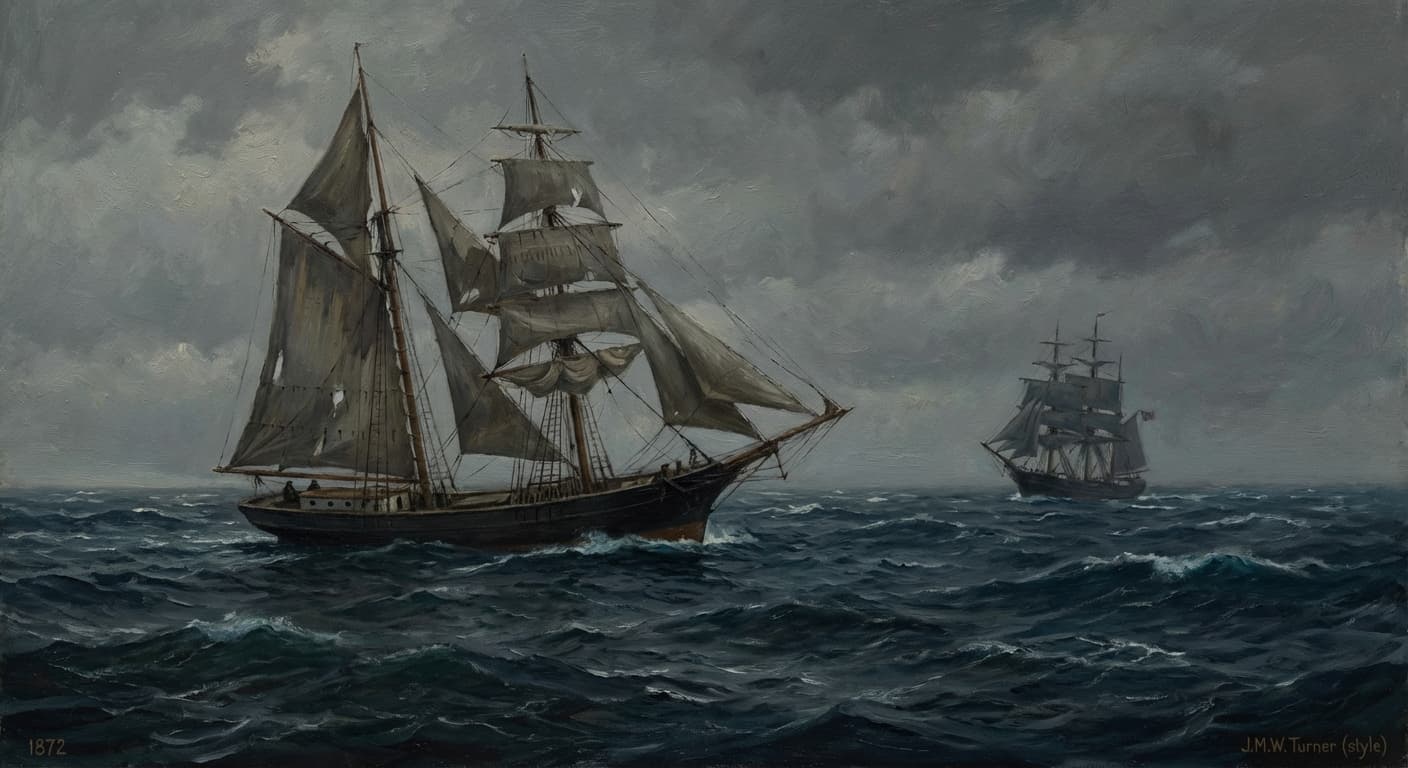
Ghost Ship of the Atlantic: The Enduring Riddle of the Mary Celeste
On the afternoon of December 4, 1872, the crew of the British brigantine Dei Gratia spotted a vessel drifting erratically through the chopping waves of the Atlantic, roughly 600 miles off the coast of Portugal. Captain David Morehouse recognized the ship immediately; it was the Mary Celeste, an American merchant brig he had seen docked in New York just a month prior. Yet, something was wrong. Her sails were slightly torn and set in a chaotic fashion, and she was yawing wildly in the wind. There were no distress signals flying, and the deck appeared ominously deserted. What Morehouse’s crew found upon boarding would spark one of the greatest nautical mysteries in history, a riddle that remains unsolved more than a century and a half later.
When the boarding party from the Dei Gratia clambered onto the Mary Celeste, they were met with an unnerving silence. The ship was in seaworthy condition, yet not a single soul was on board. The captain, Benjamin Briggs, his wife Sarah, their two-year-old daughter Sophia, and seven experienced crew members had simply vanished. Contrary to the pop-culture myths that would later emerge—tales of half-eaten breakfasts still warm on the table or smoking pipes left in ashtrays—the reality was starker but equally confusing. The ship’s single lifeboat was missing. The binnacle housing the ship's compass had been knocked over and the glass broken. A makeshift sounding rod (used to measure water in the hold) was abandoned on the deck.
The condition of the ship deepened the mystery. There was about three and a half feet of water in the hold—a significant amount, but certainly not enough to sink a sturdy vessel of that size, and the ship’s pumps were in working order. The cargo, consisting of 1,701 barrels of denatured alcohol bound for Genoa, appeared largely untouched. There were no signs of a struggle, no blood, and no fire damage. In the captain's cabin, personal items were scattered but not looted; a sword lay under the bed, and the ship's logbook was found on the desk. The final entry, dated ten days prior at 8:00 AM on November 25, gave no indication of trouble, merely noting their position near Santa Maria Island in the Azores.
The Dei Gratia crew sailed the ghost ship to Gibraltar, hoping to claim a salvage reward. However, the subsequent inquiry turned into a media sensation and a legal nightmare. Frederick Solly Flood, the Attorney General of Gibraltar, was convinced that a crime had been committed. He floated theories ranging from crew mutiny to a conspiracy between Briggs and Morehouse to defraud insurers. Flood even analyzed reddish stains found on the captain’s sword and the rail, proclaiming them to be blood, only for scientific analysis to later prove they were merely rust and mold. Despite the lack of evidence, the shadow of suspicion hung over the rescuers, and they were awarded only a fraction of the cargo’s value.
In the absence of facts, fiction rushed in to fill the void. In 1884, a young Arthur Conan Doyle published a short story titled J. Habakuk Jephson's Statement, which presented a sensationalized, fictional account of the events. Doyle changed the spelling to the Marie Celeste, a mistake that persists in the public consciousness to this day, and added embellishments like the still-warm tea and untouched meals. These fabrications became so entwined with the actual history that distinguishing the truth became nearly impossible for the casual observer.
So, what actually happened to Captain Briggs and his family? Modern historians and maritime experts lean toward a theory involving the cargo. Upon unloading in Genoa, it was discovered that nine barrels of the alcohol were empty. These barrels were made of red oak, which is more porous than white oak, and may have leaked. It is plausible that a buildup of alcohol fumes in the hold caused a small pressure explosion—a "popping" of the hatch covers—that terrified the captain. Fearing the ship was about to explode, Briggs likely ordered everyone into the lifeboat, tethering it to the Mary Celeste with a long line to wait out the danger. If a sudden squall struck, the line could have snapped, leaving the small boat unable to catch up to the brigantine as it sailed away on the wind, dooming the ten souls to the merciless Atlantic.
While the "fume theory" is the most scientifically sound, it remains unproven. The Mary Celeste continued to sail under different owners for 12 years, viewed by sailors as a cursed ship, until she was intentionally wrecked in an insurance fraud scheme in Haiti. The wreck may be gone, but the image of the ship drifting silently under partial sail remains the ultimate symbol of the ocean's terrifying power to keep its secrets.