The Ice King of Boston: How One Stubborn Visionary Sold Winter to the Tropics
If you were to hand someone a glass of warm water today, you would likely be met with a look of sheer bewilderment. Ice is a fundamental expectation of modern life, a cheap and ubiquitous comfort that we take entirely for granted. But cast your mind back to the dawn of the 19th century. If you lived in a tropical climate—say, Havana or Calcutta—ice was practically a myth, an impossible luxury known only through books or travelers' tales. That is, until a spectacularly stubborn Bostonian named Frederic Tudor decided he was going to harvest the freezing New England winter and sell it to the sweltering world.
Born in 1783 into a wealthy Massachusetts family, Tudor was a young man with grand ambitions and very little practical sense. In 1805, while enjoying a cold drink at a family picnic, a joke was made about how much the colonists in the West Indies would pay for the ice floating in their glasses. While his family laughed, Tudor saw an empire. He decided he would carve frozen blocks out of the pristine ponds of Massachusetts, pack them into the wooden holds of sailing ships, and sell them to sweating plantation owners in the Caribbean.
His contemporaries thought he had lost his mind. When Tudor sought investors for his initial voyage, he was laughed out of the financial districts of Boston and New York. Sailors were terrified to take the job, convinced that the melting ice would inevitably flood and sink their ships. Unfazed, Tudor purchased his own ship, the brig Favorite, and in February 1806, he set sail for Martinique with 130 tons of ice carved from a nearby pond.
The maiden voyage was an unmitigated disaster. While the ice remarkably survived the journey across the warm Atlantic, Tudor arrived to find a population that had no idea what to do with his product. There were no icehouses in Martinique, and the locals were unfamiliar with the concept of chilling their drinks or preserving their food with cold. The cargo melted away in the Caribbean sun, and Tudor lost nearly $4,500—a massive fortune at the time. Over the next decade, Tudor’s obsessive pursuit of his frozen dream landed him in debtor’s prison no less than three times.
Yet, the "Ice King," as he was mockingly called, refused to concede defeat. He realized that to sell ice, he first had to teach people how to use it. He built heavily insulated icehouses in Havana, Charleston, and New Orleans. He taught barkeeps how to mix iced cocktails and instructed doctors on how to use ice to soothe feverish patients. He even offered his product for free at first, knowing that once people experienced the luxury of a cold drink on a scorching day, they would be forever hooked.
The true turning point for Tudor's empire, however, came through a brilliant partnership. In the 1820s, he teamed up with Nathaniel Wyeth, a Boston hotel owner and inventor. Wyeth revolutionized the ice industry by inventing a horse-drawn ice plow, turning what was a slow, grueling manual process into a highly efficient industrial operation. Furthermore, Tudor discovered that cheap, abundant pine sawdust from New England's booming lumber industry was the perfect insulator. Packed tightly in sawdust, ice could survive journeys of astonishing length.
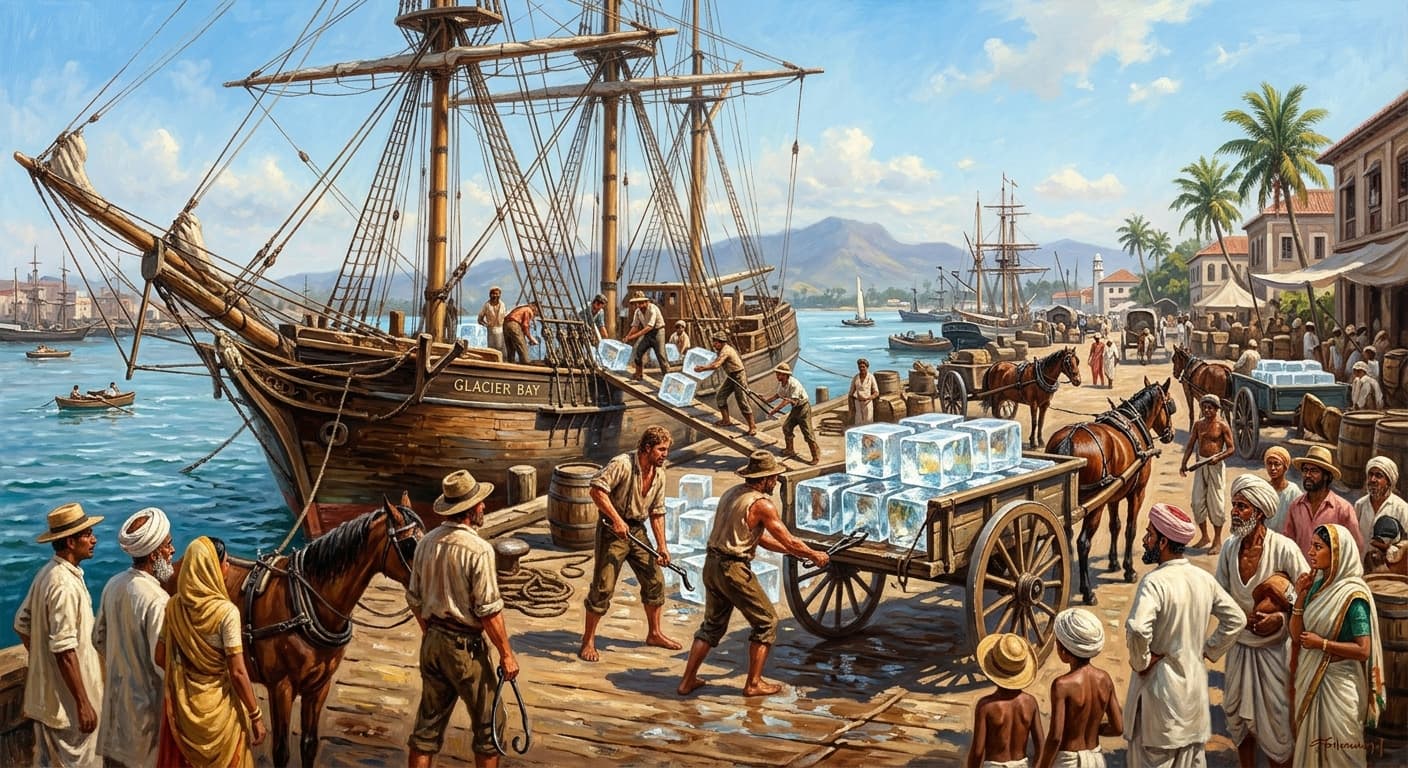
Armed with Wyeth's efficiency and sawdust insulation, Tudor executed his most audacious gamble yet. In 1833, he shipped 180 tons of ice 16,000 miles around the Cape of Good Hope to Calcutta, India. The journey took four months and crossed the equator twice. When the ship arrived, the British colonists were so astounded by the surviving ice that they immediately raised funds to build a massive icehouse. The Calcutta trade proved wildly lucrative, officially cementing Tudor’s status as a bona fide magnate.
By the time Frederic Tudor died in 1864, he was a very wealthy man, and the "frozen water trade" was one of the most vital industries in America. Hundreds of ships carried hundreds of thousands of tons of New England winter to every corner of the globe, fundamentally altering global culinary and social habits. Tudor had done the impossible: he had commodified the cold, proving that with enough sawdust and stubbornness, you truly could sell ice to anyone.