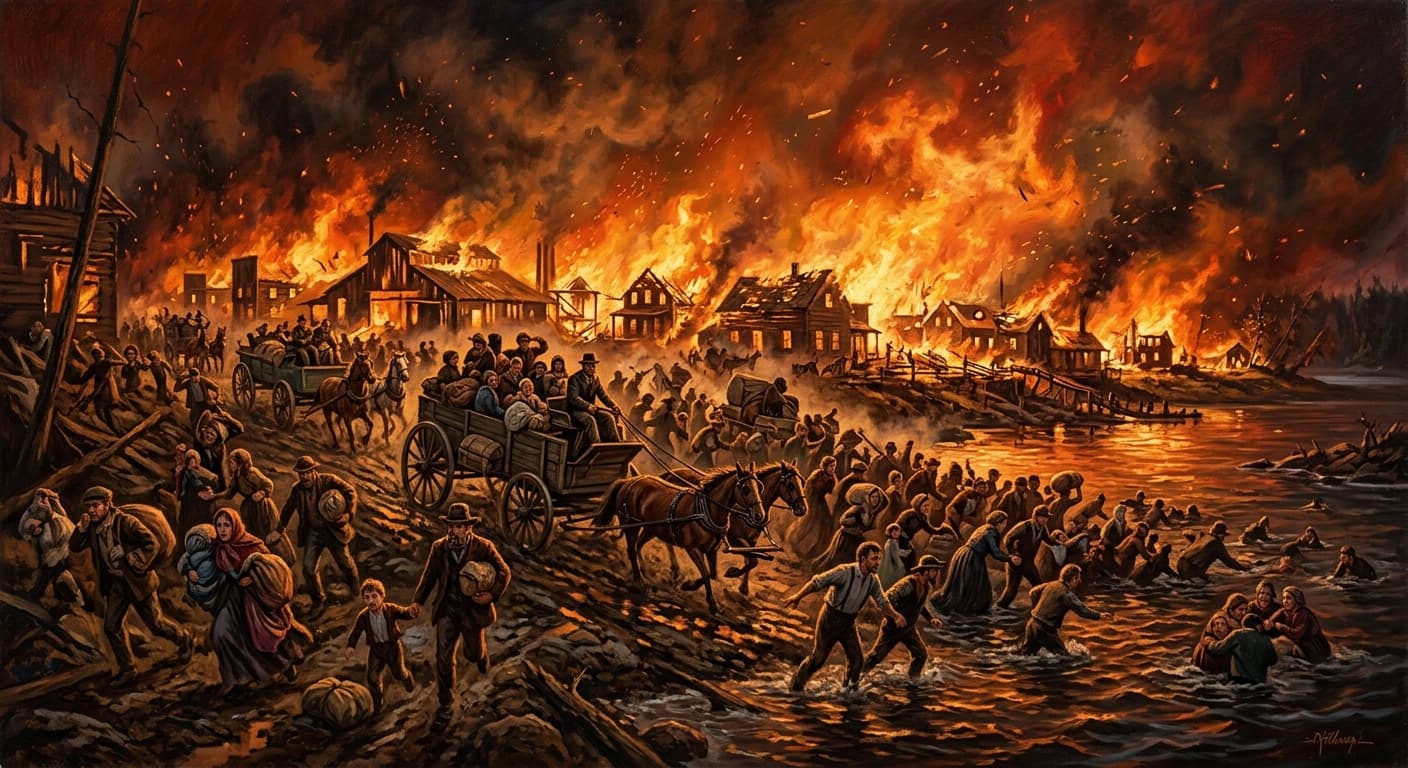
The Forgotten Inferno: How the Deadliest Wildfire in History Was Eclipsed by Chicago
October 8, 1871, is a date forever seared into the annals of American history. If you ask anyone with a passing interest in the 19th century what happened on that fateful Sunday, they will almost certainly point to the Great Chicago Fire. They might even mention Mrs. O’Leary’s infamous, scapegoated cow. The blaze that leveled the Windy City claimed approximately 300 lives and left a third of the city's population homeless, dominating headlines and capturing the sympathy of the globe.
Yet, while the world was watching Chicago burn, a far more apocalyptic nightmare was unfolding just 250 miles to the north. On the exact same night, the deadliest wildfire in recorded history obliterated the logging boomtown of Peshtigo, Wisconsin, and several surrounding villages. The Peshtigo Fire claimed an estimated 1,500 to 2,500 lives—up to eight times the death toll of Chicago—yet it remains a tragic footnote, completely eclipsed by the destruction of the Midwestern metropolis.
To understand how a disaster of this magnitude occurred, one must look at the perfect storm of environmental and human factors brewing in the fall of 1871. The upper Midwest was enduring an unprecedented drought. It had not rained significantly in months. The region was the beating heart of the booming American lumber industry, and towns like Peshtigo were built entirely of wood—wooden houses, wooden sidewalks, and streets literally paved with highly flammable sawdust.
Furthermore, the common practice of slash-and-burn land clearing meant that small, smoldering brush fires were a daily occurrence. The air in Wisconsin had been thick with smoke for weeks, so much so that ships navigating the nearby Bay of Green Bay had to rely on foghorns to avoid collisions in broad daylight. The residents of Peshtigo were entirely accustomed to the smell of burning timber. They had no idea they were living in a tinderbox waiting for a singular, catastrophic gust of wind.
On the evening of October 8, a massive cyclonic weather system swept into the region. The plummeting atmospheric pressure and howling winds fanned the scattered brush fires into a towering, monstrous wall of flame. This was not a normal wildfire; it was a "firestorm"—a localized atmospheric phenomenon where a fire burns so intensely that it creates its own cyclonic wind system. Survivors later described the approaching inferno as sounding like a fleet of freight trains roaring through the dark forest.
The town of Peshtigo was consumed in less than an hour. The heat was so incomprehensibly intense—estimated by modern experts at 2,000 degrees Fahrenheit—that it melted train cars, turned sand into glass, and caused houses to spontaneously combust before the flames even touched them. Desperate townsfolk had only one avenue of escape: the frigid waters of the Peshtigo River.
Panic ensued as men, women, children, and terrified livestock stampeded toward the water. Those who managed to plunge into the river had to endure agonizing hours submerged to their necks, constantly splashing water over their heads to keep their hair from catching fire from the relentless rain of glowing embers. They battled hypothermia in the freezing water while the air above them literally burned. The fire was so massive that it consumed the oxygen in the atmosphere, suffocating many who had managed to evade the physical flames.
When dawn finally broke, the landscape resembled an alien wasteland. Peshtigo had been wiped from the face of the earth. Over a million acres of prime forest were reduced to fine white ash. The staggering loss of life left the surviving population traumatized and utterly destitute.
Why, then, is the Peshtigo Fire so completely overshadowed by Chicago? The answer lies largely in the technology of the era. Chicago was a major hub of commerce and communication. When its telegraph lines went down, the sudden silence immediately alerted the world that something disastrous had happened. Peshtigo, by contrast, was an isolated frontier town. Its single telegraph line was severed by the fire before any call for help could be sent. By the time word of the Wisconsin annihilation finally reached the outside world days later, newspapers were already entirely saturated with dramatic coverage of Chicago's ruin.
Today, the Peshtigo Fire stands as a chilling testament to nature's unpredictable fury and the arbitrary nature of historical memory. It is a sobering reminder that the greatest tragedies are not always the ones that make the loudest noise in the press, but sometimes the ones that unfold in the dark, isolated corners of the world, leaving behind only ash and forgotten ghosts.