The Prime Minister and the Frustrated Merchant: The Forgotten Assassination of Spencer Perceval
When we think of assassinated leaders of the 19th century, our minds naturally drift across the Atlantic to the tragic fates of Abraham Lincoln or James A. Garfield. Yet, decades before John Wilkes Booth slipped into Ford's Theatre, an equally shocking assassination rocked the halls of British power. On May 11, 1812, Spencer Perceval, the Prime Minister of Great Britain, was gunned down in the lobby of the House of Commons. To this day, he remains the only British Prime Minister to have ever been assassinated.
The man who pulled the trigger was not a French spy, nor was he a radical revolutionary hoping to topple the monarchy. He was, astonishingly, just a deeply frustrated merchant tired of being ignored by the bureaucratic machine.
To understand the murder of Spencer Perceval, we first have to understand the assassin: John Bellingham. A seemingly ordinary businessman from St. Neots, Bellingham's path to infamy began thousands of miles away in Russia. In 1803, while working as an export agent in Archangel, Bellingham found himself caught up in a convoluted financial dispute. Through a series of bizarre legal maneuvers and false accusations by Russian merchants, Bellingham was thrown into a harsh Russian prison for debt.
Bellingham desperately appealed to the British authorities in Russia, particularly the ambassador, Lord Leveson-Gower, begging for diplomatic intervention. The ambassador, viewing it as a civil commercial dispute, essentially told Bellingham he was on his own. After spending five grueling years in the Russian penal system, Bellingham was finally released in 1809 and returned to England, financially ruined and burning with a deep, righteous resentment.
Upon returning home, Bellingham became a man obsessed. He firmly believed the British government owed him compensation—specifically £100,000—for its failure to protect a British subject abroad. He began a relentless letter-writing campaign, petitioning every conceivable office: the Treasury, the Privy Council, the Prime Minister's office, and even the Prince Regent. Every single petition was met with the same polite but firm 19th-century equivalent of "return to sender."
In the spring of 1812, after being told by a weary civil servant that he was free to take whatever measures he deemed necessary, Bellingham decided he had exhausted his peaceful options. He purchased a pair of half-inch caliber pistols, had a tailor sew a special hidden pocket into his overcoat, and began frequenting the lobby of the House of Commons to familiarize himself with the faces of the government ministers.
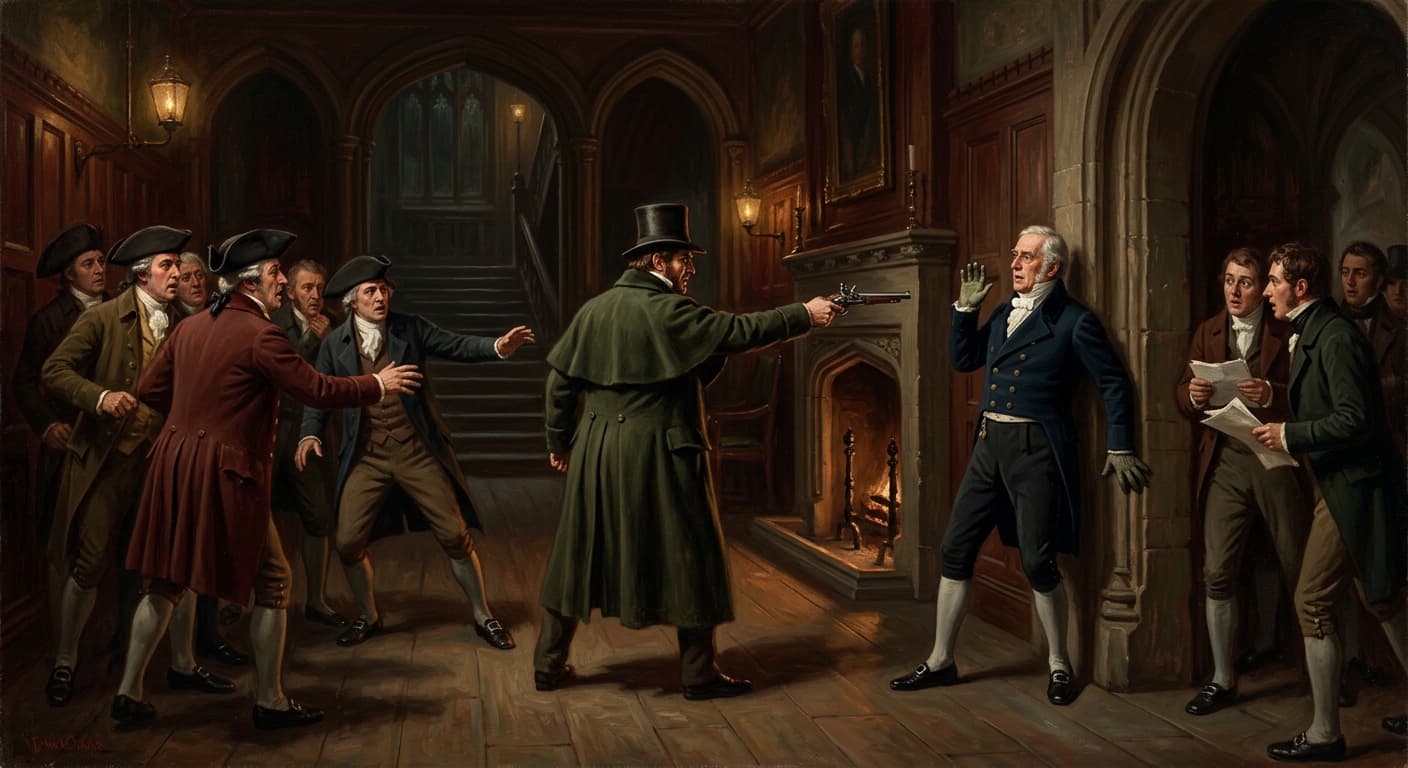
The evening of May 11 was remarkably mundane. Spencer Perceval, a hard-working and relatively popular Prime Minister among his peers—though less so with a public suffering under the heavy economic strain of the Napoleonic Wars—arrived at the House of Commons late for an inquiry. As he hurried through the bustling lobby, Bellingham stepped out from the shadows. Without a word, he drew a pistol, leveled it directly at Perceval's chest, and fired.
The Prime Minister staggered forward, uttering something that sounded like "Murder!" or "Oh my God!" before collapsing onto the cold stone floor. He was quickly carried into an adjoining room, but the heavy lead ball had pierced his heart. He was dead within minutes.
What followed was perhaps the most uniquely British response to an assassination in history. In the ensuing chaos, with onlookers screaming and guards rushing in, Bellingham made absolutely no attempt to escape. He calmly walked over to a nearby bench, sat down, and waited to be arrested. When confronted, he readily admitted to the deed, viewing it not as cold-blooded murder, but as a perfectly logical administrative escalation. He genuinely believed that a court of law would vindicate him once they heard his story of bureaucratic neglect.
The government, however, was terrified. Fearing that the assassination was the spark of a much larger, French-backed revolution or a massive working-class uprising, they rushed Bellingham to trial with dizzying speed. Just four days after the murder, Bellingham stood trial at the Old Bailey. He adamantly refused to plead insanity, insisting he was perfectly sound of mind and entirely justified in his actions. The jury took only a quarter of an hour to find him guilty.
On May 18, exactly one week after firing the fatal shot, John Bellingham was hanged outside Newgate Prison. Unrepentant to the bitter end, he died convinced he was the true victim of the affair.
Today, the assassination of Spencer Perceval is a strangely forgotten chapter of 19th-century history. There are no grand monuments to the fallen Prime Minister where he died, only a modest floor plaque in St Stephen's Hall. Yet, the bizarre saga remains a fascinating testament to a uniquely modern peril: the deadly collision between an unyielding, apathetic government bureaucracy and a fiercely aggrieved citizen who decided that if he couldn't get his money, he would settle for blood.