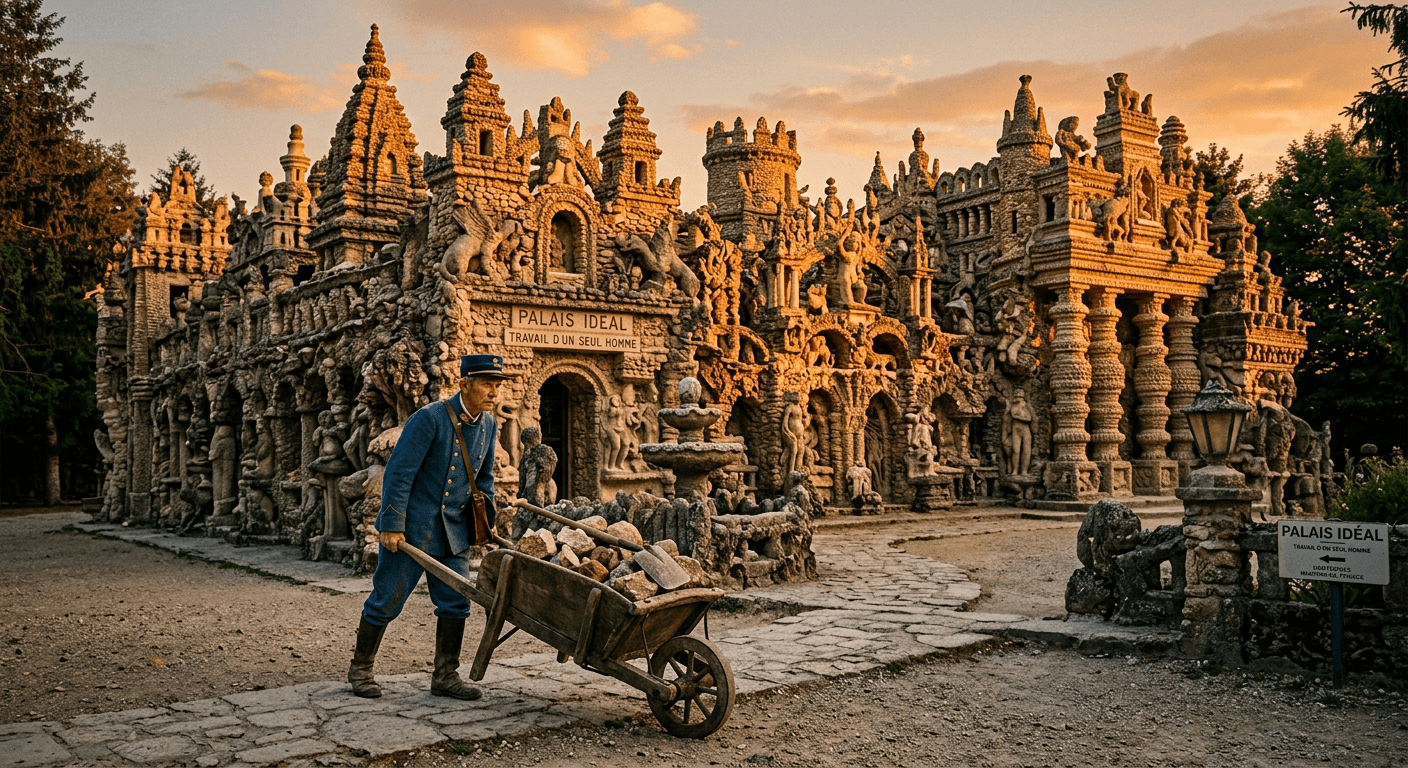
The Postman and His Pebbles: How Ferdinand Cheval Built a Palace Out of Pocket Rocks
In the spring of 1879, the 19th century was hurtling toward modernity. The Industrial Revolution was in full swing, the Eiffel Tower was less than a decade away from construction, and sweeping engineering marvels were redefining the European landscape. Yet, in the sleepy French commune of Hauterives, one of the century's most astonishing architectural feats was about to begin not with a blueprint or a steam engine, but with a clumsy footstep.
Joseph Ferdinand Cheval was a 43-year-old rural postman. Every single day, regardless of the weather, he walked a grueling 18-mile (29-kilometer) route to deliver mail to the scattered farms and villages of the Drôme region. It was a solitary, monotonous job. To pass the time, Cheval would daydream, constructing elaborate, fantastical palaces in his mind. He kept these visions to himself, convinced that a humble postman had no business entertaining such grandiose thoughts.
That all changed on an ordinary April afternoon. While walking his route, Cheval tripped on a peculiar-looking piece of limestone. Intrigued by its bizarre, almost sculptural shape, he picked it up and slipped it into his pocket. The next day, he returned to the same spot and found even more beautifully shaped stones. For Cheval, this was an epiphany. If nature could sculpt the materials, he decided, he would become the architect.
Thus began a 33-year obsession that would consume the rest of his life. At first, Cheval simply stuffed his pockets with stones as he walked his route. When his pockets began tearing from the weight, he upgraded to carrying a sturdy basket. Eventually, the sheer volume of his daily harvest required him to push a heavy wooden wheelbarrow along his 18-mile trek. By day, he was a postman; by night, working by the dim glow of an oil lamp, he became a mason, architect, and visionary.
The structure he slowly willed into existence, which he would eventually name Le Palais Idéal (The Ideal Palace), defies conventional architectural logic. Cheval had absolutely no formal training in masonry or design. Instead, his inspiration came directly from the very mail he delivered. The late 19th century saw the birth of the illustrated postcard and the rise of popular magazines, which brought images of distant lands to rural France. Through these deliveries, Cheval saw the wonders of the world—Hindu temples, Algerian mosques, Swiss chalets, medieval European castles, and biblical scenes.
He incorporated all of these disparate influences into his palace. The resulting structure is a dizzying, surreal mishmash of global styles, bound together by wire, cement, and lime. The palace features intricate grottos, looming giants, stone animals, and winding staircases. It is a physical manifestation of the emerging globalism of the 19th century, seen entirely through the imagination of a man who never left his home region.
Naturally, the local villagers thought Cheval was completely out of his mind. They mocked him relentlessly, viewing him as the village idiot who spent his nights mortaring rocks together in his garden. But Cheval was utterly unfazed by the ridicule. He etched defiant quotes and poetry into the walls of his palace as he built it, including the phrase: 'The work of one man.'
Cheval finally completed the Palais Idéal in 1912, at the age of 76. He had spent 10,000 days and 93,000 hours on his masterpiece. Yet, his work wasn't quite done. Cheval wished to be buried inside his beloved palace, but French law strictly prohibited it. Undeterred, the octogenarian spent the next eight years building an equally elaborate mausoleum in the local cemetery, finishing it just two years before his death in 1924.
Today, Ferdinand Cheval's Palais Idéal stands as one of the world's most spectacular examples of 'outsider art.' Long after the initial mockery faded, his work was championed by prominent artists like Pablo Picasso and André Breton, who saw in Cheval's palace the pure, unfiltered power of the human subconscious. The postman's monumental achievement serves as a lasting reminder that the 19th century wasn't solely defined by the titans of industry and politics; it was also shaped by the quiet, unbreakable willpower of ordinary people with extraordinary dreams.