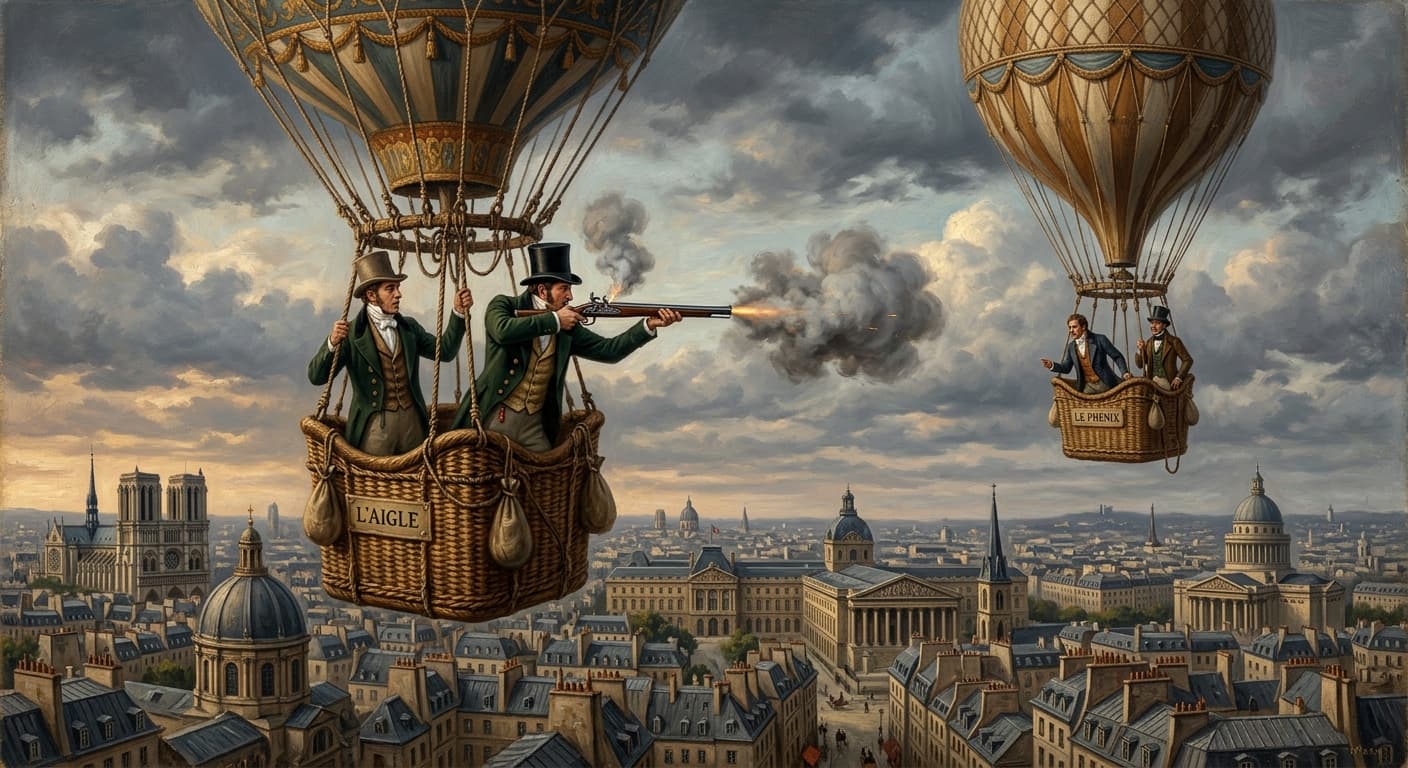
Death from Above: The Absurd and Fatal Hot Air Balloon Duel of 1808
19th-century Paris was a city of fierce passions and uncompromising honor. Napoleon Bonaparte ruled the empire, and among the wealthy gentlemen of the era, the ancient code of the duel was still the preferred method for settling a serious dispute. But pistols at dawn or swords in a misty courtyard? For Monsieur de Grandpré and Monsieur Le Pique, such pedestrian methods were utterly insufficient. They were men of immense wealth, men of science, and crucially, men entangled in a bitter, explosive love triangle. The object of their affection was Mademoiselle Tirevit, a celebrated and brilliant dancer at the Paris Opera. When Grandpré discovered that Le Pique was also enjoying the affections of his beloved, a confrontation ensued. A duel was inevitable, but the method they chose would make history: they decided to fight in the sky.
At the dawn of the 19th century, Europe was in the absolute grip of "balloonomania." Ever since the Montgolfier brothers first proved that humanity could slip the bonds of earth, hot air and gas balloons had become the obsession of the elite. For Grandpré and Le Pique, both avid aeronauts, the sky was the only arena grand enough to settle a matter of such monumental pride. They agreed to a set of rules that were as bizarre as they were terrifying. They would ascend in two identical gas balloons, accompanied by their seconds. They would not aim their weapons at each other, but at the balloons themselves. The weapon of choice? The blunderbuss, a short-barreled shotgun capable of firing a devastating spread of heavy lead balls. A single pistol shot might merely puncture the silk, allowing a slow, safe descent. A blast from a blunderbuss, however, would obliterate the fragile envelope, ensuring a catastrophic fall.
On the morning of May 3, 1808, a massive crowd gathered near the Tuileries. The atmosphere was incredibly festive. The thousands of Parisians below had absolutely no idea they were about to witness a deadly duel; they simply assumed they were being treated to a spectacular, high-stakes balloon race. The two elegant balloons, tethered about eighty yards apart, bobbed in the gentle spring breeze. Grandpré and Le Pique, dressed in their finest tailored attire, climbed into their respective wicker baskets alongside their seconds. The thick ropes were cut, and the two adversaries began their silent, majestic ascent into the heavens.
The wind was incredibly light, keeping the balloons at a relatively constant distance from one another as they rose. For several minutes, the scene was one of breathtaking tranquility. The sprawling, bustling city of Paris shrank beneath them, transforming into a miniature patchwork of rooftops and cobblestones. But inside the swaying baskets, the tension was murderous. At an altitude of approximately half a mile—roughly 2,600 feet—a pre-arranged signal was given from one basket to the other. The time for gentlemen’s pleasantries had ended; the time for gravity to claim its due had arrived.
Monsieur Le Pique raised his heavy blunderbuss first. He aimed across the terrifying, windy void at Grandpré's balloon and pulled the trigger. The roar of the shotgun echoed through the clouds, but fortune favored Grandpré. Le Pique’s shot went wide, the deadly scattershot dispersing harmlessly into the empty morning air. Now, it was Grandpré’s turn. With cold, calculated precision, he raised his own weapon, aimed it squarely at the massive, fragile sphere of gas keeping his rival aloft, and fired.
The result was instantaneous and horrifying. Grandpré’s scattershot tore a massive, jagged hole in the fabric of Le Pique’s balloon. The highly flammable gas violently expelled, and the beautiful vessel collapsed in on itself in a matter of seconds. The festive crowd below, previously cheering the ascent, watched in stunned, breathless silence as Le Pique’s basket plummeted from the sky. It fell for half a mile, gaining terrifying terminal velocity before violently crashing onto the rooftop of a Parisian home, killing both Le Pique and his second upon impact.
As his rival was violently erased from the earth, Monsieur de Grandpré did not immediately pull the valve to descend. Instead, in a display of either profound shock or chilling nonchalance, he and his second tossed their remaining sandbag ballast overboard. Relieved of the heavy weight, their balloon surged even higher into the atmosphere. They spent the next several hours drifting peacefully through the skies, completing what amounted to a triumphant victory lap over the French countryside before landing safely near Villeneuf, some twenty miles away.
The Great Balloon Duel of 1808 remains one of the most uniquely macabre events of the 19th century. It was a bizarre collision of two distinct eras: the ancient, uncompromising code of personal honor, and the dawning age of technological and scientific wonder. Today, it stands as a captivating testament to the terrifying lengths to which human beings will go to defend their pride—and a grim reminder that no matter how high we climb, we carry our most dangerous flaws up with us.