The Exploding Traffic Light: How Victorian London's First Stop Signal Ended in Disaster
Imagine standing at a major intersection in London during the 1860s. The air is thick with a mixture of coal smoke and the pungent scent of horse manure. The streets are an absolute cacophony of iron-rimmed wheels clattering over cobblestones, the shouting of costermongers, the cracking of whips, and the relentless stampede of horse-drawn omnibuses, hansom cabs, and heavy freight carts. For a pedestrian, crossing the street wasn't just a daily chore; it was a genuine game of roulette with one's life.
By 1866, the situation in the bustling metropolis had reached a tipping point. Statistics from the era paint a grim picture: in that year alone, over 1,000 people were killed and more than 1,300 were injured on London's roads. The carnage was particularly dreadful outside the Houses of Parliament at the intersection of Bridge Street and Great George Street. Members of Parliament were finding it increasingly difficult—and dangerous—to simply walk to work. The public demanded a solution, and the Metropolitan Police were desperate for a way to tame the vehicular anarchy.
Enter John Peake Knight, a bright and innovative railway engineer. As the superintendent of the South Eastern Railway, Knight was intimately familiar with the concept of managing heavy, fast-moving traffic. The railways had successfully implemented a system of semaphore signals to prevent trains from colliding. Knight looked at the chaotic streets of London and had a revolutionary thought: why not adapt railway signaling for horse-drawn traffic?
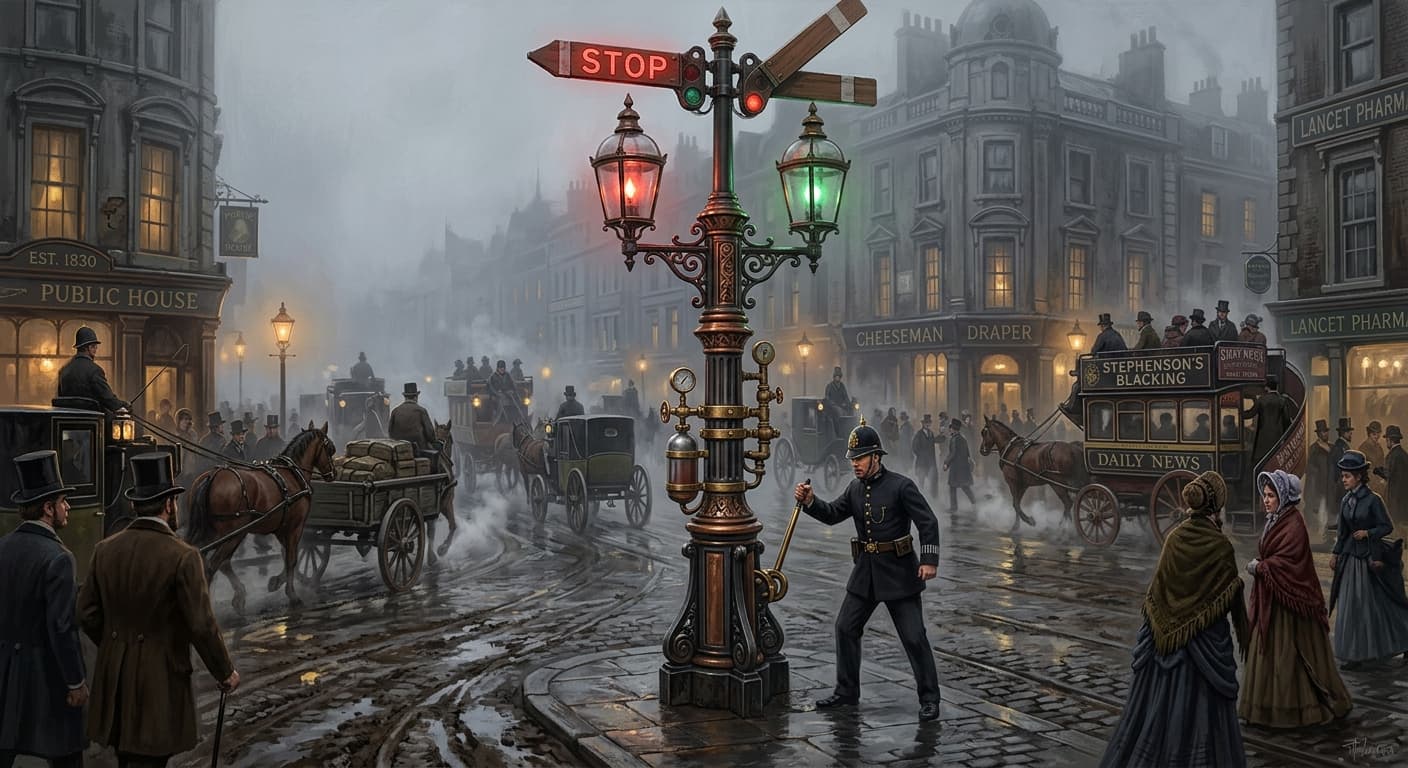
Knight pitched his idea to the Metropolitan Police, and they enthusiastically green-lit the project. On December 9, 1868, history's very first traffic light was unveiled outside the Houses of Parliament. It was an imposing structure—a beautifully ornate, 22-foot-tall cast-iron pillar. During the day, it utilized traditional railway semaphore arms. When the arms were horizontal, it meant "Stop." When they were lowered to a 45-degree angle, it meant "Caution."
However, London's infamous fog and dark winter evenings required a nocturnal solution. To make the signal visible at night, Knight topped his contraption with a revolving gas-powered lantern equipped with red and green lenses. Red meant stop, and green meant proceed. Because the system was purely mechanical, it required a police officer to stand at the base of the pillar and manually turn a lever to operate the arms and rotate the gas lantern.
For the first few weeks, Knight's invention was nothing short of a miracle. The sheer novelty of the towering mechanical policeman commanded the respect of the notoriously unruly London cab drivers. Traffic actually flowed with a semblance of order. Pedestrians, including grateful politicians, could finally cross the street without fearing for their lives. The system was hailed as a brilliant success, and there were immediate plans to install these "street semaphores" at hazardous intersections all across the city.
But the triumph was tragically short-lived. The fatal flaw of Knight's invention lay in its power source: gas. On the evening of January 2, 1869, less than a month after its installation, the traffic light met a catastrophic end. A leak had developed in the gas main running under the street, slowly filling the hollow cast-iron pillar with volatile fumes. When the police officer on duty attempted to rotate the lantern, the friction—or perhaps an exposed flame—ignited the trapped gas.
The resulting explosion was deafening. The massive Victorian traffic light blew apart in a spectacular eruption of iron, glass, and fire. The blast violently threw the unfortunate police operator to the ground, leaving him severely burned and permanently disfigured (though contrary to popular urban legend, most historical records indicate he survived the incident).
The public's infatuation with the traffic light vanished in an instant, replaced by a deep fear of the "exploding street lamps." The Metropolitan Police abruptly dismantled the ruined contraption and abandoned the project entirely. Knight’s visionary idea was deemed a public menace, and London’s streets returned to the hands of baton-waving policemen.
It would take another 45 years—and the invention of the electric lightbulb—before the world would see another traffic light, this time in Cleveland, Ohio, in 1914. John Peake Knight died in 1886, never living to see his brilliant idea vindicated. Today, his legacy illuminates every intersection in the modern world, a testament to a Victorian visionary who was simply half a century ahead of his time.