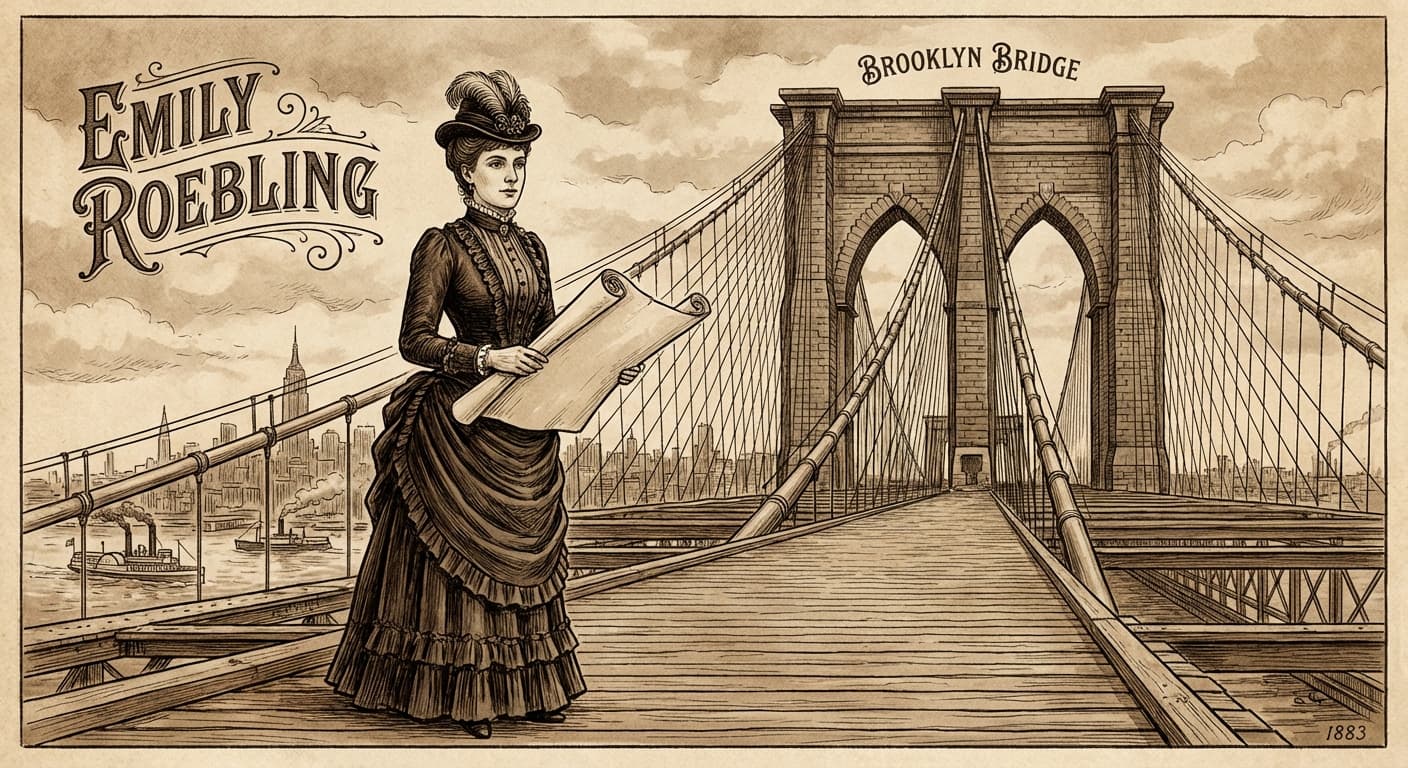
The Secret Chief Engineer: How Emily Roebling Built the Eighth Wonder of the World
When the Brooklyn Bridge exploded with fireworks on its opening day in May 1883, the world marveled at the impossible made real. It was the longest suspension bridge ever built, a cathedral of stone and steel connecting two great cities, New York and Brooklyn, across the turbulent East River. Politicians gave speeches, cannons fired, and the public gasped at the sheer audacity of the structure. But amidst the top hats and accolades, the person most responsible for holding the project together for over a decade wasn't standing at the podium. She was likely watching from a distance, having already taken the first triumphant ride across the span days earlier, carrying a rooster in her lap for good luck. Her name was Emily Warren Roebling, and without her, the "Eighth Wonder of the World" might have remained a broken dream at the bottom of the river.
The story of the bridge was supposed to be a patrilineal legacy. It was designed by the brilliant German-immigrant engineer John A. Roebling, who dreamed of a suspension bridge grander than any before it. However, the project seemed cursed from the start. Before construction even began in earnest, John’s foot was crushed in a freak accident at a ferry slip, leading to a fatal tetanus infection. The colossal task fell to his son, the 32-year-old Washington Roebling. Washington was capable and determined, but the river had a weapon no engineer of the time fully understood: the bends.
To sink the massive granite towers into the riverbed, workers toiled in caissons—giant, watertight wooden boxes filled with compressed air at the bottom of the river. It was a hellish environment, prone to fire and flooding, but the invisible killer was the rapid decompression upon resurfacing. This caused nitrogen bubbles to form in the blood, leading to excruciating pain, paralysis, and death. Scores of workers fell ill. Then, in 1872, disaster struck the top brass. Washington Roebling collapsed from a severe case of caisson disease. Partially paralyzed, blind, and unable to endure light or noise, the Chief Engineer was confined to his bed in Brooklyn Heights, watching his bridge through a telescope, unable to set foot on the site.
It was here that history took a turn. In the Victorian era, a woman’s place was defined by domesticity, certainly not the grit and grime of a construction site. Yet, Emily Roebling stepped into the void. Initially acting as a messenger between her invalid husband and his assistant engineers, she quickly realized that simply ferrying notes was insufficient. To properly convey Washington’s instructions and interpret the assistants' reports, she needed to understand the language of engineering. With a determination that rivaled the steel cables outside her window, Emily began a rigorous self-education.
She devoured books on higher mathematics, the strength of materials, stress analysis, and cable construction. She learned the intricacies of catenary curves and the specific chemistry of the steel wires. Soon, she wasn't just delivering messages; she was answering questions, solving problems, and negotiating with contractors. For over a decade, Emily Roebling effectively functioned as the Chief Engineer. She dealt with corrupt politicians who wanted to oust her husband, smoothed over labor disputes, and managed the supply chains of granite and steel. Many in the inner circle knew that the "instructions from Washington" were often decisions made by Emily, yet she maintained the facade to protect her husband's position.
When the bridge was finally completed, it stood as a testament to human ingenuity, but specifically to Emily's resilience. Recognizing her pivotal role, Washington insisted that she be the first person to cross the completed span. A week before the official opening, she rode in an open carriage across the bridge, claiming the victory she had engineered. At the dedication ceremony, Congressman Abram Hewitt paid tribute to her, describing the bridge as "an everlasting monument to the sacrificing devotion of a woman and of her capacity for that higher education from which she has been too long disbarred."
Today, a small plaque on the bridge honors her memory, but her true monument is the structure itself. Every day, thousands of commuters cross the East River, suspended by the steel webs that Emily Roebling helped weave. Her story remains a powerful reminder that in the 19th century, behind the beards and top hats of industrial progress, there were often brilliant women building the future, one calculated risk at a time.