The Man Who Cut the Cord: How Elisha Otis Defied Death and Birthed the Skyline
Imagine looking at the skyline of New York City in the early 19th century. You wouldn't see the towering cathedrals of commerce or the gleaming spikes of glass and steel that define the metropolis today. Instead, you would see a squat, horizontal city. The reason was simple: human stamina. Buildings rarely exceeded five or six stories because climbing stairs was exhausting, and the upper floors were considered the least desirable real estate, reserved for the poorest tenants or servants. The sky was conquered not by a daring architect, but by a 41-year-old mechanic with a flair for the dramatic and a remarkably simple invention.
The concept of a hoist was not new. Since the days of ancient Rome, humans had used ropes, pulleys, and animal power to lift heavy loads. By the mid-19th century, steam-powered hoists were common in factories and warehouses. However, they carried a terrifying fatal flaw. If the hemp rope lifting the platform snapped—an all-too-common occurrence—the platform and everything on it would plummet to the earth in a deadly freefall. Because of this, passenger elevators were considered a suicidal gamble. No sensible person would step onto a suspended platform, keeping humanity tethered firmly to the ground.
Enter Elisha Graves Otis. Born on a farm in Vermont, Otis was a tinkerer who had bounced between various trades, from building carriages to manufacturing bedsteads. In 1852, while clearing out an abandoned sawmill in Yonkers, New York, to convert it into a factory, Otis needed to move heavy debris to the upper levels. Unwilling to risk his own life or the lives of his workers on a standard hoist, he set his mind to solving the age-old problem of the broken rope.
Otis's solution was brilliantly elegant. He didn't focus on making an unbreakable rope; instead, he designed a failsafe for when the rope inevitably failed. He attached a tough, steel wagon-spring mechanism to the top of the elevator platform. He then lined the elevator shaft with ratcheted guide rails. As long as the rope was taut, the tension held the spring perfectly flat, allowing the elevator to glide up and down. But if the rope snapped, the tension would instantly vanish. The spring would snap open, driving its ends into the iron teeth of the guide rails and locking the platform securely in place. He had invented the world's first "safety elevator."
Despite the genius of his invention, Otis faced a major hurdle: nobody cared. He established a small elevator company, but sales were entirely stagnant. The public was simply too terrified of vertical travel, and factory owners didn't see the need to spend money on a fancy safety device. Otis needed a way to prove that his invention was foolproof, and he needed an audience.
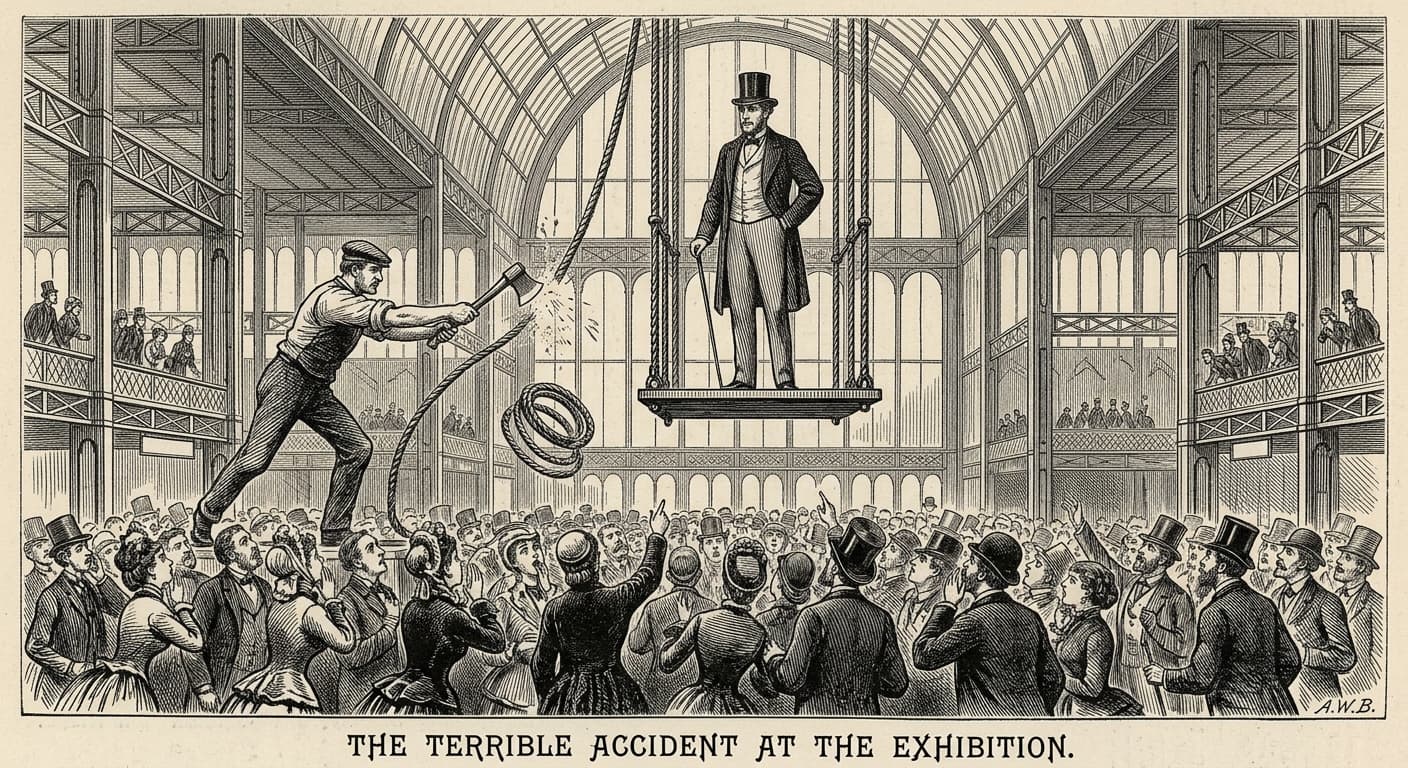
He found his opportunity at the 1853 Exhibition of the Industry of All Nations, held in New York's dazzling Crystal Palace. The event was a massive showcase of technological marvels, drawing thousands of spectators. Otis constructed a towering, open-sided elevator shaft right in the main exhibition hall. To maximize the spectacle, he leaned into the theatricality of the era, adopting a persona reminiscent of the great showmen of the age.
Surrounded by a massive crowd of curious onlookers, Otis stepped onto the open platform. He signaled to his assistant, and the steam-powered engine began to hoist him high above the exhibition floor. The crowd watched with bated breath as he ascended past the third story. Then, Otis gave a shocking order. He instructed an assistant armed with a sharp axe to completely sever the thick hoisting rope holding the platform aloft.
The axe fell. The rope snapped with a loud crack. The platform dropped—but only by a few terrifying inches. Instantly, the safety springs violently engaged with the ratcheted guide rails, bringing the platform to a sudden, absolute halt. The crowd gasped, fully expecting to witness a gruesome tragedy, but instead, they saw Elisha Otis calmly standing on the suspended platform. He doffed his top hat, bowed to the stunned audience, and famously declared, "All safe, gentlemen. All safe."
That single, heart-stopping moment changed the trajectory of human engineering forever. The stunt made headlines, and orders for Otis's safety elevator began to pour in. Just four years later, in 1857, the first commercial passenger elevator was installed in the E.V. Haughwout Building in New York City. The psychological barrier to vertical travel had been spectacularly shattered.
The impact of Elisha Otis's invention cannot be overstated. It completely inverted the economics of real estate; the higher, cleaner floors with the best views suddenly became the most sought-after spaces, giving birth to the luxury penthouse. More importantly, it removed the physical limits on building height. Without Otis's dramatic leap of faith in 1853, the steel-framed skyscrapers of the late 19th and 20th centuries would have been utterly impractical. By cutting the cord, Elisha Otis gave cities the power to touch the clouds, forever redrawing the skyline of the modern world.