The Devil's Footprints: The Bizarre Winter Mystery That Terrified Victorian England
The winter of 1855 was notoriously brutal across the British Isles. Rivers froze thick enough to support ice skating, and heavy snowfalls blanketed the countryside in a pristine, uninterrupted white. But in the quiet, rural villages of South Devon, a sudden overnight snowfall on February 8th would leave behind something far more chilling than the frigid temperatures. When the sun rose the following morning, residents awoke to find a trail of impossible footprints zigzagging across the landscape, a bizarre phenomenon that would soon be known as the 'Devil's Footprints.'
A Bizarre Discovery
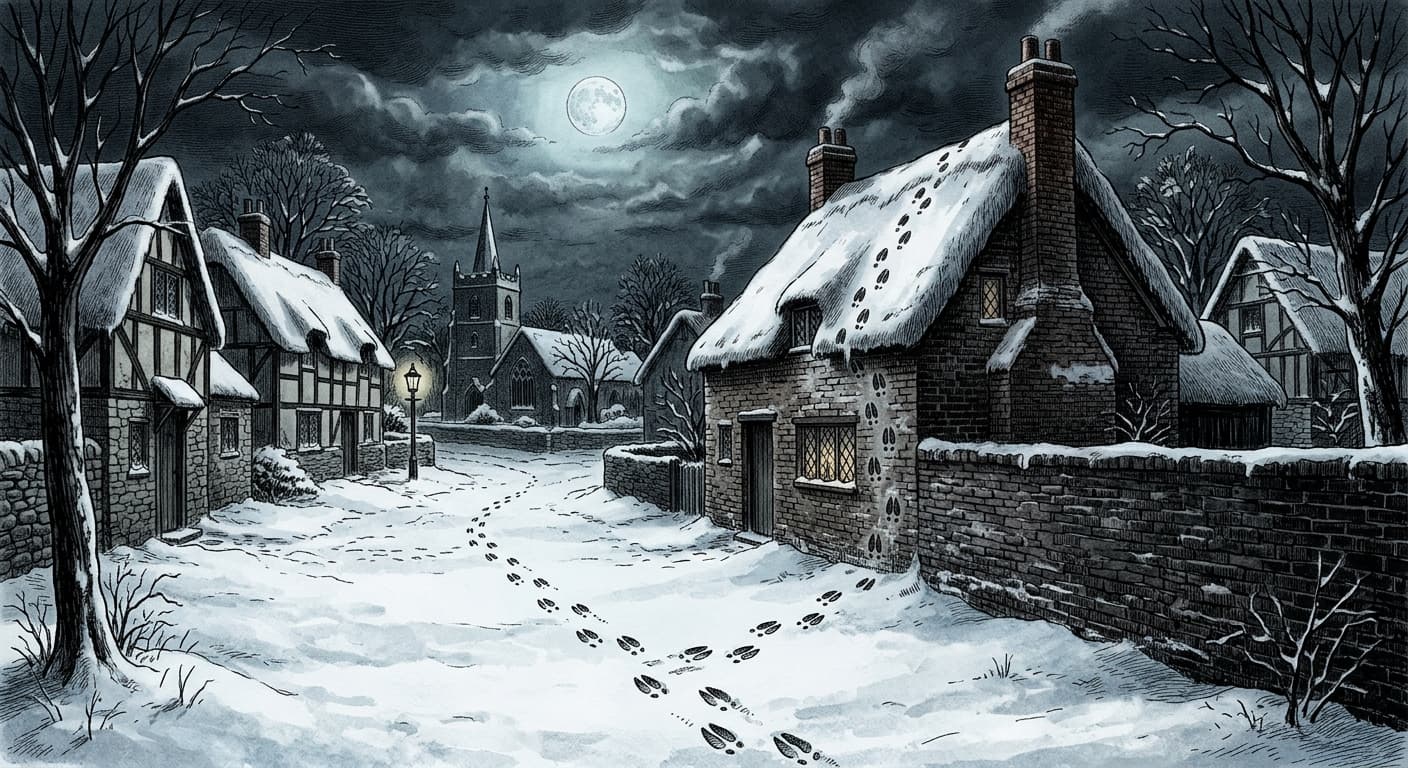
At first glance, a villager stepping out of their cottage might have dismissed the marks as those of a stray donkey or pony. However, a closer inspection revealed an unnerving pattern. The prints were shaped like cloven hooves, measuring about four inches long and three inches across. What made them truly eerie was their alignment. Instead of the staggered gait of a quadruped, the tracks were perfectly linear, placed one right in front of the other, exactly eight and a half inches apart. Whatever had made them walked on two legs.
As word spread from neighbor to neighbor, it became apparent that the tracks were not confined to a single yard or village. They stretched across an astonishing distance, estimated to be anywhere from 40 to 100 miles, snaking through over thirty parishes including Topsham, Lympstone, Exmouth, and Dawlish.
The Impossible Journey
The sheer geography of the tracks defied all logic. They did not merely stick to roads or paths. They marched in a stubbornly straight line over whatever obstacle lay in their path. The prints were found scaling 14-foot vertical walls, marching across snow-covered rooftops, squeezing through narrow drain pipes, and traversing locked, enclosed courtyards. In one widely reported instance, the tracks approached a haystack, stopped, and seemingly resumed on the other side without disturbing the hay.
Most baffling of all was the crossing of the River Exe. The estuary is roughly two miles wide, yet the footprints marched right up to the water's icy edge on one side and picked up exactly on the opposite bank, as if the creature had simply stepped over the freezing depths.
Panic and Rationalism
Panic quickly gripped the local populace. In the deeply religious and superstitious atmosphere of the era, the conclusion seemed obvious to many: the Devil himself had roamed the Devonshire countryside looking for lost souls. Armed posses of local men formed, roaming the woods and fields with muskets, pitchforks, and hunting dogs to track down the demonic interloper. The hounds, however, were reportedly terrified, howling and refusing to follow the scent of the cloven marks.
As news of the hysteria reached London, the Victorian press eagerly seized upon the mystery. Soon, the greatest scientific and rational minds of the 19th century were trying to debunk the demonic theory. Sir Richard Owen, a preeminent biologist and paleontologist, suggested that the tracks were made by badgers wandering in search of food. He argued that the thawing and freezing of the snow had distorted the animal tracks into the peculiar hoof-like shape.
Other theories were far more creative. One popular notion posited that an experimental hot air balloon had escaped from a nearby dockyard in Devonport. According to this theory, the balloon was dragging a mooring rope with a horseshoe-shaped shackle at the end, which repeatedly struck the ground as the balloon drifted in the wind. Another rumor circulated that a kangaroo had escaped from a private menagerie in Sidmouth, bounding across the countryside. Still others blamed leaping mice, hungry swans, or just a widespread, coordinated hoax by mischievous locals.
An Enduring Mystery
None of the rational explanations managed to satisfy all the facts. A dragging shackle would have caught in trees and destroyed roofs, yet the tracks showed delicate, deliberate placement. A kangaroo's gait does not resemble a small cloven hoof, and badgers certainly do not scale 14-foot walls in a perfect single file.
To this day, the Devil's Footprints of 1855 remain one of the most enduring and captivating mysteries of the Victorian age. The event sits at a fascinating intersection of 19th-century scientific rationalism and ancient, deep-seated folklore. Whether the tracks were the result of strange weather phenomena, anomalous animal behavior, an elaborate prank, or something altogether unexplainable, they left an indelible mark on history, a chilling reminder that even in an era defined by industrial progress and scientific discovery, the world still harbored secrets that defied understanding.