The Death of Pain: How a Boston Dentist Conquered the Surgeon's Knife
Imagine facing a surgeon's knife in the early 19th century. Hospitals were places of last resort, echoing with the screams of the afflicted. Before 1846, surgery was a brutal, agonizing ordeal. Surgeons were prized not for their delicate precision, but for their brute strength and blinding speed. The best doctors could amputate a leg in under ninety seconds. Pain relief consisted of a stiff drink of whiskey, a wooden block clamped between the teeth, or the unreliable haze of opium. To go under the knife was to willingly step into a waking nightmare.
The medical establishment had largely accepted suffering as an unavoidable consequence of human frailty. However, a quiet revolution was brewing, not in the esteemed halls of European medical academies, but in the bustling, ambitious atmosphere of 1840s Boston. The hero of this story was an unlikely one: William T.G. Morton, a young, somewhat opportunistic dentist with a burning desire for wealth and fame. Morton had a practical problem; patients were terrified of having their rotting teeth pulled. He realized that if he could invent a way to extract teeth without pain, he would become a very rich man.
Morton wasn't the first to search for a solution. His former business partner, Horace Wells, had recently attempted a public demonstration of nitrous oxide (laughing gas) for a tooth extraction. It ended in disaster when the patient cried out, and Wells was literally laughed out of the room by medical students shouting "Humbug!" Undeterred by his partner's humiliation, Morton sought the advice of Charles T. Jackson, a brilliant but eccentric physician and chemist. Jackson suggested trying sulfuric ether, a highly volatile chemical compound that was occasionally used at "ether frolics" for its intoxicating effects.
Morton began experimenting with ether in secret. After testing it on his family dog, various insects, and finally himself, he successfully extracted a tooth from a willing patient, Eben Frost, who felt absolutely nothing. Word of this miraculous, painless extraction reached the esteemed Dr. John Collins Warren, senior surgeon at the Massachusetts General Hospital. Warren, a man who had inflicted unimaginable pain over his long career, was intrigued. He invited the relatively unknown dentist to demonstrate his mysterious compound during a major surgical procedure.
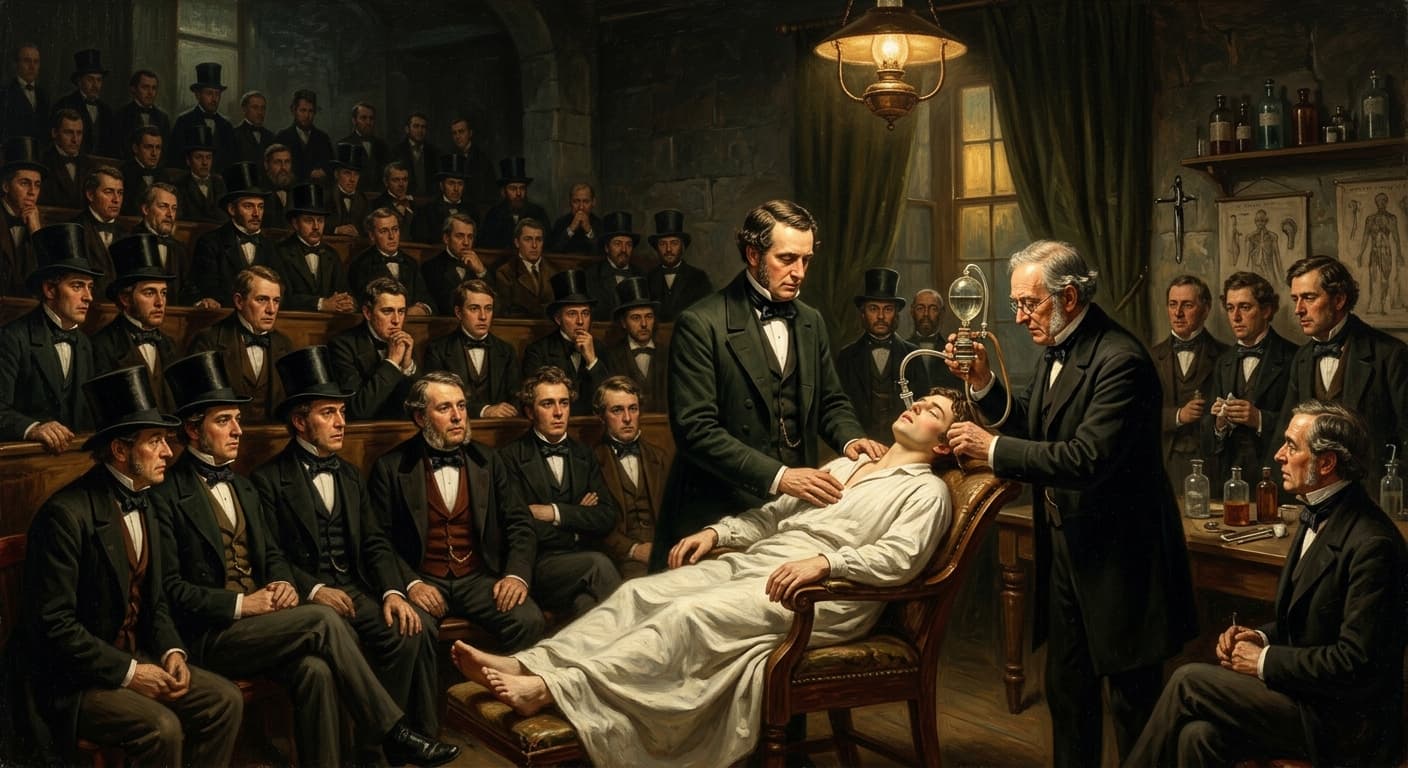
The date was set for October 16, 1846. The hospital's surgical amphitheater—now famously known as the Ether Dome—was packed with skeptical doctors and medical students expecting another humiliating failure. The patient, a young printer named Edward Gilbert Abbott, sat nervously in the operating chair with a tumor on his jaw. The scheduled time arrived, but Morton was nowhere to be found. He had been frantically making last-minute adjustments to his newly designed glass inhaler. Just as Dr. Warren picked up his scalpel and announced, "As Dr. Morton has not arrived, I presume he is otherwise engaged," Morton rushed through the doors.
"Well, sir, your patient is ready," Dr. Warren said dryly. Morton placed the glass inhaler to Abbott's lips and instructed him to breathe deeply. Within minutes, Abbott's eyes closed, and he slipped into a profound, unnatural slumber. Morton stepped back and told Warren, "Your patient is ready, sir." The crowd held its breath as Warren's scalpel sliced into Abbott's neck. The patient didn't flinch. He didn't scream. He simply lay there, entirely unaware of the procedure. When Abbott finally awoke, he reported feeling only a faint scratching sensation.
The silence in the amphitheater was deafening. Dr. Warren, a man who had seen decades of surgical horrors, turned to the stunned audience of medical professionals. With tears in his eyes, he delivered a line that would echo through the annals of medical history: "Gentlemen, this is no humbug." In that single, breathtaking moment, the era of surgical agony was brought to a close, and the modern age of medicine was born.
The news of the successful demonstration spread across the globe with unprecedented speed. Riding the cutting-edge technology of the steamship, the news reached London and Paris within weeks. Surgeons rejoiced, realizing they could now take their time, operating with care and precision rather than frantic haste. Intricate internal surgeries that were previously impossible suddenly became feasible. The discovery of anesthesia fundamentally changed the trajectory of human life expectancy and medical science.
Yet, the personal aftermath for the men involved was deeply tragic. A bitter, decades-long dispute erupted over who truly deserved the credit—and the financial rewards—for the discovery. Charles Jackson claimed the intellectual triumph; Horace Wells claimed he had pioneered the concept first; and William Morton fought viciously to defend his patent. The "Ether Controversy" consumed their lives. Wells tragically died by suicide, Morton died impoverished of a stroke fueled by the endless legal battles, and Jackson spent his final years in an insane asylum.
Despite the grim fate of its pioneers, the legacy of that fateful October morning remains one of the greatest triumphs of the 19th century. The men who conquered surgical pain may have lost their own minds and fortunes in the process, but they gifted humanity an immeasurable mercy. Today, every patient who slips peacefully into a dreamless sleep before surgery owes a silent debt of gratitude to the ambitious Boston dentist, the skeptical surgeon, and the day the Ether Dome lived up to its legendary name.