The Daredevil Who Cooked an Omelet Over Niagara: The High-Wire Antics of the Great Blondin
In the summer of 1859, the border between the United States and Canada became the stage for one of the most audacious displays of human courage—and perhaps lunacy—in history. The venue was the thundering, misty chasm of Niagara Falls, a place where millions of gallons of water pulverized the rocks below with enough force to shake the earth. The protagonist was not a general or a king, but a diminutive French acrobat named Jean François Gravelet, better known to the world as "The Great Blondin."
While the Victorian era is often remembered for its stiff collars and industrial grimness, it was also an age of spectacle and mania. The public craved the impossible, and Blondin delivered it on a scale never seen before. He proposed to walk across the gorge, spanning 1,100 feet from the American side to the Canadian side, on a hemp rope merely three inches in diameter. To the skeptics and the press, it was a suicide mission. The "roaring waters," they claimed, would induce vertigo in any man foolish enough to suspend himself 160 feet above the churn.
On June 30, 1859, a crowd of 25,000 thrill-seekers gathered to watch the macabre event, many reportedly placing bets on exactly when the acrobat would plummet to his death. Dressed in pink tights and a yellow tunic, wielding a heavy balancing pole made of ash, Blondin stepped onto the cable. The crowd fell silent. The only sound was the deafening roar of the falls. With a calm that bordered on the supernatural, Blondin didn't just walk; he strolled. At one point, he stopped, lay down on his back, and rested. He eventually reached the Canadian side, rested for a glass of champagne, and then walked back. The world was astounded, but for Blondin, a simple walk was far too boring.
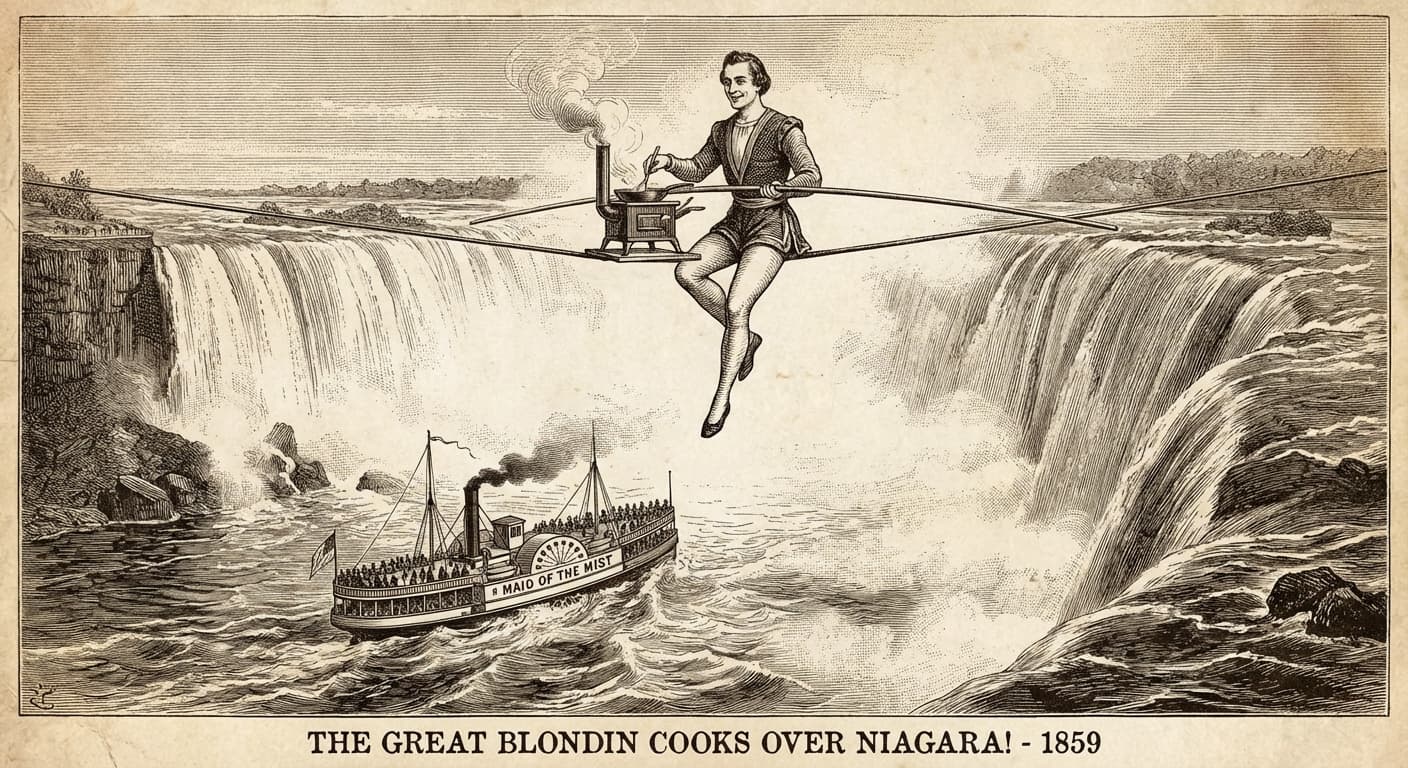
Over the fateful summer, Blondin returned to the rope again and again, each time escalating the danger to theatrical new heights. He crossed backward. He crossed while blindfolded. He crossed with his body stuffed inside a burlap sack. He crossed on stilts. In one particularly surreal performance, he carried a small stove and utensils out to the middle of the wire, sat down, cracked an egg, cooked an omelet, and lowered it on a cord to the passengers of the Maid of the Mist ferry below. The sheer absurdity of cooking breakfast while suspended over a watery abyss cemented his legend as the greatest showman of his time.
However, the most heart-stopping moment of his career occurred on August 19, when he announced he would cross with a live passenger on his back. The "volunteer" was his manager, Harry Colcord. Colcord was terrified, and rightly so. The physics of two bodies moving on a swaying rope were vastly different from one. As they inched over the gorge, the guy lines keeping the main rope steady began to snap due to sabotage or stress. The rope began to swing violently. Blondin, fighting for balance, ordered Colcord to dismount and stand on the vibrating cable—a request that surely froze the blood in the manager’s veins. Through sheer grit, Colcord dismounted, Blondin stabilized the line, and Colcord climbed back on. They finished the crossing, though Colcord reportedly aged a decade in those few minutes and never volunteered for such a stunt again.
Blondin's feats at Niagara sparked a "Blondin Mania" across the globe. He became a symbol of the triumph of human will over nature, a living testament to the Victorian obsession with conquering the elements. Yet, despite risking his life hundreds of times in front of screaming crowds, the Great Blondin did not die in a tragic fall. He passed away peacefully in his bed in London at the age of 72, from complications of diabetes. In an era defined by heavy industry and rigid social structures, he remains a glittering reminder of the power of pure, unadulterated daring.