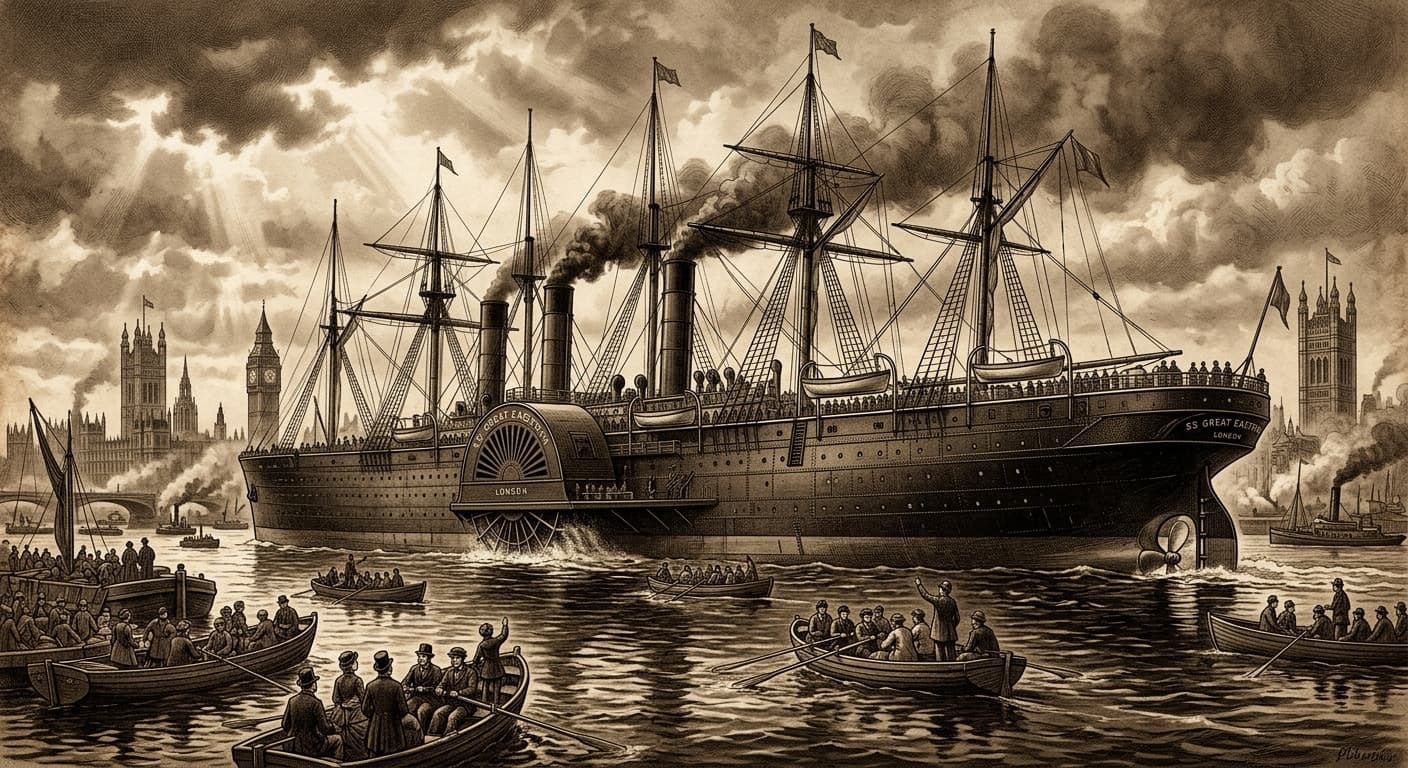
The Leviathan That Broke Its Creator: The Cursed Triumph of the SS Great Eastern
The 19th century was an era defined by men who believed that iron, steam, and sheer force of will could conquer the natural world. Among these titans of industry, none was more audacious than Isambard Kingdom Brunel. A cigar-chomping, top-hat-wearing British engineer, Brunel had already bored tunnels under the Thames, flung suspension bridges across gaping gorges, and built a network of revolutionary railways. But his final project would prove to be his most magnificent—and his most tragic. It was a ship so monstrously large that it defied the limits of Victorian technology, ultimately breaking the man who dreamed it into existence. This is the story of the SS Great Eastern, the Leviathan of the deep.
The concept for the Great Eastern was born in 1852 out of a uniquely 19th-century problem. Britain's empire was expanding, but traveling to Australia required ships to make numerous stops to restock their massive coal reserves. Brunel proposed a radical solution: build a ship large enough to carry all the coal it would need for a non-stop round trip to the other side of the world. The mathematics of ship design dictated that a vessel's carrying capacity increased faster than the water resistance against its hull. If you built a ship big enough, it would theoretically be the most efficient vessel on the seas.
When Brunel finalized the blueprints, the specifications were staggering. The Great Eastern was designed to be 692 feet long and displace 32,000 tons. To put this into perspective, she was six times larger than any ship that had ever been built. She was designed to carry 4,000 passengers—a floating city that wouldn't be surpassed in size for nearly fifty years. To propel this iron mountain, Brunel incorporated three forms of propulsion: a massive screw propeller, two colossal 58-foot paddle wheels, and six masts for sails. She was an unprecedented triumph of imagination, boasting a revolutionary double-hulled design that would later become a standard for maritime safety.
However, building the future was a brutal endeavor. The construction on the Isle of Dogs in London quickly became a nightmare. Brunel partnered with shipbuilder John Scott Russell, but the project was plagued by financial crises, labor strikes, and terrible accidents. The sheer amount of iron required—30,000 plates held together by three million rivets—strained the limits of British industry. The constant hammering of the riveters was deafening, and rumors began to circulate that some workers had fallen into the narrow gap between the double hulls and were sealed inside to die, adding a grim, cursed mythology to the vessel.
The troubles truly compounded when it came time to launch the behemoth in late 1857. Because she was too long to be launched bow-first into the narrow River Thames, Brunel was forced to launch her sideways. Pushing 12,000 tons of deadweight iron down a slipway proved nearly impossible. The initial launch attempt resulted in snapped chains and the death of a worker. It took three agonizing months and the deployment of massive hydraulic rams to finally inch the Leviathan into the water. The delay bankrupted the company and deeply embarrassed Brunel, whose health was rapidly failing under the immense stress.
In early September 1859, just days before the Great Eastern was scheduled for her maiden voyage, Brunel suffered a severe stroke on her deck. He died a week later at the age of 53, blissfully unaware of the tragedy that was about to unfold. During her sea trials, a massive explosion in the ship's forward funnel killed several stokers and severely damaged the grand saloon. The great ship had claimed her creator and the lives of the men who powered her, cementing her reputation as an unlucky vessel.
Despite her visionary engineering, the Great Eastern was a commercial failure. She was too slow, required too much coal, and drew too much water to fit into most global harbors. Furthermore, the opening of the Suez Canal in 1869—which the Great Eastern was far too wide to pass through—made her intended route obsolete. After a brief stint as a highly unprofitable passenger liner across the Atlantic, she found her only true success as a cable-laying ship. Stripped of her luxurious passenger accommodations, her massive hull provided the perfect storage for the thousands of miles of wire needed to lay the first permanent transatlantic telegraph cable.
By the late 1880s, the ship that had once represented the pinnacle of human ambition was reduced to a floating music hall and advertising billboard. She was finally sold for scrap in 1889. True to form, the Great Eastern refused to go quietly. Her iron hull was built with such incredible strength that it took an agonizing two years and a small fortune to dismantle her. The scrap yard went bankrupt in the process. Today, the Great Eastern stands as a testament to the soaring, sometimes reckless ambition of the Victorian era—a magnificent failure that dared to dream half a century too early.